If your employee training still runs on a mix of Zoom calls, emailed PDFs, and spreadsheets to track who did what, I get it. That setup works until it does not.
The moment you need to prove compliance, onboard 50 people at once, or train a remote team across three time zones, the whole thing falls apart.
According to LinkedIn’s Workplace Learning Report 2025, 49% of learning and talent development professionals say their executives are concerned that employees do not have the skills needed to execute business strategy, making structured employee training a growing business priority.
I have been there. That is exactly why I put together this guide to the best LMS for employee training. This is not a list of every LMS on the market. It is the 10 platforms I genuinely believe are worth your time, evaluated on what actually matters: ease of use, training for different employee types, compliance tracking, scalability, and real cost.
What Is an LMS for Employee Training?
Here is why that matters for HR and L&D teams specifically:
- Centralization: All training content, from onboarding to compliance, lives in one place. No more version chaos.
- Automation: Enrollment, reminders, and certifications run without manual follow-up.
- Visibility: You know exactly who completed what, when, and how they scored.
- Consistency: Every employee gets the same quality of training regardless of manager, location, or shift.
- Scalability: You can train 10 employees or 10,000 using the same system without rebuilding everything.
- Compliance proof: Audit trails, completion records, and certificates are generated automatically.
10 Best LMS Platforms for Employee Training
Choosing the right LMS for employee training isn’t always straightforward. To help you evaluate your options, I’ve reviewed the top platforms based on features, ease of use, scalability, pricing, and overall value.
| Platform | Best For | User Rating (Capterra) | Pricing Starts At |
| ProProfs Training Maker | AI course creation + compliance | 4.8/5 | Free; $1.99/learner/month |
| Absorb LMS | AI-powered admin automation | 4.5/5 | Custom Quote |
| CYPHER Learning | Automated personalized learning | 4.5/5 | Custom Quote |
| Docebo | Large enterprise scale | 4.4/5 | Custom Quote |
| LearnUpon | SMEs and training companies | 4.7/5 | Custom Quote |
| Litmos | Blended learning + field teams | 4.2/5 | Custom Quote |
| 360Learning | Social and collaborative learning | 4.7/5 | $8/user/month |
| Moodle | Open-source customization | 4.3/5 | $170/month (annually) |
| iSpring Learn | PowerPoint-heavy content libraries | 4.7/5 | $3.97/user/month |
| EdApp | Microlearning + mobile-first | 4.6/5 | $5/learner/month (billed annually) |
1. ProProfs Training Maker: Best for Easy AI-Powered Course Creation and Compliance Training
ProProfs Training Maker is the LMS for employee training I have spent the most time with, and for good reason. It is the platform I recommend most consistently to HR and L&D teams who need to launch training fast without a dedicated technical team.
What sets it apart is the AI course generation. I can type a prompt, and the AI builds a structured training program. You can try it here:

Let ProProfs AI create your training course
Or I can pull a pre-built course from the library of 500+ expert-built courses on sexual harassment prevention, workplace safety, or leadership, and let AI customize it in minutes. Either way, I am not starting from scratch.
The platform handles everything from onboarding sequences to compliance certification in one place. Gamification (badges, leaderboards, points), branched scenarios, and mobile support keep learners engaged. The analytics show exactly where people are getting stuck, not just whether they clicked “complete.”
For teams that need to prove compliance, the audit trails and automated certificate tracking are genuinely excellent.
Pros:
- AI generates complete courses from a single prompt, which saves hours of content development time
- 500+ expert-built courses on compliance, safety, leadership, and skills training mean you have a solid starting point immediately
- Built-in quizzes with randomization, time limits, and anti-cheating controls make assessments reliable
- Real-time dashboards and individual progress reports give you the visibility you actually need
- Supports 70+ languages, which matters for distributed or multilingual teams
- Integrates with Salesforce, Justworks, and SSO tools; SCORM/xAPI compliant for content portability
- Full white-labeling so the learning environment matches your brand
Cons:
- No on-premise or downloadable version; cloud-only
- No dark mode for learners in low-light environments
User Rating: 4.8/5 (Capterra)
Pricing: Free for small teams. Paid plan starts at $1.99/active learner/month. Business Plan at $3.99/active learner/month (billed annually). Enterprise from $499/year.
Use Case: HR and L&D teams at growing companies who need fast course creation, compliance tracking, and an LMS that non-technical users can actually run.
2. Absorb LMS: Best for AI-Powered Administration
I found Absorb LMS particularly useful for reducing the administrative workload that often comes with managing employee training. What stood out to me was Intelligent Assist. Instead of navigating through multiple settings, I could simply use natural language commands to complete tasks, which saved a lot of time.
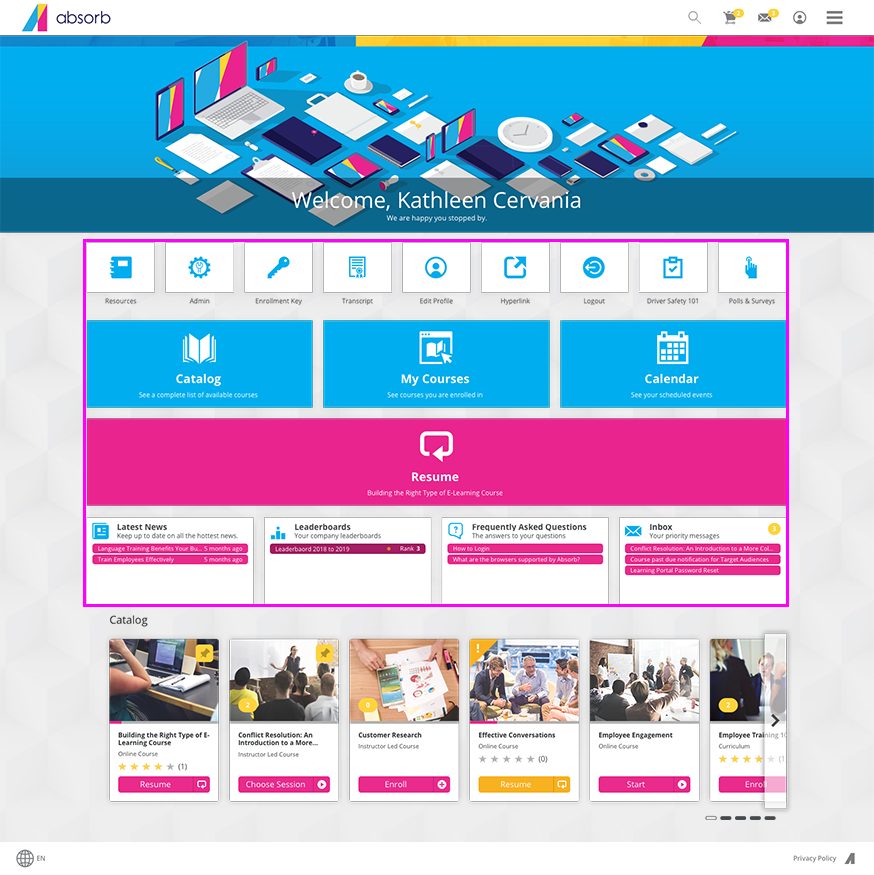
I also liked the Intelligent Recommendations feature, which automatically suggested relevant courses based on learner behavior, profiles, and feedback. This made it easier to deliver personalized learning experiences without manually building training paths.
The separate portals for administrators and learners keep everything organized, while the mobile app makes learning accessible from anywhere. Overall, I felt Absorb LMS focused as much on simplifying administration as it did on improving learning.
Pros:
- Intelligent Assist reduces admin workload through natural language task execution
- Personalized content recommendations based on learner data and behavior
- Separate admin and learner portals keep the experience clean for both user types
- Supports self-paced learning with automated curriculum allocation
- Clean, modern interface that is intuitive for learners
Cons:
- Users must be re-enrolled manually after each course modification, which creates extra admin work
- Initial setup and configuration can be complex for smaller teams without technical support
- Recurring session scheduling is not available
- Pricing is on the higher end for SMBs
User Rating: 4.5/5 (Capterra)
Pricing: Custom Quote
Use Case: Mid-size to enterprise organizations with large learner populations that want to reduce L&D admin overhead through AI automation.
3. CYPHER Learning: Best for Automated and Personalized Learning
When I explored CYPHER Learning, what impressed me most was how much of the administrative work it automates. Instead of manually assigning courses, tracking progress, and managing learner communication, I could set up rules once and let the platform handle the rest.
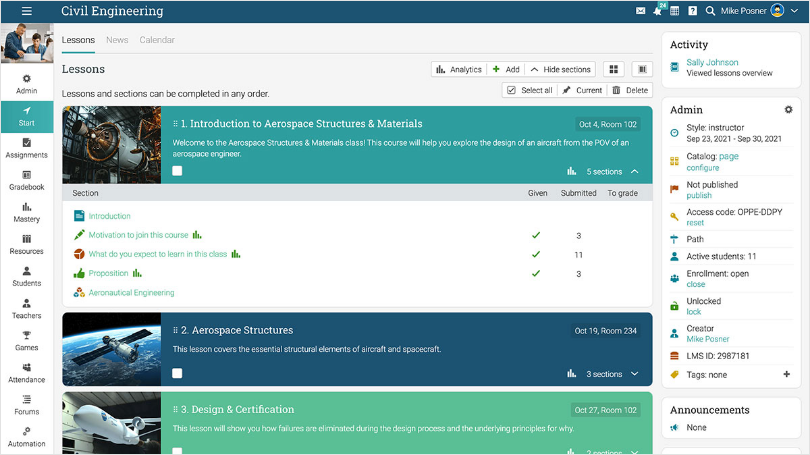
This made training management far more efficient. I was also impressed by CYPHER Copilot, the platform’s AI-powered course creation tool. It helped generate interactive, multimedia-rich, and gamified learning content quickly, which is especially valuable when creating courses at scale.
Another feature I liked was the ability for learners to build their own learning paths based on their interests and career goals. In my experience, this creates a more engaging learning environment and encourages employees to take greater ownership of their development.
Pros:
- Advanced automation for enrollment, grading, and learner communication reduces manual admin
- CYPHER Copilot generates interactive, multimedia, gamified courses with AI
- Learners can create their own learning paths, increasing engagement and ownership
- Real-time reporting gives clear visibility into progress and performance
- Modern, attractive interface that makes learning feel less like a chore
- Strong data privacy and security standards
Cons:
- Some features have reported bugs or inconsistencies that require support tickets
- The platform can feel overwhelming for users who are not comfortable with technology
- Does not notify senders when an email bounces due to an incorrect learner address
User Rating: 4.5/5 (Capterra)
Pricing: Custom Quote
Use Case: Organizations that want to automate training management and empower learners with some ownership over their development paths.
4. Docebo Learn LMS: Best for Large Enterprise Training at Scale
From my experience, Docebo stands out when you need to manage training at a large scale. I found it particularly well-suited for organizations with employees spread across different countries, departments, and languages. What caught my attention was its approach to skills-based learning.
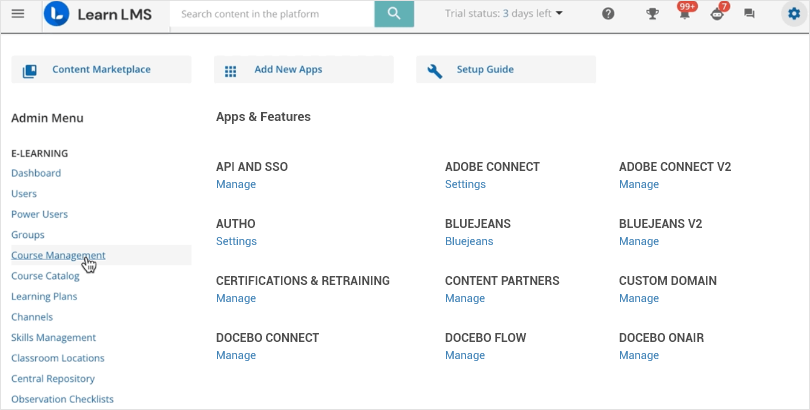
The platform can analyze course content, identify the skills being taught, and connect that learning to employees through adaptive learning paths. As roles and business priorities evolve, those learning paths can evolve too, which helps keep training relevant.
I also liked how Docebo brings multiple training formats together in one place. Whether you’re delivering webinars, instructor-led sessions, virtual classes, microlearning content, or gamified experiences, everything feels connected rather than spread across separate systems.
Pros:
- Built to scale for millions of users across global enterprise environments
- AI-driven skills mapping connects content to workforce development goals automatically
- Supports the full spectrum of learning formats: ILT, virtual classrooms, microlearning, gamification
- Integrates with Salesforce, Zoom, Adobe Connect, and most major enterprise tools
- Comprehensive analytics for data-driven L&D decision-making
Cons:
- Training video uploads have a file size limit that can be frustrating for high-quality content
- API access is limited and does not cover all objects and actions in the system
- SMBs will find the pricing and feature complexity difficult to justify
User Rating: 4.4/5 (Capterra)
Pricing: Custom Quote
Use Case: Large enterprises with dedicated L&D teams, complex training requirements, and the budget to match.
5. LearnUpon: Best LMS for SMEs and Training Companies
I first heard about LearnUpon from a training consultant who managed learning programs for both employees and external customers. During a discussion about LMS platforms, they mentioned that LearnUpon struck a good balance between functionality and simplicity.
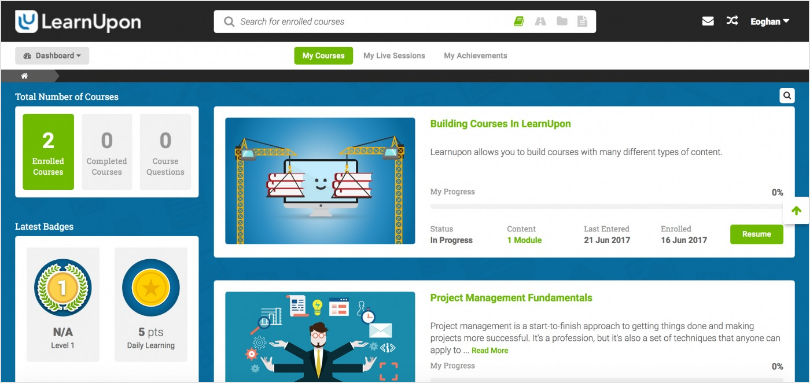
What stood out in their experience was how easy it was to create separate training portals for different audiences without managing multiple systems. They used one portal for employees, another for customers, and a third for partners, each with its own branding and content.
They also spoke highly of the automated enrollment workflows, which reduced a lot of manual work. According to them, the reporting tools provided clear insights into learner progress, and integrations with Salesforce and Zapier fit smoothly into their existing processes.
Pros:
- Manages multiple learner audiences (employees, customers, partners) from one platform
- Clean interface with strong admin functionality that does not require technical expertise
- Custom reports, dashboards, and certificates with real flexibility
- SCORM/Tin Can compliant for content portability
- 24/7 support via live chat, phone, and email
Cons:
- Creating course modules requires more manual effort than AI-assisted platforms
- If a course is updated, learners cannot retake it without re-enrollment
- Not suited for teams that need highly advanced features or heavy customization
User Rating: 4.7/5 (Capterra)
Pricing: Custom Quote
Use Case: SMEs and training companies that need to manage training for multiple distinct audiences without enterprise-level complexity or cost.
6. Litmos: Best for Modern Enterprises With Blended Learning Needs
Litmos came onto my radar while I was researching training solutions for companies with large frontline workforces. I noticed it being recommended repeatedly in discussions about training employees who aren’t always sitting behind a desk.
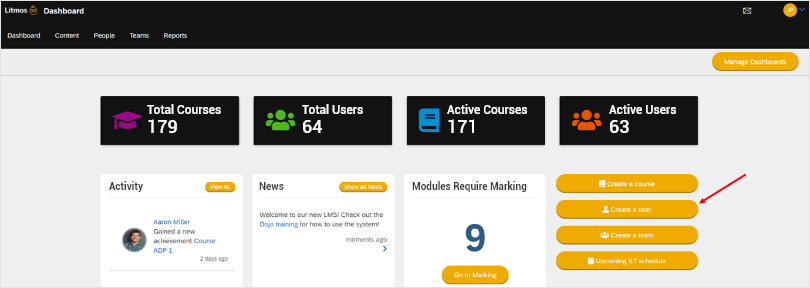
One training leader shared how they were struggling to keep learning consistent across office staff, field technicians, and remote workers. What attracted them to Litmos was its ability to combine live sessions, self-paced courses, and assessments without forcing learners into separate systems.
They also mentioned that offline mobile access made a noticeable difference because employees could complete training during downtime, even without an internet connection. The built-in content library was another reason they adopted it, helping them launch compliance training much faster than expected.
Pros:
- Excellent blended learning support: online, offline, and live training in one system
- Mobile app with offline access for field and remote employees
- Gamification with leaderboards and rewards keeps engagement high
- Comprehensive compliance content library reduces course development time
- Robust analytics to track and improve training impact
Cons:
- Reporting for learning paths needs improvement; it is not as intuitive as overall reporting
- Courses cannot be set as optional for learners, which limits flexibility in some programs
- First-time users experience a learning curve before they are productive
User Rating: Custom Quote
Pricing: Starts at $6/user/month (for 150 to 500 active learners)
Use Case: Modern enterprises with field or distributed teams that need blended learning, offline access, and strong compliance content built in.
7. 360Learning: Best for Collaborative and Social Learning
I became interested in 360Learning after noticing how often it came up in conversations about building a stronger learning culture, not just delivering training. One HR leader described how their biggest challenge wasn’t creating courses, but capturing the knowledge that already existed inside the company.
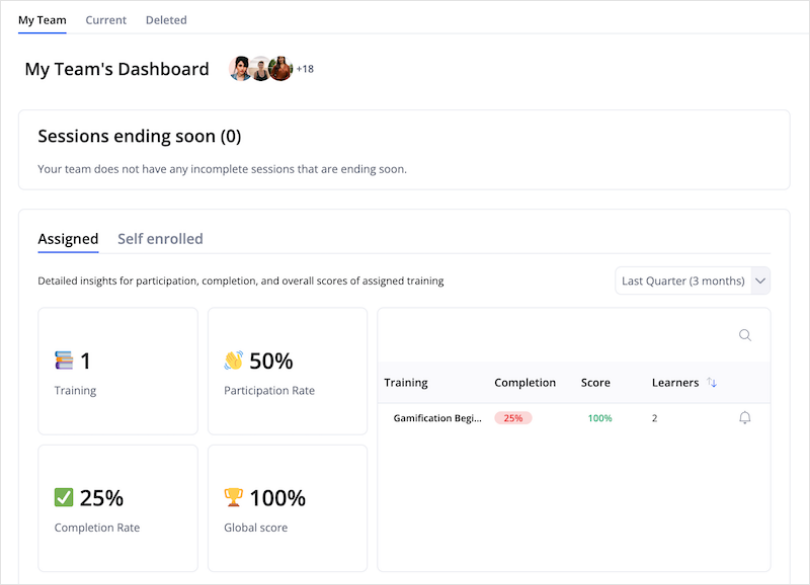
Experienced employees had valuable insights, yet that knowledge rarely made it into formal training. What impressed them about 360Learning was how easy it was for subject matter experts to create and improve content without relying heavily on the L&D team.
Employees could contribute ideas, comment on lessons, and share feedback as they learned. From what I heard, this collaborative approach led to much higher participation because training felt like a shared effort rather than another mandatory task.
Pros:
- Collaborative course creation lets internal experts contribute their knowledge directly
- Social learning features (discussions, live chat, feedback) build a genuine learning community
- Mobile app lets learners access and collaborate from anywhere
- Drag-and-drop builder with gamification elements, video, assignments, and surveys
- Strong integrations with Salesforce, Workday, and communication tools
Cons:
- Customer support response times can be inconsistent
- Frequent platform updates, while generally improvements, can disrupt user familiarity
- Quiz functionality is less advanced than some competing platforms
User Rating: 4.7/5 (Capterra)
Pricing: Starts at $8/user/month
Use Case: Organizations building a learning culture where peer knowledge-sharing and collaborative content creation are a strategic priority.
8. Moodle: Best Free Open-Source LMS for Customizable Training Environments
I got a firsthand look at Moodle through a university administrator I worked with who had been using it for years to manage both academic and professional training programs. What they liked most was the freedom it offered. Instead of adapting their training process to fit the software, they could customize the platform to match their exact requirements.
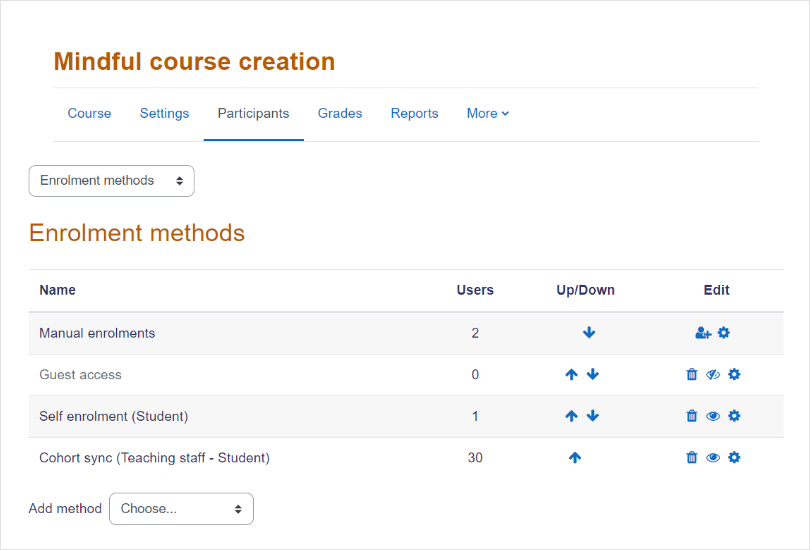
They showed me how they used forums, collaborative activities, and custom plugins to create a learning experience that felt unique to their organization. At the same time, they were very candid about the challenges.
While the software itself didn’t strain the budget, maintaining updates, managing integrations, and handling technical issues required ongoing IT involvement. Their experience reinforced that Moodle can be incredibly powerful, but it works best when you have the technical resources to support it.
Pros:
- Open-source with no licensing cost for the core platform
- Highly customizable through themes, plugins, and direct source code modification
- Supports LTI standard for integration with other educational tools
- Active global community continuously improves the platform and adds plugins
- Full range of learning formats: badges, certificates, competency tracking, and direct learning paths
Cons:
- Basic reporting that lacks the depth of commercial platforms
- Course engagement tracking is limited out of the box
- Requires technical expertise to set up, customize, and maintain
- Scheduling management could be more intuitive
User Rating: 4.3/5 (Capterra)
Pricing: Starts at $170/month (annually)
Use Case: Organizations or educational institutions with IT resources that need a highly customizable, cost-controlled LMS and are willing to invest in setup and maintenance.
9. iSpring Learn: Best for Organizations With Existing PowerPoint Content
When I explored iSpring Learn, the feature that immediately caught my attention was its ability to turn PowerPoint presentations into online courses with almost no extra effort. I’ve seen many organizations sit on years of training content because rebuilding everything for a new LMS felt overwhelming.
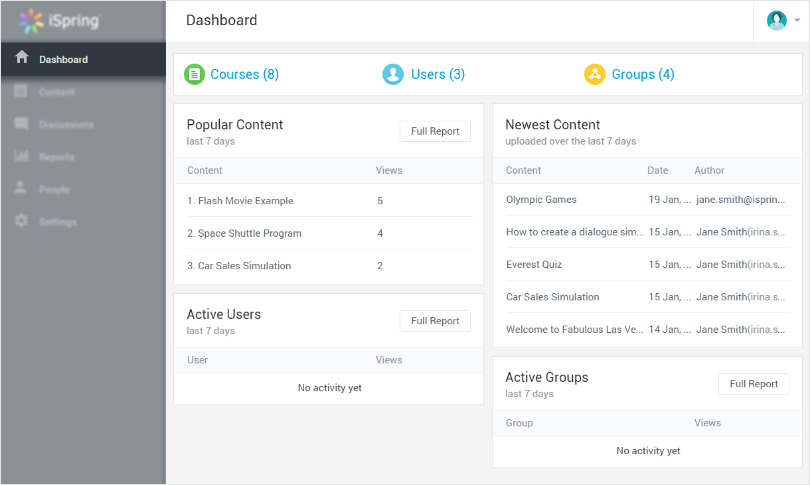
What I liked about iSpring was that it preserved animations, transitions, and formatting while making courses accessible across devices. That can save an enormous amount of time during implementation.
Beyond content conversion, I found the platform covers the essentials well, including automated training assignments, role-based management, and detailed reporting. I also appreciated the built-in social learning features like chats, news feeds, and leaderboards, which help make training more interactive without requiring a complete redesign of existing courses.
Pros:
- One-click PowerPoint to HTML5 conversion preserves existing content investment
- Clean, user-friendly admin portal that is easy to manage without technical expertise
- Extensive reporting with insights into learning gaps by individual and team
- Supports onboarding, compliance, product, and sales training use cases
- Social learning features (news feeds, chats, leaderboards) increase engagement
Cons:
- Limited language support makes it less suitable for globally diverse teams
- Takes significant time to master all functionalities and settings
- No built-in course marketplace or content library for ready-made training
User Rating: 4.7/5 (Capterra)
Pricing: Starts at $3.97/user/month
Use Case: Organizations with large PowerPoint training libraries that want to modernize their delivery and add tracking without rebuilding content from scratch.
10. EdApp (SC Training): Best for Microlearning and Mobile-First Training
Mobile-first learning is where SC Training really stands out. While exploring platforms for frontline and deskless workforces, I noticed that many LMS solutions still rely on traditional course structures that demand dedicated training time. SC Training takes a more practical approach with short microlearning modules that employees can finish in just a few minutes between tasks.
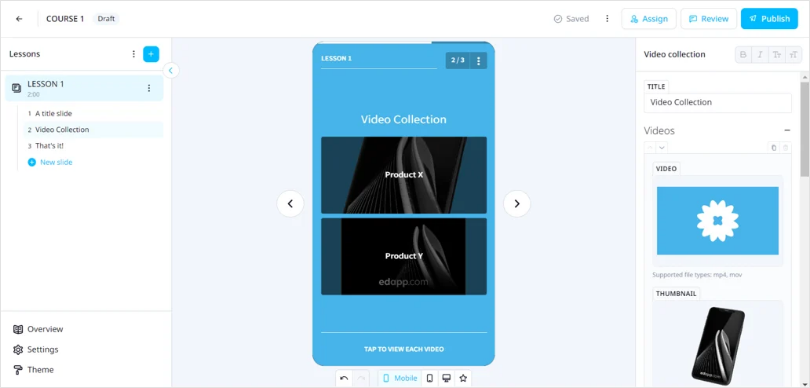
The AI Create feature also caught my attention because it helps speed up content development, especially when training needs to be rolled out quickly. The library of microlearning templates provides a useful starting point instead of building every course from scratch.
What I found particularly valuable was the combination of push notifications and offline access, which helps keep training accessible and encourages higher completion rates across distributed teams.
Pros:
- Purpose-built for mobile-first, microlearning delivery with 50+ templates
- AI Create generates course content automatically from a topic or document
- Offline mobile access with push notifications drives completion for field teams
- Cloud-based translation for multilingual course delivery
- Robust analytics on learner performance, retention, and engagement
- Canva integration and PowerPoint conversion for content repurposing
Cons:
- Customization options are limited compared to full-featured LMS platforms
- Additional layout options are needed for more varied course design
- Learner enrollment process needs streamlining
- Free version has basic reporting and no custom certificates
User Rating: 4.6/5 (Capterra)
Pricing: Starts at $5/learner/month (billed annually)
Use Case: Organizations with frontline, field, or mobile-first workforces that need short, engaging training that employees can complete on their phones.
My Top 3 Picks for Employee Training
After evaluating these LMS platforms across onboarding, compliance, skills development, automation, and ease of administration, here are the three I would recommend most often depending on the situation.
Best Overall for Most Organizations: ProProfs Training Maker
For most HR and L&D teams, ProProfs Training Maker strikes the best balance between functionality, ease of use, and affordability. The AI course builder, large course library, compliance tracking, assessments, certifications, and automation features cover nearly everything organizations need for employee training. What I like most is that it delivers enterprise-level capabilities without requiring a dedicated LMS administrator.
Best for Large Enterprises: Absorb LMS
When training programs become complex and learner populations grow into the thousands, Absorb LMS stands out. Its AI-powered administration tools significantly reduce the manual work associated with managing large training programs, while intelligent recommendations help personalize learning at scale. Organizations with dedicated L&D teams and more sophisticated requirements will appreciate its automation capabilities, reporting, and enterprise-ready infrastructure.
Best for Training Automation and Personalized Learning: CYPHER Learning
CYPHER Learning is the platform I would choose when the goal is maximizing automation and learner engagement. Features like automated enrollment, grading, learner communication, and AI-powered course creation can dramatically reduce administrative workload. The ability for learners to build personalized learning paths also encourages greater ownership of development, making it a strong fit for organizations focused on continuous learning and employee growth rather than just compliance training.
How I Evaluated These LMS for Employee Training
The evaluation of LMS platforms included in this article follows an unbiased and systematic approach designed to provide a fair and practical assessment for employee training needs. Each platform was evaluated using the following six criteria:
1. User Reviews / Ratings
I analyzed user reviews and ratings from trusted software review sites to understand how each LMS performs in real-world training environments. This helped identify common strengths, recurring complaints, and overall customer satisfaction.
2. Essential Features & Functionality
The evaluation focused on the features that matter most for employee training, including course creation, assessments, certification management, reporting, automation, mobile learning, compliance tracking, integrations, and AI capabilities where available.
3. Ease of Use
A feature-rich LMS has limited value if employees or administrators struggle to use it. I assessed the learning curve, navigation, course management workflows, and overall user experience from both the learner and administrator perspectives.
4. Customer Support
I reviewed onboarding resources, documentation, training materials, support channels, and customer feedback to understand how effectively each vendor supports organizations during implementation and ongoing use.
5. Value for Money
Pricing was evaluated alongside the platform’s capabilities, scalability, automation, reporting, and overall training functionality to determine whether it delivers meaningful value for the investment.
6. Personal Experience / Experts’ Opinions
In addition to hands-on research, I considered customer experiences, expert insights, industry discussions, and conversations with training professionals to better understand how these LMS platforms perform beyond vendor marketing claims.
What Features Should an LMS for Employee Training Include?
Here is the feature checklist I use when evaluating any LMS. These are the must-haves for any organization serious about employee training.
| Category | Feature | Why It Matters |
| Core Capabilities | Course creation tools | Lets you build and manage courses directly inside the LMS without relying on separate authoring software. |
| Core Capabilities | Content library | Provides ready-made courses for onboarding, compliance, and employee development. |
| Core Capabilities | SCORM/xAPI support | Ensures training content from other tools can be imported while preserving tracking data. |
| Core Capabilities | Mobile access | Allows employees to complete training from any device without sacrificing the learning experience. |
| Core Capabilities | Multilingual support | Essential for training global teams and employees who prefer different languages. |
| Assessment & Certification | Built-in quizzes and assessments | Helps measure knowledge retention with features like question randomization and time limits. |
| Assessment & Certification | Branched scenarios | Enables employees to practice real-world decision-making through interactive learning experiences. |
| Assessment & Certification | Automated certificates | Issues certificates automatically and tracks renewal deadlines for recurring training. |
| Tracking & Reporting | Real-time dashboards | Provides visibility into completion rates, scores, progress, and learner activity. |
| Tracking & Reporting | Compliance audit trails | Creates exportable records showing who completed required training and when. |
| Tracking & Reporting | Skill gap analytics | Identifies knowledge gaps across teams to guide future training initiatives. |
| Administration & Automation | Role-based enrollment | Automatically assigns training based on job role, department, or location. |
| Administration & Automation | Automated reminders | Reduces administrative work by reminding learners about incomplete training. |
| Administration & Automation | Learning paths | Guides employees through structured training journeys from onboarding to advanced skills. |
| Integration | HRIS connectivity | Syncs with HR systems like Workday, BambooHR, or Justworks to automate learner management. |
| Integration | CRM integration | Connects employee and sales training programs with systems such as Salesforce. |
| Integration | SSO support | Allows employees to access training using existing company credentials without creating new accounts. |
How to Map LMS Use Cases to Employee Lifecycle Stages
Most LMS buyers focus on features. What actually determines success is matching the right platform capabilities to the right moment in an employee’s journey. Here is how I think about it:
| Employee Lifecycle Stage | What You Need | The Goal | Recommended Platforms |
| New Hire Onboarding (Days 1 to 90) | Learning paths, role-based auto-enrollment, orientation content, milestone tracking | Ensure every new hire receives a consistent and structured onboarding experience regardless of manager or location | ProProfs, LearnUpon, CYPHER Learning |
| Compliance Training (Ongoing) | Audit trails, automated recertification reminders, certificate management, completion proof | Maintain compliance and provide training records whenever required | ProProfs, Litmos, Absorb LMS |
| Skills Development (Continuous) | Content libraries, AI recommendations, learning paths tied to role progression | Help employees build the skills needed to support evolving business goals | Docebo, 360Learning, Absorb LMS |
| Manager and Leadership Training | Scenario-based learning, coaching tools, blended learning support | Develop stronger leaders who can effectively manage and coach teams | ProProfs, Docebo, Litmos |
| Remote and Distributed Teams | Mobile access, multilingual support, offline capability, push notifications | Deliver training consistently across locations, devices, and languages | ProProfs, EdApp, Litmos |
| Frontline and Field Workers | Mobile-first design, microlearning, offline access, quick-completion formats | Fit training into busy work schedules without disrupting daily operations | EdApp, Litmos |
5 Common Mistakes to Avoid When Choosing an LMS
I have seen these mistakes cost teams months of wasted time and budget.
Mistake 1: Choosing Based on the Demo, Not the Admin Experience
Demos show you the learner view. The admin experience is where most time is actually spent. Ask for an unguided walkthrough of course creation, reporting, and enrollment management before you decide.
Mistake 2: Underestimating Migration Complexity
If you are moving from another LMS or a DIY stack, ask specifically about SCORM import, content migration support, and how long historical data can be ported. This is where implementations go wrong.
Mistake 3: Ignoring per-User Pricing Math
$6 per user per month looks reasonable until you have 500 active learners. Calculate total cost at your current headcount and at 2x growth before signing a contract.
Mistake 4: Choosing a Platform Your Team Cannot Actually Run
If your L&D team is small or non-technical, avoid platforms that require dedicated administrators or extensive customization to be functional. Ease of use is a feature, not a luxury.
Mistake 5: Skipping the Content Library Evaluation
If a platform has a content library, spend 20 minutes reviewing the actual courses on the topics you need. Library size is irrelevant if the content quality is poor or the topics do not match your training priorities.
How an LMS Solves the Specific Problems HR and L&D Teams Face
Based on the community research and customer conversations that informed this guide, here are the exact problems I hear most often and how a well-chosen employee training LMS addresses them.
The need for effective employee development is becoming increasingly urgent. According to Gallup’s State of the Global Workplace 2025 report, global employee engagement fell to 21%, highlighting the importance of providing employees with meaningful learning and growth opportunities.
1. “Training varies by manager. There is no consistency.”
An employee training LMS enforces consistency by delivering the same course content to every employee. Role-based learning paths mean the right training goes to the right person automatically, regardless of who their manager is.
2. “I cannot prove who completed compliance training.”
Every completion, score, and certificate is timestamped and logged in the LMS. You can pull an audit report in minutes showing exactly who completed what, when, and how they scored.
3. “Employees click through training without actually engaging.”
Gamification, branched scenarios, quizzes with randomization, and time-limited questions all make passive click-through harder. Completion tracking by section shows where people are skipping.
4. “We are paying for features we never use.”
This is a platform selection problem. The right LMS for a 200-person company is not the same as the best LMS for employee training for a 20,000-person enterprise. Match the platform to your actual use case.
5. “Our tools do not talk to each other.”
Modern employee training LMS for corporates integrates with HRIS, CRM, and SSO tools. When a new hire is added to your HR system, they are automatically enrolled in the LMS onboarding program. When they complete training, that data is returned to your HR records.
6. “We are growing fast, and the current system cannot keep up.”
Cloud-based LMS platforms scale without the need for infrastructure work on your end. Adding 100 users is the same as adding 10.
Choose the LMS That Solves Your Biggest Training Challenge
The best LMS for employee onboarding and training is not necessarily the one with the longest feature list. It is the one that helps you create consistent onboarding, simplify compliance, automate repetitive tasks, and give employees a better learning experience.
Whether your priority is training remote teams, developing future leaders, managing compliance, or scaling learning across a growing workforce, the right platform should make training easier to deliver, track, and improve.
If I had to recommend one platform for most organizations, it would be ProProfs Training Maker. The combination of AI-powered course creation, 500+ ready-made courses, compliance tracking, assessments, certifications, automation, multilingual support, and affordable pricing makes it one of the most practical solutions for HR and L&D teams.
Ready to see how it works? Start with a free account, create your first AI-generated course, or explore the course library to launch onboarding, compliance, or employee development training in minutes.
Frequently Asked Questions
What is the difference between an LMS and a learning experience platform (LXP)?
An LMS focuses on delivering, tracking, and reporting employee training. An LXP emphasizes personalized learning, content recommendations, and learner engagement. Many modern platforms combine both approaches. If your priority is compliance, onboarding, and training management, an LMS is usually enough. For self-directed learning, look for LXP capabilities.
How long does it take to implement an LMS for employee training?
Implementation time depends on your requirements. A basic cloud-based LMS can be up and running within a few days. More advanced deployments involving integrations, custom branding, content migration, and user setup typically take several weeks. In most cases, preparing training content takes longer than configuring the platform.
Can a small business afford an LMS for employee training?
Yes. Many LMS platforms offer affordable plans designed for small businesses, and some even provide free options for smaller teams. While software costs are often manageable, creating, organizing, and maintaining training content usually requires the biggest investment of time and resources.
How do I track employee training completion for compliance purposes?
Most LMS platforms provide completion reports, timestamps, and training records. For compliance management, look for features such as automated certificates, certification expiration tracking, audit-ready reports, and reminder notifications. These tools help ensure employees stay current with required training and simplify compliance audits.
What is SCORM and why does it matter for employee training?
SCORM is a widely used standard that allows e-learning content to work across different LMS platforms while preserving learner progress and completion data. It makes training content more portable and reusable, helping organizations avoid rebuilding courses when changing systems or content providers.
How does an LMS support remote employee training?
A cloud-based LMS allows employees to access training from anywhere using a computer, tablet, or smartphone. It automatically tracks progress and completion while supporting flexible learning schedules. Features like mobile access, notifications, multilingual content, and self-paced learning make remote training easier to manage.
How do I get employees to actually complete training on the LMS?
Employees are more likely to complete training when it is relevant, engaging, and easy to consume. Use short learning modules, automated reminders, progress tracking, and clear expectations. Connecting training to job performance, career growth, or certifications can also significantly improve participation and completion rates.
What is the ROI of implementing an LMS for employee training?
An LMS delivers value by reducing onboarding time, lowering administrative workload, improving compliance management, and making training more accessible. Organizations often see faster employee productivity, fewer compliance issues, and more consistent learning outcomes, resulting in long-term savings and operational efficiency.
Let ProProfs AI create your training course

 We'd love your feedback!
What did you like & how can we make it even better?
 Thanks for your feedback!
 Ask Your Question
Have a question? Get expert help to make your decision easier.