

WordPress is genuinely great at a lot of things. Running a learning management system is not one of them, at least not without help.
Out of the box, you get a post editor, a block builder, and a theme. If you want courses, quizzes, progress tracking, certificates, and payments, you need a plugin for that. And picking the wrong one is not a small mistake: it means rebuilding your entire course setup six months later, migrating learner data, and reconfiguring workflows you already spent hours on.
I have been through this research process myself, and I have compared tools across very different use cases, from selling online courses to external audiences to running internal compliance training across a distributed team.
In this list, I’ll break down the best WordPress LMS plugins, including ProProfs Training Maker, what they’re actually good at, where they fall short, what they really cost, and how they impact your site’s performance.
This guide is for:
- Course creators selling programs to external audiences
- HR and L&D managers running employee or compliance training on a WordPress site
- Membership site owners bundling courses with subscriptions
- Developers building custom learning portals for clients
- Small business owners who need something fast, affordable, and honest about pricing
What Is a WordPress LMS Plugin?
A WordPress LMS plugin adds learning management system functionality directly to your existing WordPress site, including course creation, assessments, learner progress tracking, certificates, and payment processing.
Without a plugin, WordPress has no native ability to create or manage structured learning. The plugin handles all of that inside your existing site, without requiring a separate platform.
The distinction between plugin types matters more than most roundups acknowledge. Some are lightweight add-ons that give you basic quizzes and a course page template. Others are fully-featured learning management systems that support drip content, gamification, SCORM imports, branched scenarios, and eCommerce with multiple payment gateways.
Choosing the wrong tier for your use case means either overpaying for complexity you will never use, or hitting a hard ceiling right when your programs start to scale.
Quick Comparison: Best WordPress LMS Plugins
| Tool | Best For | Key Features | Capterra Rating | Starting Price |
|---|---|---|---|---|
| ProProfs Training Maker | Easy employee training and course selling | AI course builder, 500+ ready courses, compliance tracking, gamification, 70+ languages | 4.8/5 | Free; paid plans start at $1.99 per active learner/month |
| LearnDash | Intuitive course builder | Drag-and-drop builder, advanced quizzes, drip content, group management, gradebook | 4.5/5 | $199/year |
| LifterLMS | Online courses and memberships | Courses + memberships in one, drip content, WooCommerce integration, engagement tools | 4.5/5 | Free; paid from $199/year |
| Tutor LMS | Drag-and-drop course building | Visual builder, monetization (bundles, subscriptions, commissions), earnings reports | 4.7/5 | Free; paid from $199/year |
| MemberPress | Membership sites | Access control, content restriction, drip content, recurring billing | 4.4/5 | $179.50/year |
| MasterStudy LMS | Specialized eLearning portals | Advanced quiz engine, instant feedback, customizable front-end, analytics | 4.6/5 | Free; paid from $54.99 |
| Sensei LMS | Interactive online courses | Native WP/WooCommerce integration, gamification, discussion forums, drip content | 4.2/5 | Free; paid from $15/month |
| LearnPress | Creating and selling courses | Course creation, quizzes, payment gateways, extensive add-on library | 4.3/5 | Free; paid from $149 |
| WP Courseware | Simple course builder | Drag-and-drop builder, multimedia support, drip content, quiz grading | 4.3/5 | $129/year |
| CoursePress Pro | Integrations | 12+ payment gateways, course + registration + payments in one plugin | 4.1/5 | $59 (single site) |
| Namaste! LMS | Developer-friendliness | Extensive API/hook library, deep customization, robust tracking | 4.2/5 | Free; Pro from $67/year |
11 Best LMS Plugins for WordPress
I’ve worked with several WordPress LMS plugins over the years, and this list is based on my experience, research, and recommendations from friends and colleagues, as well as reviews and client feedback.
1.ProProfs Training Maker – Best for Employee Training
ProProfs Training Maker is not just a cloud platform you bolt onto WordPress. It has a native WordPress plugin that embeds your training portal directly into your site. No separate platform to log into, no fragmented experience for your learners.
What makes it the strongest option on this list for employee training is the combination of AI course generation and out-of-the-box compliance infrastructure. You type a prompt describing what the training should cover, and the AI builds a full course structure you can edit immediately. Why don’t you try it yourself:

Let ProProfs AI create your training course
Don’t want to start from scratch at all? There’s a library of 500+ expert-built, ready-to-use courses covering OSHA safety, harassment prevention, leadership, GDPR, and communication, all fully editable for your specific context.
For L&D managers and compliance officers, the features that actually matter day to day are the ones that prove things happened: audit-ready completion reports, certification tracking, IP tracking, and role-based assignment. ProProfs handles all of that natively. For course creators selling to external audiences, the free plan already supports course selling, so you’re not locked out of monetization until you upgrade.
I tested it against several WordPress-native options for a distributed team training setup, and the setup time difference was significant. Other plugins required me to configure quiz settings, certificate templates, and learner management separately. ProProfs had everything working from a single interface.
Pros:
- Native WordPress plugin available
- AI course generation from a text prompt; no blank-page problem
- 500+ pre-built, fully editable compliance and soft skills courses
- Course selling is supported on the free plan, not locked behind paid tiers
- Anti-cheating quiz settings: randomized questions, IP tracking, timed assessments
- Audit-ready completion reports and certification management
- Gamification (badges, leaderboards, points) to reduce passive click-through
- Mobile-ready; supports 70+ languages for distributed or multilingual teams
- Integrates with Salesforce, Justworks, SCORM/xAPI, and SSO
Cons:
- No on-premise deployment option
- No dark mode
- Free plan caps at 10 learners
Capterra Rating: 4.8/5
Pricing: Free for up to 10 learners, including course selling. Paid plans start at $1.99 per active learner/month. Business plan at $3.99/active learner/month.
2. LearnDash: Best Intuitive Course Builder
LearnDash is the most feature-complete dedicated WordPress LMS plugin on this list. Universities use it. Independent course creators who have outgrown everything else use it. I’ve used it personally for a multi-instructor setup, and the thing that stands out is how much you can configure without writing a single line of code.

The course builder uses a drag-and-drop hierarchy: course, section, lesson, topic. You can build layered learning paths, set prerequisites between courses, enable drip schedules, and manage group enrollments from the same interface. The quiz engine handles multiple question types, randomization, and gradebooks. If you need a WordPress LMS plugin that will genuinely grow with you, LearnDash is the safest long-term bet on this list.
The honest caveat: the initial setup has a real learning curve. There are a lot of settings, the documentation is dense, and you should not expect to be fully operational in an afternoon. If you’re willing to invest a few days to configure it properly, you end up with a setup that rarely needs to be replaced.
Pros:
- Drag-and-drop course builder with logical content hierarchy
- Flexible quiz engine: multiple question types, randomization, gradebook
- Advanced course management including drip, prerequisites, and group enrollment
- Detailed learner analytics to track progress and identify drop-off points
Cons:
- Initial setup is time-intensive; steep learning curve for first-time users
- Some advanced features require purchasing premium add-ons
- Third-party integrations occasionally need extra configuration work
Capterra Rating: 4.5/5
Pricing: Starts at $199/year
3. LifterLMS: Best for Online Courses and Memberships
LifterLMS handles both courses and memberships without being built primarily for either, which puts it in an interesting position on this list. A colleague of mine describes it as “the plugin that replaced three other plugins I was running simultaneously,” which tells you exactly what it solves for.
You get a full course builder alongside membership tiers, private community access, and subscription management. The WooCommerce integration is seamless, which matters if you’re already running WooCommerce for other things on your site. Drip content, prerequisites, and multimedia are all supported natively. Where you need to be careful is the pricing model: the base plugin is free, but the paid add-on bundles called “Universe” and “Infinity” are where most serious functionality lives. Budget for those from the start.
Pros:
- Covers courses, memberships, and eCommerce in a single plugin
- Flexible course structures with drip content, prerequisites, and multimedia
- Seamless WooCommerce integration for payment handling
- Accessible to non-technical users for basic setup and management
Cons:
- Add-on bundles are where the real cost lives; base plugin pricing understates total spend
- Managing large content libraries in WordPress can get unwieldy at scale
- Compatibility issues may arise with third-party plugins outside WooCommerce
Capterra Rating: 4.5/5
Pricing: Free plan available. Paid plans start at $199/year.
4. Tutor LMS: Best for Drag-and-Drop Course Building
Tutor LMS competes directly with LearnDash on price and interface, and for a lot of users, it wins on both. Someone I work with switched from LearnDash to Tutor LMS specifically because the visual builder was faster for her team to navigate, and she wasn’t using most of what LearnDash offered at that price point.
The free version is genuinely generous compared to most at this tier. The paid plans add the monetization layer: course bundles, subscription pricing, and instructor commission management, making it a strong choice for a marketplace-style setup. Where it falls behind is third-party integrations: if your workflow depends on a specific CRM or automation tool, check the integration list before committing.
Pros:
- Fast visual course builder with real-time preview
- Strong assessment tools: multiple question types, randomization, timed quizzes
- Built-in monetization including bundles, subscriptions, and instructor commissions
- Detailed earnings reports for instructors and site admins
Cons:
- Most monetization features require the paid tier; free eCommerce is limited
- Third-party integration options are narrower than some competitors
- Customer support response times can be slow
Capterra Rating: 4.7/5
Pricing: Free plan available. Paid plans start at $199/year.
5. MemberPress: Best for Membership Sites
MemberPress is not an LMS in the traditional sense, and understanding that distinction will save you from configuring the wrong tool. A colleague who runs a professional development membership site uses it as her backbone, and the way she described it is the most accurate summary I’ve heard: “It’s less about teaching people things and more about controlling who sees what and when.”
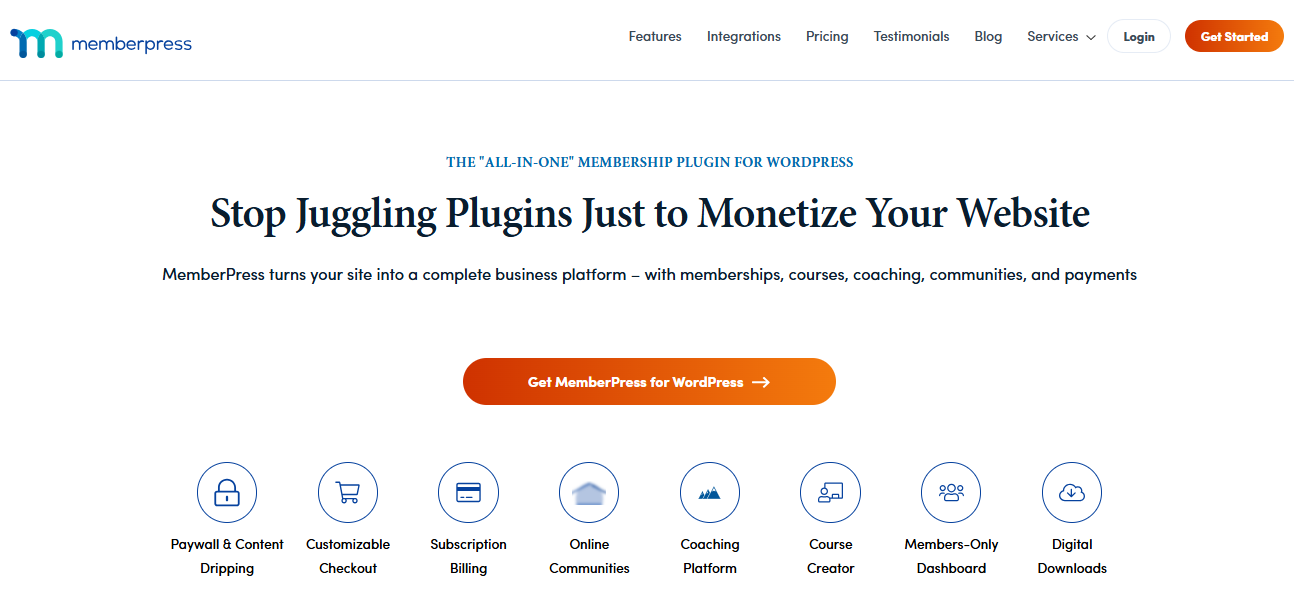
That’s exactly right. MemberPress excels at access control: restricting individual posts, pages, categories, or entire course tracks based on membership tier. Drip content, subscription pricing, and recurring billing are all handled natively. What it doesn’t handle well is assessment depth, certificate generation, or gamification. If those matter for your use case, you’ll need to layer in another plugin alongside it.
Pros:
- Granular content restriction tied to membership levels
- Drip content scheduling for paced, controlled content release
- Multiple payment gateway support for one-time or recurring billing
- Strong integration with email marketing tools and CRMs
Cons:
- Limited course management features; not a substitute for a real LMS
- Basic quiz functionality only
- Minimal gamification support
Capterra Rating: 4.4/5
Pricing: Starts at $179.50/year
6. MasterStudy LMS: Best for Specialized eLearning Portals
MasterStudy LMS is built for professional eLearning portals: certification programs, test prep courses, and professional development platforms that need to look polished and function reliably under real usage. A developer I know used it to build a custom learning portal for a professional association, and what he valued most was how much front-end customization was possible without hiring a designer.

The quiz engine is more advanced than most on this list: multiple question types, instant personalized feedback, and configurable passing grades. The analytics cover both learner progress and course performance in enough detail to support instructional decisions. The trade-off is setup time: if you need to be running in a day, this is not the right starting point.
Pros:
- Flexible, customizable course structures for varied learning formats
- Advanced quiz engine with instant feedback and configurable passing grades
- Comprehensive analytics covering learner progress and course performance
- Good integration with other WordPress plugins for a unified site experience
Cons:
- Steeper setup learning curve than most competitors
- Some advanced features absent compared to LearnDash or Tutor LMS
- Customer support options are limited; response times can be slower
Capterra Rating: 4.6/5
Pricing: Free plan available (limited add-ons). Paid plans start at $54.99.
7. Sensei LMS: Best for Interactive Online Courses
Sensei LMS is made by Automattic, the same company behind WordPress.com and WooCommerce. That heritage means tighter native integration with the WordPress ecosystem than any third-party plugin can match. Updates stay in sync with WordPress core, and the block editor integration feels genuinely built-in rather than added on.
I found it the fastest option for building interactive, multimedia-rich courses quickly. WooCommerce monetization works without configuration gymnastics. Discussion forums and gamification are built in. Where it shows its limits is advanced assessment and membership functionality: if you need either at any serious depth, you’ll need additional plugins.
Pros:
- Native WordPress and block editor integration
- Content dripping and prerequisites for structured, paced learning
- Gamification and discussion forums built in
- Comprehensive progress reporting for instructors and admins
Cons:
- Limited payment gateway options outside of WooCommerce
- No built-in membership system; requires a separate plugin
- Advanced assessment features are limited
Capterra Rating: 4.2/5
Pricing: Free plan available (basic quizzes only). Paid plans start at $15/month.
8. LearnPress: Best for Creating and Selling Courses Online
LearnPress was one of the first plugins I tested when I was looking for a genuinely functional free option. The honest answer: the free tier is more capable than most free WordPress LMS plugins, but you’ll hit its ceiling faster than the pricing page suggests.
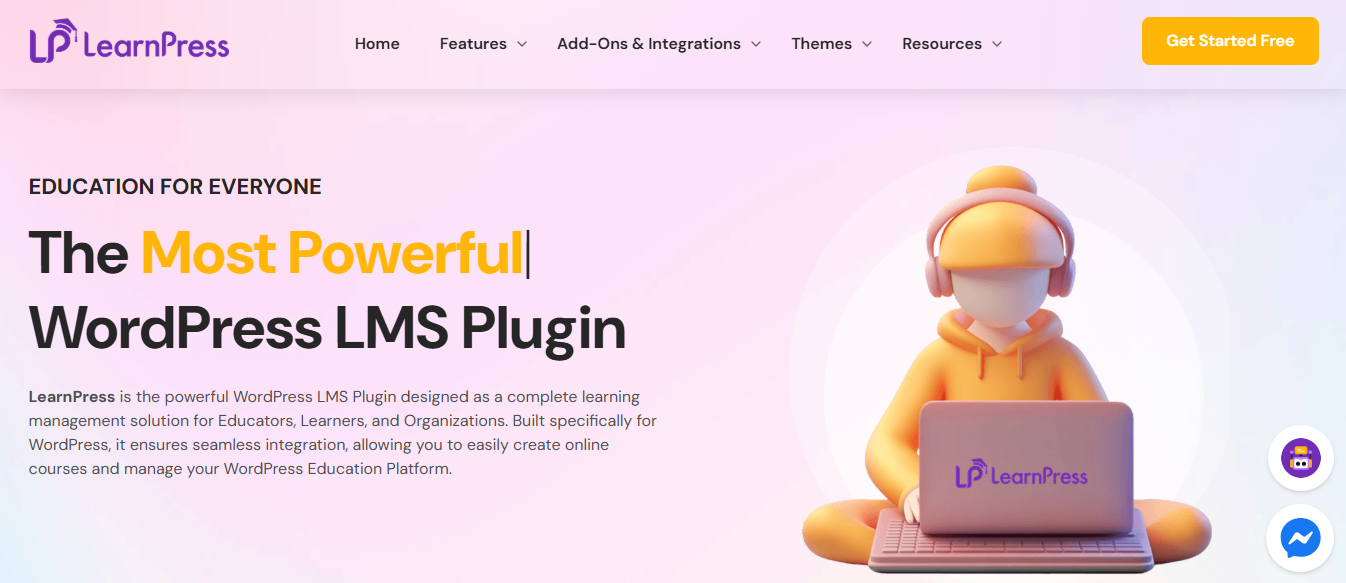
The core plugin handles course creation, quizzes, student management, and basic payment integration well. A friend of mine building a course business on a tight budget found that by the time she had added the extensions she actually needed (certificates, prerequisites, drip content), LearnPress was no longer the budget option she started with. That’s not a knock on the plugin; it’s just the reality of how add-on pricing works here. Know what you need before you assume the free version covers it.
Pros:
- Functional free tier for course creation, quizzes, and basic payments
- Wide selection of add-ons for expanded functionality
- Intuitive interface that doesn’t require prior LMS experience
- Multiple payment gateway support for course monetization
Cons:
- Advanced assessment features (proctoring, timed quizzes, varied question types) require paid add-ons
- Plugin update cycles can lag, occasionally creating compatibility issues
- Customer support is inconsistent; complex issues can take longer than expected to resolve
Capterra Rating: 4.3/5
Pricing: Free plan available. Paid plans start at $149.
9. WP Courseware: Best Simple Course Builder
WP Courseware has been running since 2012. That longevity says something specific: it is stable, well-documented, and has been through enough iterations to smooth out the friction that newer plugins still have. A training manager I know has used it for four years specifically because she doesn’t want to deal with surprise updates that break her course pages.

The drag-and-drop builder is one of the simpler ones on this list, genuinely accessible to non-technical users. The trade-off: gamification, certificate generation, and some payment options require separate add-ons. Factor those into your budget from the start rather than discovering them mid-configuration.
Pros:
- Simple drag-and-drop interface accessible to non-technical users
- Multimedia support for video, audio, images, and downloadable files
- Drip content scheduling for structured, sequential learning paths
- Flexible quiz and grading options with configurable passing thresholds
Cons:
- Gamification and certificate generation require separate add-ons
- Limited built-in payment gateways; most setups need additional integrations
- Advanced customization may require custom code or supplementary plugins
Capterra Rating: 4.3/5
Pricing: Starts at $129/year
10. CoursePress Pro: Best Integrated WordPress LMS System
CoursePress Pro’s main selling point is integration breadth. It handles course creation, learner registration, and payment processing in a single plugin, and supports more than 12 payment gateways, which is more than any other plugin on this list. That matters when you’re selling to international audiences and need payment flexibility.
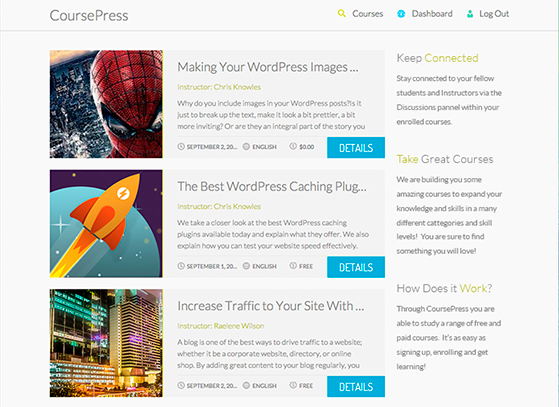
I tested it for a setup requiring both online and offline courses simultaneously, and it managed that more cleanly than I expected. The performance caveat is real though: it’s resource-intensive on shared hosting. Test it on a staging environment before going live, especially if your site is already running several plugins.
Pros:
- Handles courses, registration, and payments in one integrated plugin
- 12+ payment gateway support for global course sales
- Robust customization options for branding and design
- Comprehensive assessment and grading tools
Cons:
- Resource-intensive; can affect performance on shared hosting
- Initial configuration can feel overwhelming for first-time LMS users
- Some advanced features require additional paid add-ons
Capterra Rating: 4.1/5
Pricing: Starts at $59 for a single site license.
11. Namaste! LMS: Best Developer-Friendly LMS
Namaste! LMS does not pretend to be a point-and-click tool. It’s built for developers, and the API and hook library reflects that.
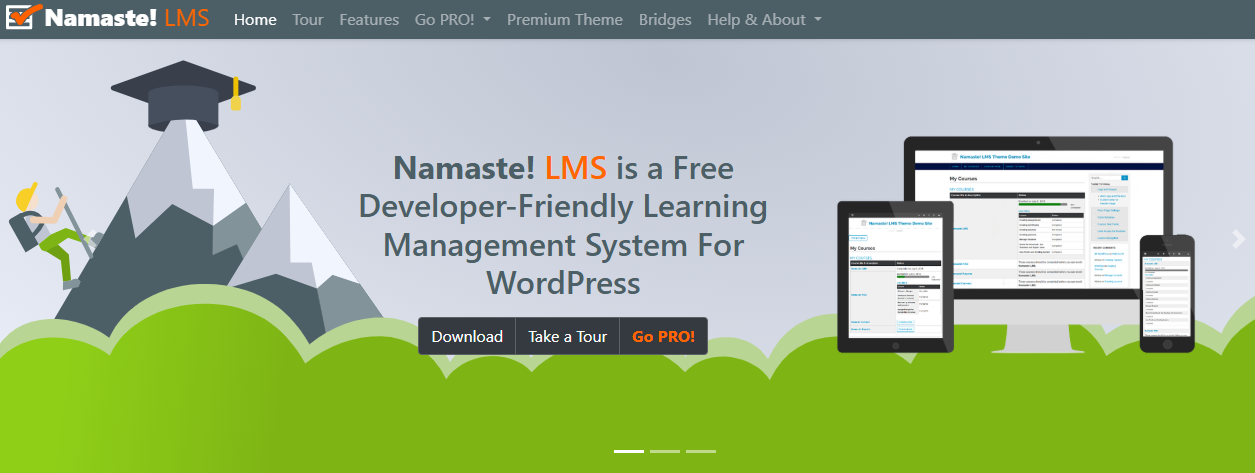
I haven’t used it personally, but a developer colleague who builds learning portals for corporate clients recommended it specifically for situations where no out-of-the-box plugin can satisfy a client’s requirements. His caveat: budget extra time for configuration, and make sure you have the technical capacity in-house to manage it. For non-developers, this is the wrong choice.
Pros:
- Extensive API and hook library for deep customization
- Seamless integration with other WordPress plugins via developer-friendly architecture
- Robust progress tracking and reporting once configured
- Accessible course management interface after proper setup
Cons:
- Limited pre-built templates; not suitable for non-technical users out of the box
- Complex initial setup
- Some third-party integrations require custom development
Capterra Rating: 4.2/5
Pricing: Free (limited functionality). Pro version starts at $67/year.
How Were These WordPress LMS Plugins Evaluated?
I didn’t rely on a single review site or just marketing pages to build this list. It’s based on a mix of firsthand experience, real user conversations, and cross-checking ratings with what people actually say after using these tools.
Here’s what went into it:
- I’ve personally used several of these plugins across different setups, so I know how they perform beyond the demo stage.
- I spoke with trainers and course creators who use them daily, which helped validate what works in real scenarios.
- I compared Capterra and G2 ratings with user feedback to spot any gaps between reviews and actual experience.
- For tools I haven’t used directly, I looked for consistent, specific feedback across multiple sources, not just promotional claims.
- I also included insights from two colleagues, one who runs a membership site and tests multiple plugins, and another who builds custom learning portals for corporate clients.
The main things I focused on were launch speed, the real cost after add-ons are included, impact on site performance, and how well each tool delivers on its promises.
My Top 3 WordPress LMS Plugins Recommendations
After going through all twelve, here’s where I’d point most people, depending on their situation.
ProProfs Training Maker is my top pick overall, specifically if your primary use case is employee training or compliance. The native WordPress plugin, AI course builder, free-plan course selling, and built-in compliance infrastructure put it ahead of everything else at this use case. The free plan alone is worth testing before you spend a dollar.
LearnDash is the strongest pick for external course creators who need power and scalability. It’s the most feature-complete plugin on this list, and the quiz engine and analytics justify the price for anyone building serious course programs. Just go in knowing the setup will take time.
LifterLMS earns the third spot for anyone who needs both courses and memberships without assembling four separate plugins. The WooCommerce integration is the smoothest of any option here, and the all-in-one approach keeps operational complexity low once you’re past the initial configuration.
How WordPress LMS Plugins Affect Your Site’s Performance
Adding a full LMS plugin to your WordPress site is not the same as adding a contact form plugin. LMS usage generates large amounts of metadata: as students complete lessons, take quizzes, and interact with dashboards, the database grows continuously, and many LMS sites accumulate hundreds of thousands of metadata entries. At any real volume, that’s something you need to plan for.
Here’s what to actually think about before you install:
Hosting requirements
Shared hosting works fine for testing and early-stage use, but once you cross 100+ active learners or run quiz-heavy courses, you’ll likely need a VPS or managed WordPress host. Plugins like LearnDash, LifterLMS, and CoursePress Pro are particularly resource-intensive. ProProfs Training Maker offloads the server load entirely to its cloud infrastructure, which is one practical advantage of its architecture.
Watch: What Is a Cloud-Based Learning Management System (LMS)?
Database load
Every quiz attempt, lesson completion, and progress update writes to your WordPress database. At scale, this creates table bloat. Use a plugin like WP-Optimize or a managed host that includes database optimization, and review your LMS plugin’s documentation for its database structure before you commit.
Caching
Most LMS plugins require exceptions in your caching configuration. Logged-in learner pages, quiz pages, and progress tracking endpoints should not be cached the same way as static content. If you’re using WP Rocket, W3 Total Cache, or host-level caching, configure exclusions for your course and learner pages from day one.
CDN integration
If your courses include video or heavy multimedia, a CDN is not optional at any meaningful learner volume. For video specifically, hosting through a service like Vimeo or Bunny.net and embedding into your LMS is almost always more performant than storing video files directly on your WordPress install.
The short version: plan your hosting environment for the scale you expect in 12 months, not your current learner count. Migrating a live LMS to a new hosting environment is genuinely painful.
What Does a WordPress LMS Plugin Actually Cost?
The headline price on almost every plugin on this list is not what you’ll spend. Here’s a realistic total cost of ownership breakdown based on what I’ve seen in practice.
| Cost Category | What to Expect |
|---|---|
| Plugin license | $0 to $199/year depending on tier and plugin. This is the number on the pricing page. |
| Add-ons | Certificates, gamification, advanced quiz types, drip content, and certain payment gateways are frequently sold separately. Budget $50 to $200/year in add-ons for most serious setups. |
| Payment gateway fees | Stripe and PayPal both charge transaction fees (typically 2.9% + $0.30 per transaction). Some plugins also take a platform cut on course sales. Read the fine print. |
| Hosting upgrades | Shared hosting works for testing. A managed WordPress host (WP Engine, Kinsta, Flywheel) runs $30 to $100+/month and is often necessary at any real learner volume. |
| Developer customization | Custom integrations, branded certificate templates, or non-standard course structures require developer time. $500 to $2,000 for a typical custom setup is realistic. |
| Ongoing maintenance | Plugin updates, compatibility checks, and database optimization. If you have technical capacity in-house, this is the time. If you don't, it's another cost. |
A plugin starting at $31 can cost $300 to $800 per year once you’ve assembled the stack you actually need. A plugin starting at $199 often includes more natively and ends up cheaper in practice. Don’t compare headline prices; compare what you get for the total spend.
Which WordPress LMS Plugin Actually Fits Your Situation?
Three scenarios where the choice becomes clear.
1. If you’re selling courses to an external audience, ProProfs Training Maker is worth evaluating first. It supports external course selling on the free plan, including payment processing, and the AI course creation can save significant production time. LearnDash and Tutor LMS are also strong, dedicated options: LearnDash for power and long-term scalability, and Tutor LMS for a lower price point and a faster visual builder.
2. If memberships and recurring revenue are the core model, MemberPress is purpose-built for that. LifterLMS is the better choice if you also need a full course engine alongside the membership layer.
3. If your use case is employee training and compliance, most plugins on this list are designed for selling to external audiences, and the compliance infrastructure (audit trails, role-based assignment, completion tracking for legal purposes) is not what they were built for. ProProfs Training Maker is built specifically for that use case. The WordPress plugin embeds directly on your site, and the free plan covers everything you need to validate the setup before spending a dime.
Stop Treating the Best WordPress LMS as a Single Answer
The honest conclusion I’ve come to after testing and comparing these tools is that there’s no single best WordPress LMS plugin. There’s only the best one for the job you’re actually trying to do.
What I’d push back on is the tendency to choose based solely on the headline price. Run the total cost calculation from the section above. Test in a staging environment before going live. And before you commit, ask yourself whether you’re buying for the volume you have today or the one you expect in 18 months.
The setup cost of choosing the wrong plugin isn’t just money. It’s rebuilt courses, migrated learner data, and reconfigured workflows. Start with the right tool.
Yes. ProProfs Training Maker has a native WordPress plugin available that embeds your training portal directly into your WordPress site. It supports both internal employee training and external course selling, including on the free plan.
Frequently Asked Questions

Does WordPress have a built-in LMS?
No. WordPress has no native LMS functionality. Courses, quizzes, progress tracking, and certificates all require a plugin. The tools on this list are the most established ways to add that capability to a WordPress site.
How do I integrate an LMS with WordPress?
Most LMS plugins install like any standard WordPress plugin: download the .zip file, upload via the Plugins dashboard, activate, and work through the setup wizard. Simple plugins like WP Courseware can be running in under 30 minutes. Complex setups with custom integrations take longer. ProProfs Training Maker installs via its dedicated plugin and embeds your training portal directly into your site.
How much does a WordPress LMS plugin cost?
The headline price covers the base license only. Certificates, gamification, advanced quiz types, and payment gateways often cost extra as add-ons. Managed hosting adds $30 to $100+/month at any real learner volume. A plugin starting at $31 can cost $300 to $800 annually once fully configured. Budget for the full feature stack, not just the license.
Can I sell courses with a WordPress LMS plugin?
Yes. Most plugins on this list support course monetization with integrated payment gateways. ProProfs Training Maker is notable because course selling is available on the free plan, not locked behind a paid tier.
What is the best free WordPress LMS plugin?
For employee training, ProProfs Training Maker’s free plan stands out first, offering compliance tracking, AI course generation, quiz management, progress reporting, and support for course creation, external selling, and interactive learning experiences, all in one platform, which most free tiers simply don’t include.
How do WordPress LMS plugins affect site speed?
Significantly, if you're not prepared for it. LMS plugins write to your database constantly: every lesson completion, quiz attempt, and progress update. At volume, this creates a database load that shared hosting handles poorly. Use a caching plugin with LMS-aware exceptions, consider a CDN for multimedia content, and plan your hosting environment for your expected learner volume 12 months out, not your current count.
Is the ProProfs Training Maker a real WordPress plugin?
Yes. ProProfs Training Maker has a native WordPress plugin available that embeds your training portal directly into your WordPress site. It supports both internal employee training and external course selling, including on the free plan.
Let ProProfs AI create your training course

 We'd love your feedback!
What did you like & how can we make it even better?
 Thanks for your feedback!
 Ask Your Question
Have a question? Get expert help to make your decision easier.