
If you’ve ever tried comparing a few corporate LMS platforms, you already know how this goes.
You open five tabs, skim through feature lists, maybe book a couple of demos… and somehow everything starts sounding the same.
AI-powered learning. Mobile access. SCORM or xAPI support. Analytics dashboards. Every corporate LMS checks the same boxes, so it’s hard to tell what actually matters.
Here’s where things get tricky.
What really separates these tools isn’t in the obvious features. It’s in what they’re built for, who they actually work best for, and where they start to struggle once you’re using them regularly.
That’s exactly what I’ve tried to break down here across these 11 platforms. Not just what they promise, but how they fit different use cases, where they fall short, and what you won’t figure out from a quick comparison.
What Is a Corporate Learning Management System (LMS)?
A corporate LMS is a centralized platform for creating, delivering, and tracking employee training. That sounds simple because, in principle, it is. You build courses, assign them to people, track who completed what, and pull reports. The complexity shows up in the details: how courses are built, how assignments scale across departments, how compliance certification is tracked, and how all of it integrates with the rest of your HR stack.
One distinction worth knowing upfront: an LMS is admin-driven. You assign training, learners complete it, and you report on it. An LXP (Learning Experience Platform) is learner-driven, surfacing content based on behavior and interests. Many modern tools blend both, which is why you’ll hear vendors use both terms. When that happens, I’d ask specifically: who controls what gets recommended, the admin or the algorithm?
What Are the Best Corporate LMS Platforms for Businesses?
Here’s your at-a-glance comparison before the full breakdowns:
| Platform | Best For | Starting Price | Capterra Rating |
|---|---|---|---|
| ProProfs Training Maker | Easy online employee training | $1.99 per active learner/month | 4.8 |
| Absorb LMS | Complex training needs | Custom | 4.5 |
| Docebo | Complex enterprise training | Custom | 4.4 |
| Paylocity | Employee training + HR in one place | Custom | 4.3 |
| Litmos | Off-the-shelf training content | Custom | 4.2 |
| Rippling | Automated compliance training | Custom | 4.9 |
| iSpring Learn | eLearning and interactive content | $6.70/user/mo | 4.7 |
| Edmingle | Training businesses and educators | $109/mo | 4.5 |
| Seismic Learning | Sales team enablement | Custom | 4.6 |
| Tovuti | Community-driven L&D | Custom | 4.8 |
| 360Learning | Collaborative and peer-led learning | $8/user/mo | 4.7 |
I’ve used or closely tested most of these. For the ones I haven’t used directly, a colleague in L&D or someone in my network has used them and given me a candid read. I’ll flag which is which as we go.
How Does a Corporate LMS Work? (Step by Step)
Understanding the mechanics helps you ask better questions during demos. Here’s what actually happens under the hood:
Step 1: Content creation. An admin (usually in HR or L&D) builds or uploads course content, such as videos, PDFs, SCORM/xAPI packages, or interactive modules built in the platform’s authoring tool. AI course builders on platforms like ProProfs Training Maker now compress this step significantly.
Step 2: User management. Learners are added individually, imported via CSV, or synced automatically from your HRIS. You assign them to groups based on role, department, or location.
Step 3: Course assignment. You assign courses to individuals or groups, set due dates, and configure automated reminders. Some platforms (Rippling, for example) trigger assignments automatically based on employee events like onboarding or role changes.
Step 4: Learning delivery. Learners access training on desktop or mobile, work through modules, take assessments, and earn certifications. The best platforms make this experience smooth enough that learners don’t resist it.
Step 5: Tracking and reporting. The system logs every completion, quiz score, time-spent-per-module, and certification status. Agile learning analytics go further, giving you real-time dashboards for skills-gap analysis and training ROI, not just a compliance checkbox.
Step 6: Iteration. You use the data to improve content, close skill gaps, and report on training effectiveness to stakeholders. This step is where most platforms under-deliver relative to what they promise in demos.
The 11 Best Corporate LMS Platforms
1. ProProfs Training Maker – Best for Easy Online Employee Training
I’d point most growing teams toward ProProfs Training Maker first, specifically because it closes the gap between “we need training” and “training is running” faster than anything else in this list.
The AI course builder is the clearest example. You type something like “30-minute OSHA safety training for warehouse staff,” and it returns a structured course: lessons, quizzes, and a resource framework. It’s not magic; you’ll still edit and brand it. But it replaces the hardest part of course creation, which is staring at a blank slide and figuring out where to start.

Let ProProfs AI create your training course
A friend of mine who runs L&D for a regional healthcare network uses it specifically because the free plan isn’t a stripped-down trial. You get unlimited AI course creation, gamification, mobile access, and analytics without paying anything upfront, which matters when you’re still building the internal case for budget.
The 500+ expert-built courses covering HIPAA, OSHA, sexual harassment prevention, leadership, and communication give you two parallel paths: build from scratch with AI assistance, or take something off the shelf and let AI customize it to your needs. For compliance-heavy US teams, that combination is hard to beat at this price point.
On SCORM/xAPI support, content import, and SSO integrations, it checks the boxes without requiring an IT project to get live.
Key features:
- AI course builder and 500+ ready-to-use, editable compliance courses
- Quizzes, brain games, flashcards, and branched scenarios for engagement
- SCORM and xAPI support, video and PDF uploads, 70+ language support with AI-generated voiceovers
- White labeling, custom certificates, SSO and HR tool integrations
- Real-time progress reports, completion tracking, and skill-gap analytics
Pros:
- Free plan includes real features, not just a time-limited trial
- Fast course creation without deep L&D experience required
- Strong anti-cheating and assessment controls
- Mobile-friendly, built for global and distributed teams
Cons:
- No downloadable or on-premise version
- No dedicated account manager on the free plan
Pricing: Free plan for growing teams. Paid plans start at $1.99 per active learner/month; Business plan at $3.99/active learner/month.
Capterra Rating: 4.8/5
2. Absorb LMS – Best for Complex Training Needs
Absorb is the one I’d look at when your training environment has gotten complicated: multiple departments, varied content types, hands-on skills you need to validate alongside digital courses. The observational checklists are a feature you don’t see everywhere.
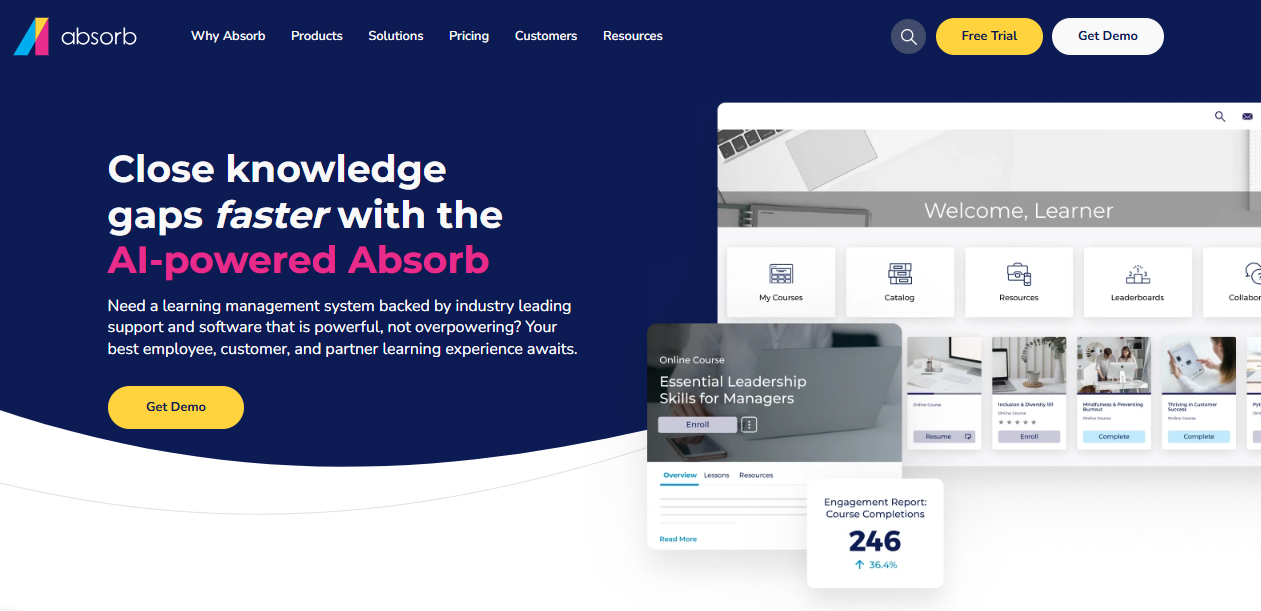
If your compliance requires confirming someone can actually perform a task on the floor, not just pass a quiz about it, Absorb has a structured workflow for that. It’s particularly relevant in manufacturing, healthcare, and logistics.
The 24/7 in-house support (not outsourced) is a genuine differentiator at this tier. The honest trade-off: custom reports require significant configuration time. If your team doesn’t have someone willing to invest in building reporting templates, you’ll have useful data that’s harder to surface than it should be.
Key features:
- Observational checklists for practical, on-the-job skills validation
- AI recommendations based on individual learner behavior
- SCORM/xAPI compatibility and in-video content search
- Built-in eCommerce for organizations that sell training externally
- Customizable dashboards and detailed outcome reporting
Pros:
- Dedicated mobile app for anytime learning access
- 24/7 in-house support team
- Strong for organizations selling training externally as a product
Cons:
- Custom reports require heavy manual configuration
- Assessment type variety is limited compared to specialized tools
Pricing: Custom, based on user count, features, and support level.
Capterra Rating: 4.5/5
3. Docebo – Best for Complex Enterprise Training
Docebo is built for scale in the operational sense. If you’re managing training across multiple regions, business units, or legal entities with different compliance requirements and different languages, it’s designed for exactly that level of complexity.
The Salesforce integration is one I hear mentioned specifically by sales enablement teams: training data surfacing inside the CRM that reps and managers already live in changes how coaching actually happens, rather than sitting in a separate system nobody checks.
Where I’d push back on Docebo as a first choice: interface customization limits are genuinely frustrating, and the inability for admins to proxy into a learner’s account is a real operational gap at an enterprise price point.
Key features:
- AI-driven personalized learning paths and admin task automation
- Social learning tools and peer-to-peer knowledge sharing
- Virtual classrooms via video conferencing integrations
- Salesforce integration for sales team training visibility
- White labeling and language localization for global rollout
Pros:
- Handles large-scale, multi-geography training well
- Strong white-labeling for brand-consistent learner experience
- Language localization supports global enterprise training
Cons:
- Admins can’t proxy into user accounts to troubleshoot issues
- Interface customization is more limited than you’d expect at this tier
Pricing: Custom, based on user count, features, and support.
Capterra Rating: 4.4/5
4. Paylocity – Best for Employee Training and Development
Paylocity makes the most sense if you’re already inside their HR platform. That’s not a knock; it’s just the honest framing. The training module is meaningfully more powerful when learner data, org structure, and role changes already live in the same system.
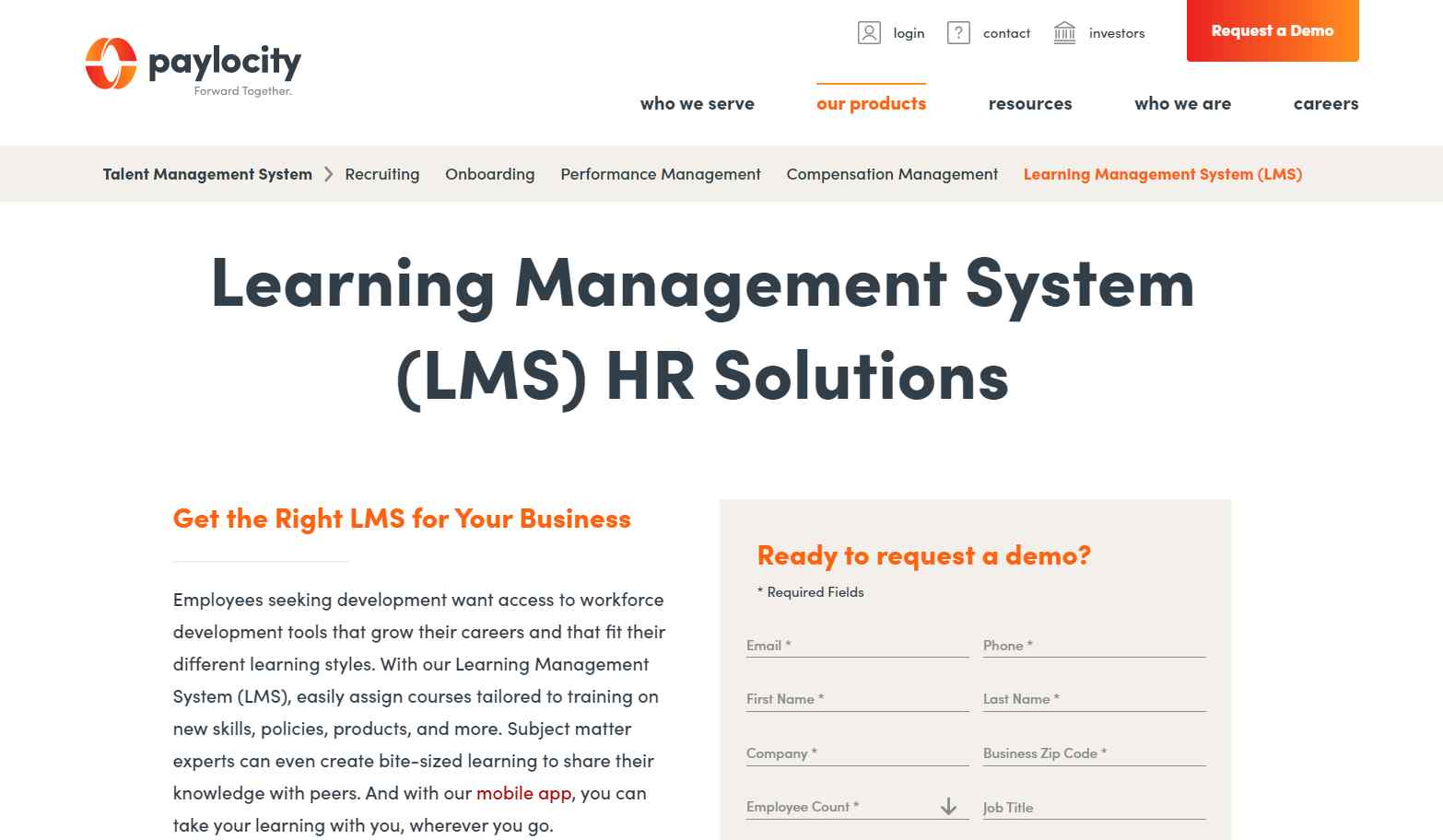
If you’re evaluating it purely as a standalone LMS, there are better dedicated options. If you’re evaluating it as part of broader HR consolidation, the training piece adds real value without adding another vendor.
The Community hub for distributing training content turns training into an ongoing conversation rather than a one-time assignment. My caveat: the dashboard can feel disorienting for non-technical admins, and the bulk assignment tools lack the filtering sophistication that larger or more dynamic teams need.
Key features:
- Native integration with Paylocity HR and payroll workflows
- Bulk course assignment with completion tracking
- Employee-generated content and Community hub for peer sharing
- Supervisor sign-offs to confirm learning outcomes
- Pre-built DEI and safety training bundles
Pros:
- Seamless for existing Paylocity HR users
- Mobile access and flexible blended learning formats
- Peer content features support a continuous learning culture
Cons:
- Dashboard complexity can challenge non-technical admins
- Bulk assignment lacks advanced dynamic group filtering
Pricing: Custom, based on modules, employee count, and service level.
Capterra Rating: 4.3/5
5. Litmos – Best for Off-the-Shelf Training Content
If your primary challenge is that you need training deployed quickly and you don’t have an L&D team with bandwidth to build original content, Litmos is worth a close look.
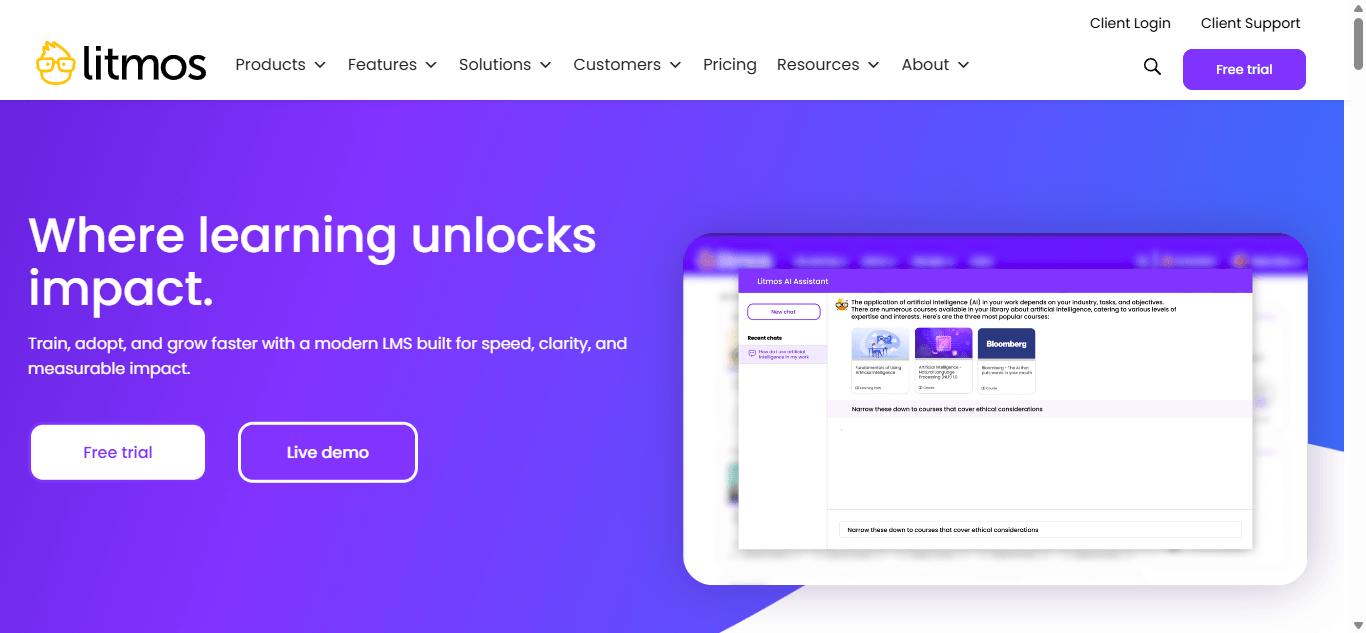
The pre-built catalog across compliance, leadership, and sales is substantial, and the manager dashboards with compliance nudging, where the system flags non-completers and prompts managers to act, is a feature that gets undervalued in most reviews. It closes a gap most teams manage manually.
What I’d flag going in: the course-building interface has a steeper learning curve than platforms like ProProfs, and managing re-enrollment for the same course across different cohorts requires more manual steps than it should.
Key features:
- Pre-built course library across compliance, leadership, and sales
- AI-powered recommendations tailored to learner behavior
- Gamification: badges, leaderboards, and completion certificates
- Video assessments with AI review of learner submissions
- Manager dashboards with non-completer nudging
Pros:
- Extensive off-the-shelf content reduces build time significantly
- Offline mobile access for field and frontline employees
- AI recommendations create personalization without admin effort
Cons:
- Course authoring has a noticeable learning curve
- Re-enrollment management across cohorts requires unnecessary manual steps
Pricing: Custom, based on features, user count, and support.
Capterra Rating: 4.2/5
6. Rippling – Best for Automated Compliance Training
Rippling is the option I’d recommend to any HR team whose main LMS frustration is: “I have to remember to assign training, and then I have to chase people down to complete it.” That’s the exact problem it’s built to eliminate.
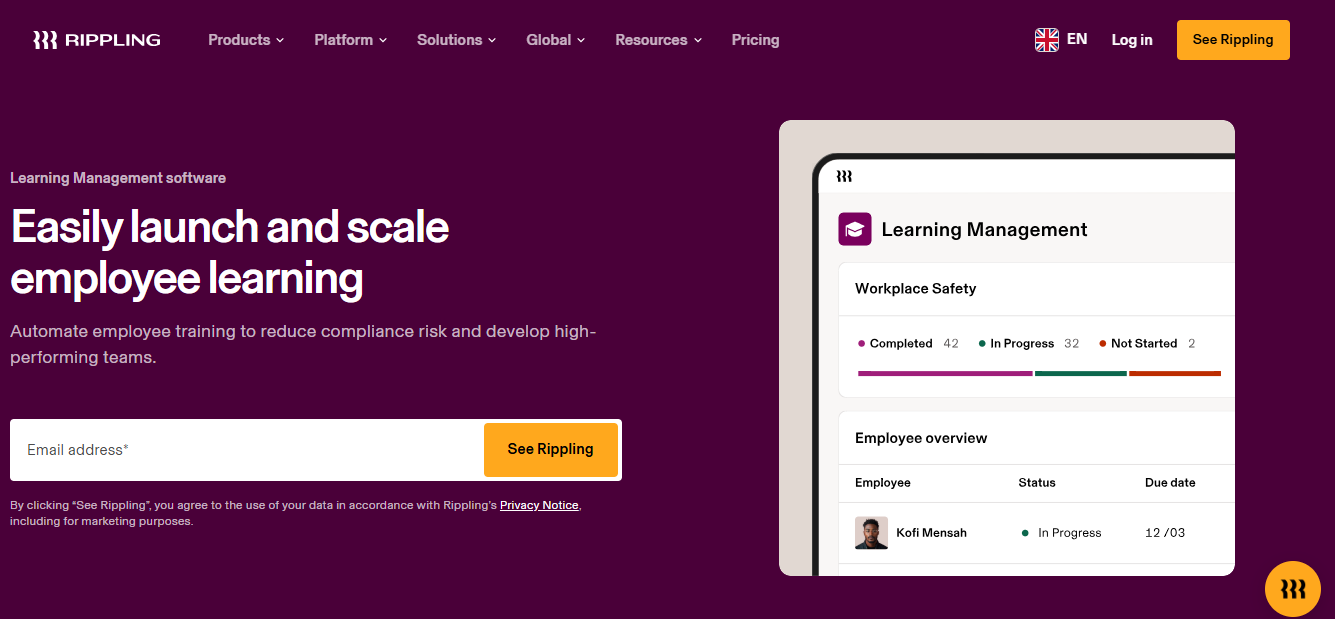
Course assignments trigger automatically based on employee events. A new hire in a specific role is enrolled in the right onboarding and compliance sequence on day one, without anyone manually setting it up. Reminders send automatically. Completion records update in the same system as payroll and benefits. For compliance-heavy US environments, the reduction in admin overhead is substantial.
The trade-off is depth. If your L&D team needs serious skills-gap analysis, agile learning analytics, or granular reporting beyond completion rates, Rippling will feel limited compared to a dedicated LMS. It’s an HR platform with a strong training automation layer, not the other way around.
Key features:
- Automated course assignment triggered by onboarding and role events
- Go1 integration for an expanded third-party course library
- Pre-built compliance content: workplace safety, anti-harassment, and more
- SCORM upload support
- Automated email and push notification reminders
Pros:
- Compliance training essentially runs itself once configured
- Full HR platform integration (payroll, benefits, training in one place)
- Mobile-friendly across devices
Cons:
- Reporting and agile learning analytics are limited vs. dedicated LMS tools
- Go1 course customization is restricted as a third-party dependency
Pricing: Custom, based on modules, employee count, and support level.
Capterra Rating: 4.9/5
7. iSpring Learn – Best for eLearning and Interactive Training
iSpring Learn is for teams that take course design seriously and want the authoring power to match. The real differentiator is the iSpring Suite integration: a desktop authoring tool for building interactive simulations, branched scenarios, and video lectures that go significantly beyond what most browser-based builders can do.
Here’s the honest caveat: you’re buying a system, not just a platform. iSpring Learn, on its own, is solid. iSpring Learn with iSpring Suite is where it gets genuinely powerful, and that’s an additional investment requiring someone willing to learn the authoring environment. If that describes your team, the output quality is worth it. If you want something faster and lower-overhead, look at ProProfs or Litmos first.
Key features:
- Deep iSpring Suite integration for interactive course authoring
- SCORM/xAPI compatibility and sequential step-by-step learning paths
- Embedded self-tests and quiz and simulation tools
- Zoom integration for live webinar delivery alongside self-paced content
- Unlimited storage for video and multimedia training libraries
Pros:
- Strong multimedia and authoring depth when used with iSpring Suite
- Excellent mobile compatibility
- Unlimited storage is a real long-term advantage for video-heavy training
Cons:
- Full value requires the additional iSpring Suite investment
- Custom reporting has documented bugs in user reviews
Pricing: Starts at $6.70/user/month.
Capterra Rating: 4.7/5
8. Edmingle – Best for Training Businesses and Educators
Edmingle is different from everything else in this list in a useful way. Most corporate LMS platforms are built for internal training delivery. Edmingle is built for organizations that deliver training as a product: coaching companies, professional training businesses, and educators running programs for external learners.
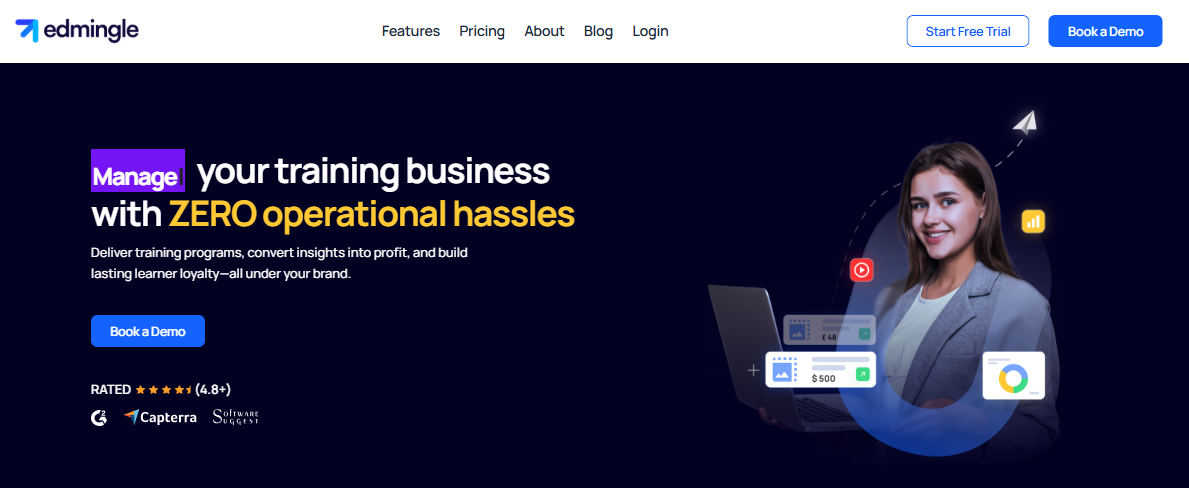
The 100% white-labeled website, landing pages, and mobile apps (Android and iOS) mean your learners interact with your brand throughout. The AI analytics cover learner engagement, course performance, and assessment results in a way designed for optimizing your training business, not just tracking internal employees. Getting live in under a week is a real claim based on what users report, not just marketing copy.
The sticking point: some users note a confusing onboarding flow for new students, which matters more when your learners are paying customers rather than employees you can nudge directly.
Key features:
- Fully white-labeled website, landing pages, and mobile apps (Android + iOS)
- AI-powered analytics on learner engagement, courses, and assessments
- SCORM support with DRM and watermarking for content security
- Deep Zoom integration with automated attendance tracking and recording
- Multi-tenant platform for managing multiple cohorts and branches
Pros:
- Launch-ready in under a week
- Built to scale for training businesses, not just internal teams
- Strong content security features for proprietary course material
Cons:
- Student onboarding flow can create early friction for new learners
Pricing: Starts at $109/month.
Capterra Rating: 4.5/5
9. Seismic Learning – Best for Sales Team Enablement
Seismic Learning (previously Lessonly) is purpose-built for one job: getting sales reps productive faster and keeping them sharp. It’s not trying to be a general corporate LMS, and that focus is the reason I’d recommend it for sales-heavy organizations and caution against it for everything else.
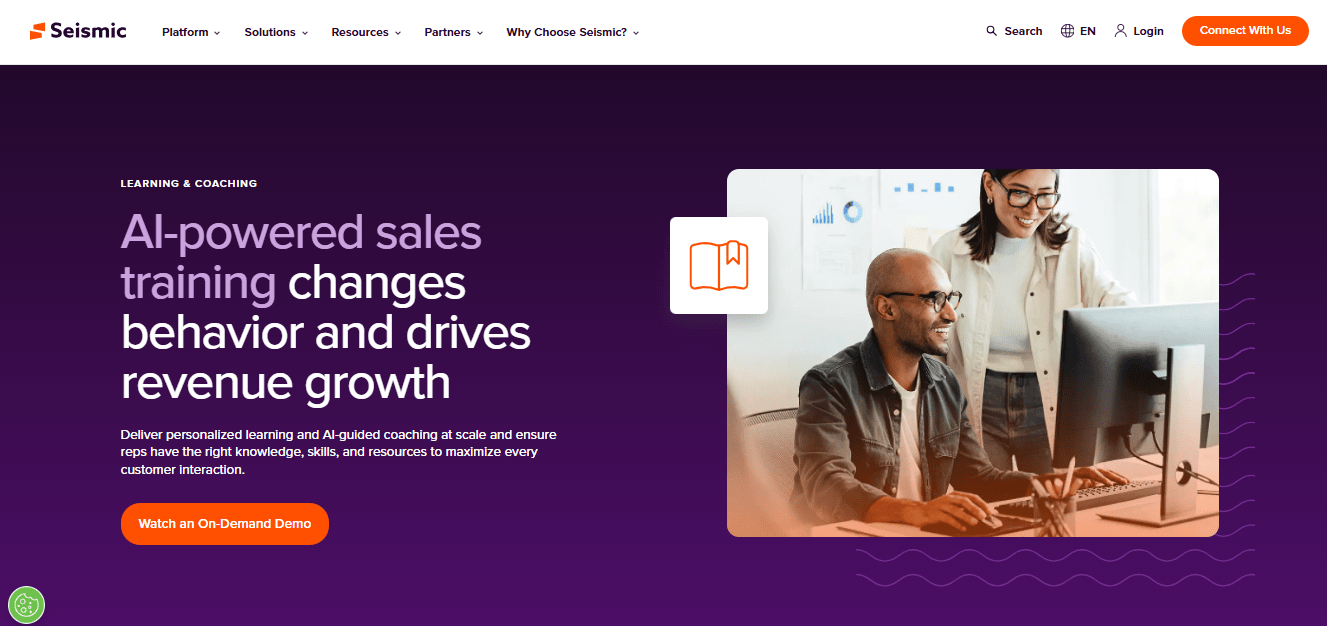
The AI personalizes training recommendations based on a rep’s role, experience level, and the deals they’re actively working on. That context-sensitivity is meaningful. A new SDR and a senior AE need different things, and Seismic actually reflects that. The Salesforce and Microsoft Dynamics integrations put training data where managers already spend their time.
Issues to know going in: content version control has caused problems when updating training mid-program (some learners end up in a confusing mixed state), and advanced quiz formats are less robust than a dedicated assessment platform.
Key features:
- AI-driven personalized learning paths based on role, experience, and active deals
- Practice scenarios and coaching tools with personalized feedback loops
- Training impact analytics tied to win rates and quota performance
- Salesforce and Microsoft Dynamics integration
- Blended learning across multiple delivery formats
Pros:
- Purpose-built for accelerated sales rep onboarding and continuous enablement
- Direct line of sight from training completion to sales performance data
- Scalable paths that adapt to different rep experience levels
Cons:
- Version control issues when updating training mid-program
- Advanced assessment formats are more limited than a specialized LMS
Pricing: Custom, based on user count, features, and deployment.
Capterra Rating: 4.6/5
10. Tovuti – Best for Community-Driven Learning and Development
Tovuti is the choice when you want your LMS to do more than assign and track courses. If building a culture of continuous learning is the actual goal, not just a talking point in your L&D strategy doc, Tovuti has the social infrastructure to support it: discussion forums, peer-to-peer assessments, virtual classrooms, and dedicated spaces for mentoring programs.
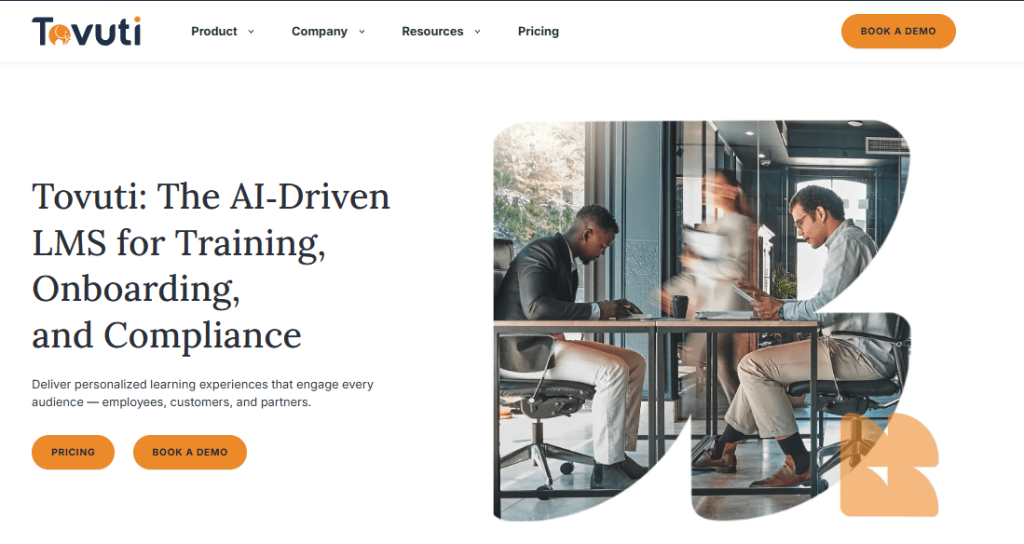
What I’d flag honestly: the backend is more complex than it looks in a demo. First-time admins consistently note a steeper configuration curve than they expected, and the white-labeling options feel limited for a platform that’s otherwise strong on learner experience.
Key features:
- Discussion forums, peer assessments, and virtual classrooms
- Learning paths with lesson gating and milestone-based progression
- Gamification: badges, leaderboards, and challenges
- SCORM/xAPI support and varied quiz question types
- Full event management: registrations, reminders, and waitlists
Pros:
- Strong community and social learning infrastructure
- Robust event management for instructor-led and virtual sessions
- Granular user group controls for permissions and reporting
Cons:
- Backend configuration is more complex than the demo suggests
- White-labeling options are narrower than expected at this tier
Pricing: Subscription-based, scales with learner count and features. eCommerce, custom branding, and advanced analytics are paid add-ons.
Capterra Rating: 4.8/5
11. 360Learning – Best for Collaborative and Peer-Led Learning
360Learning is built around a conviction I find genuinely compelling: the most valuable training in most organizations already lives inside the heads of your experienced employees. The platform is designed to capture and distribute that knowledge efficiently, rather than routing everything through a central L&D team that can’t possibly keep up with how fast the business moves.
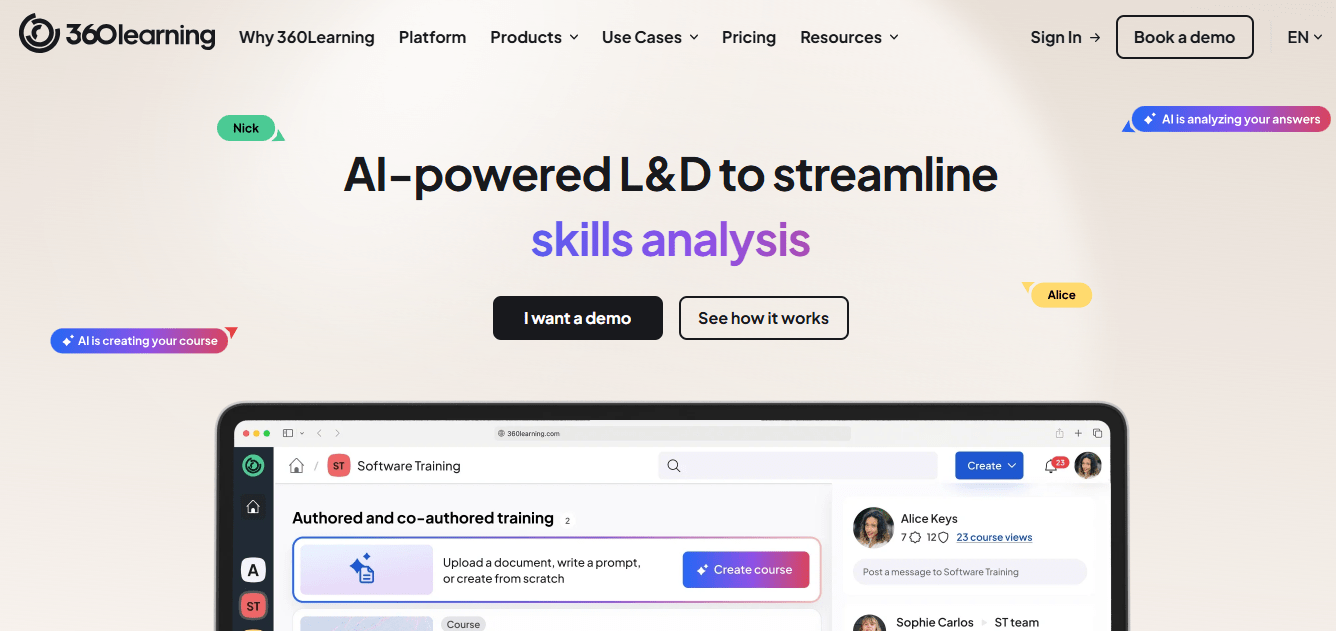
The mechanics: a sales rep discovers a new objection-handling technique, creates a short course, and the broader team has access to it by Friday. An operations manager documents a process that’s cutting ramp time in half, and it’s searchable and reusable within days.
I’d be clear about where this breaks down: it requires a workforce willing to create content, and enough organizational trust for peer-created material to be taken seriously. If your culture is more hierarchical or your employees are skeptical of training in general, the collaborative model is a harder sell.
Key features:
- Peer-created course authoring with collaborative content tools
- SCORM/xAPI support and lesson gating for structured paths
- Gamification and community engagement features
- Virtual classrooms with real-time interaction
- User groups for permissions, content management, and reporting
Pros:
- Turns institutional knowledge into distributable training at scale
- Strong community features for discussion and knowledge exchange
- Flexible user group controls for complex org structures
Cons:
- Steeper learning curve than simpler LMS platforms
- Admin workflows involve unnecessary extra steps
Pricing: Starts at $8/user/month (up to 100 learners).
Capterra Rating: 4.7/5
What Most LMS Guides Don’t Tell You
I’ve watched teams choose the wrong platform not because they picked a bad tool, but because they evaluated it against a clean demo scenario rather than their actual reality. Here’s what actually matters more than the feature list:
Notification behavior is make-or-break for adoption: Platforms that over-notify train employees to route alerts to spam, ignore them, or disable them entirely. Before you commit, specifically test how granular the notification controls are. This is one of the most common reasons early engagement collapses, yet almost no review articles mention it.
“Role-based course assignment” is not all equal: Most platforms support it. The quality of the logic varies enormously. Bring a real, slightly complex scenario to every demo: “This course is mandatory for warehouse employees, optional for office staff, and blocked entirely for contractors.” Watch how the admin handles it live.
The software is usually the cheapest part of the investment: Admin configuration time, content migration, L&D hours to keep courses current, and the productivity cost when adoption fails: these are where the real budget goes. Calculate cost per trained employee over 24 months, not cost per license seat.
Cloud-based vs. self-hosted LMS: the honest answer for most US teams: Every tool in this list is cloud-based, and for good reason. Cloud-based LMS platforms update automatically, scale without infrastructure investment, and work for remote and hybrid teams out of the box. Self-hosted options (like Moodle) give you maximum control and customization, but require significant IT resources to configure and maintain. Unless you have a specific security or data-residency requirement that a cloud vendor can’t meet, the cloud path wins on total cost of ownership for most organizations.
xAPI vs. SCORM: what you actually need to know: SCORM is the industry standard for uploading existing courses into your LMS and tracking completions. xAPI (also called Tin Can) goes further: it can track learning that happens outside the LMS, like on-the-job performance, mobile apps, or even physical training simulations. If your training is primarily course-based, SCORM is sufficient. If you want to connect learning data to real-world performance metrics, xAPI gives you that capability. Most modern platforms in this list support both.
How a Corporate LMS Helps Your Organization: What Actually Moves the Needle
According to LinkedIn’s 2025 Workplace Learning Report, 7 in 10 employees say that learning improves their sense of connection to their company. That number matters in a US labor market where the average cost to replace an employee ranges from $4,000 to $20,000, depending on role and seniority.
Here’s what a well-implemented corporate LMS actually delivers:
- Consistent onboarding: Every new hire gets the same quality experience, regardless of which manager onboards them or how stretched your team is that week.
- Compliance without manual chasing: Automated assignments, reminders, and certification tracking keep records current without someone personally following up on every renewal.
- Agile learning analytics that drive decisions: Real-time dashboards for completions, quiz performance, time-spent per module, and skills-gap identification give you something to report beyond a checkbox percentage.
- Upskilling at scale: Cloud-based LMS platforms support continuous upskilling across remote and hybrid workforces without the logistics or cost of in-person delivery.
- Training ROI you can measure: Cost-per-learner tracking, performance correlation, and custom reporting give finance and leadership the data to see training as an investment rather than an overhead line.
“Learning and development is no longer just an HR function — it’s a strategic driver of retention, performance, and competitive advantage. The organizations that treat their LMS as a talent tool, not a compliance tool, are the ones seeing measurable outcomes.” — Josh Bersin, HR Industry Analyst
How to Choose the Right Corporate LMS: A Practical Framework
Who should be in the evaluation: L&D and HR own training needs and compliance requirements. IT evaluates security, integrations, and technical fit. Department heads know their team’s actual training workflow. Finance models total cost of ownership. And at least two or three actual end-users need to test the learner experience on a real device before anyone signs anything. These perspectives catch things the others miss.
Step 1: Define the specific training problem.
“We need an LMS” doesn’t tell you which tool to buy. “We have 300 new hires per year who finish onboarding without understanding their OSHA obligations and we have no audit trail to prove training happened” does.
Step 2: Build your feature shortlist honestly.
For most corporate teams, the realistic must-have list is: SCORM/xAPI support, role-based access controls, automated reminders, completion tracking, mobile access, and integration with your HRIS. Everything else is evaluated against your actual use cases, not vendor feature sheets.
Step 3: Demo with a real scenario, not a clean one.
Bring your most complex compliance use case, your most dynamic user group, your messiest reporting requirement. If the demo falls apart on that, the platform will fall apart in production.
Step 4: Calculate 24-month total cost of ownership.
Include implementation time, content migration, admin training, ongoing maintenance, and internal L&D hours to keep content current. A higher monthly cost with better automation often wins this calculation over a cheaper platform with a steep setup curve.
Corporate-Specific Features Worth Holding Vendors Accountable To
| Feature | What to actually test |
|---|---|
| AI course creation | Run your actual training topic live in the demo, not a curated example |
| Compliance management | Ask: "Can I pull an audit-ready recertification report for the next 30 days?" |
| SCORM/xAPI support | Confirm which standard is native and whether xAPI tracking works outside the LMS |
| Agile learning analytics | Ask: "Can I see time-spent per module and identify low-scoring quiz questions?" |
| HRIS integration | Ask: "Is this native or middleware-dependent?" Native and Zapier are not the same |
| Notification controls | Test specifically: can learners control frequency? What happens to spam routing? |
| Mobile experience | Test on an actual phone, not a browser resize |
Corporate Training Wins: LMS Case Studies
Now that we are almost at the end of the blog, let’s examine some real-life examples of how learning management systems for corporate training have contributed to businesses’ success.
Here are some of the winning case studies that I found the most relevant –
1. Tupperware Brands: Simplifying Safety Training Across Borders
Tupperware, a global leader in household products, faced a significant challenge: how to provide consistent safety training to operators across multiple European plants.
The training was crucial for maintaining operational safety and compliance with ISO certification standards, yet managing it manually was prone to errors. They decided to use ProProfs Training Maker.
Using ProProfs, Tupperware created accessible online courses and assessments tailored to their safety requirements. The results were transformative. Not only did the company achieve consistent safety compliance across all locations, but it also streamlined the ISO certification process.
Looking for the full success story? Click here or watch this video below –
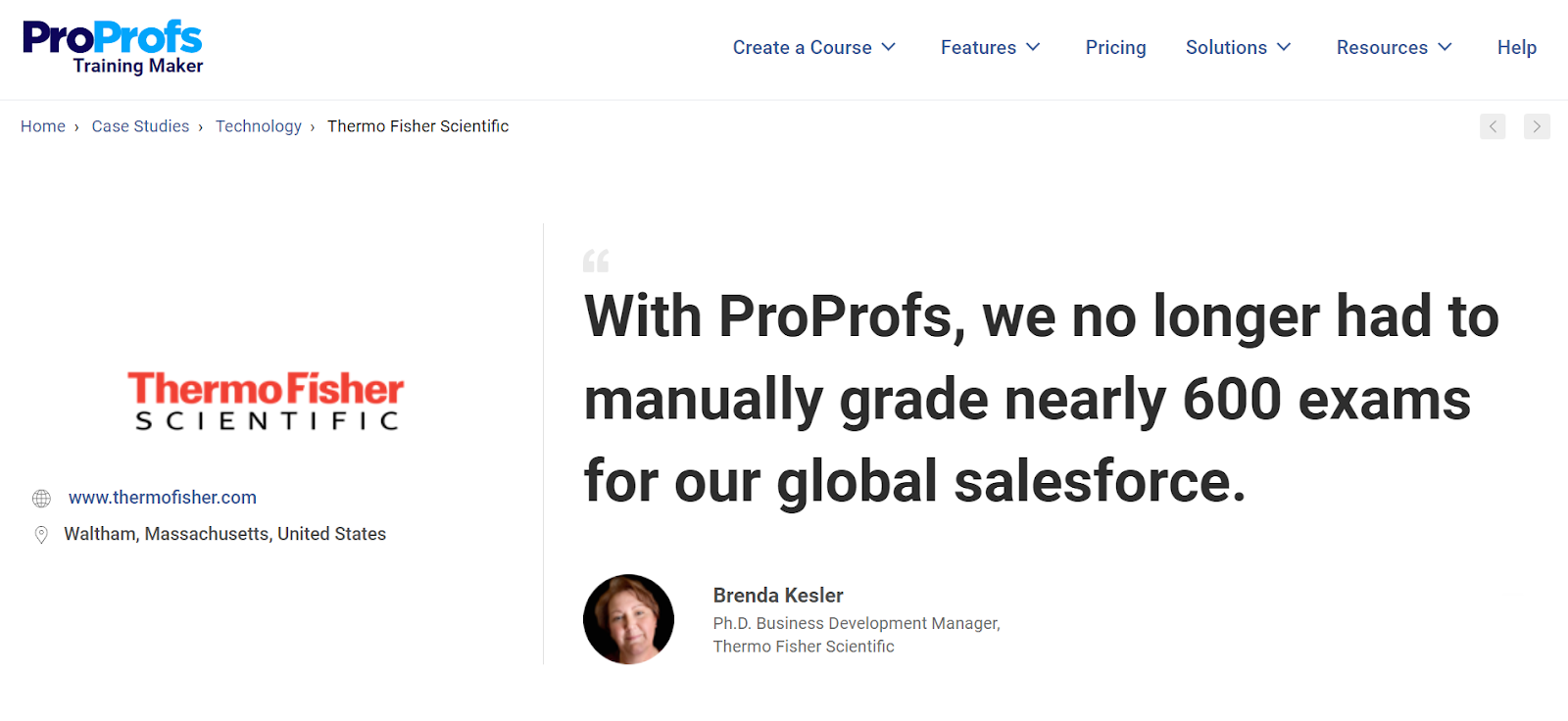
2. Thermo Fisher Scientific: Revolutionizing Global Assessments
When a multinational giant like Thermo Fisher Scientific needed to administer exams to a vast, globally dispersed workforce, the traditional methods weren’t cutting it.
Scheduling and executing tests for hundreds of employees across different time zones was a logistical nightmare. That’s when ProProfs Training Maker became their game-changer.
Using the LMS, Thermo Fisher transitioned to an online exam format that was both scalable and efficient.
The company could automate the process and deliver exams to employees worldwide. Beyond convenience, ProProfs offered detailed analytics, helping Thermo Fisher refine their questions and assess employee performance with unprecedented accuracy.
Which Corporate LMS Is Right for You?
Before you open five demo tabs, here’s a faster way to narrow it down:
| If your main challenge is... | Start with... |
|---|---|
| Launching training fast with compliance automation & minimal L&D resources | ProProfs Training Maker |
| Compliance automation that runs without manual intervention | Rippling |
| Large-scale, multi-geography enterprise training | Docebo |
| Getting sales reps productive faster | Seismic Learning |
| Capturing and distributing institutional knowledge | 360Learning |
| Delivering training as a product to external clients | Edmingle |
| Deep eLearning authoring capability | iSpring Learn + iSpring Suite |
| Validating hands-on skills alongside digital courses | Absorb LMS |
| Building community and mentoring programs | Tovuti |
The honest truth: no single platform wins every category. The best corporate learning management system for your organization is the one that fits your specific training problem, not the one with the most five-star logos on the homepage.
Start with a free trial or a focused demo on your hardest use case. You’ll know within one session whether it fits. And if you want to start somewhere today, ProProfs Training Maker has a forever-free plan that lets you build and launch your first course before you’ve committed to anything.
Frequently Asked Questions

How does a corporate LMS differ from a general LMS?
A general LMS is built for academic or self-directed learning. A corporate LMS is admin-driven and performance-linked: it handles mandatory training, compliance certification, role-based assignment, and integrates with HR and payroll systems. The reporting is designed for compliance audits and training ROI measurement, not academic progress tracking.
What are the benefits of using a corporate LMS for employee development?
The main benefits are consistent onboarding delivery, automated compliance tracking, measurable learning outcomes through agile learning analytics, significantly reduced cost compared to in-person training, and the ability to scale upskilling across large or distributed teams without increasing admin overhead proportionally. Organizations also see improved employee retention when learning and development programs are structured and accessible.
Is a corporate LMS worth it for small businesses?
Yes, though the calculus is different. Small businesses get the most value from platforms with free or low-cost entry points, fast setup, and ready-made course libraries, so they’re not spending L&D resources building content from scratch. Tools like ProProfs Training Maker offer a free plan specifically designed for this.
How do you choose the best corporate LMS for your organization?
Start with the specific training problem you’re solving (compliance, onboarding, skills development, sales enablement), define your must-have features, and test with real use cases rather than idealized demos. Calculate total cost of ownership across at least 24 months. Involve both admins and end-users in evaluation. The platform that handles your hardest scenario in a demo will handle it in production too.
What is the ROI of implementing a corporate LMS?
ROI comes from reduced in-person training costs, automated admin work, faster onboarding time-to-productivity, fewer compliance violations, and improved employee retention linked to learning investment. For organizations with high headcount or high turnover, admin time savings and retention impact alone typically justify the cost within the first year.
What’s the difference between SCORM and xAPI, and do I need both?
SCORM is the standard for uploading courses into your LMS and tracking completions. xAPI (Tin Can) goes further: it tracks learning that happens outside the LMS, including on-the-job performance and physical training. If your training is primarily course-based, SCORM is sufficient. If you want to connect learning data to real-world performance metrics, xAPI gives you that capability. Most modern platforms support both.
What’s the difference between cloud-based and self-hosted LMS platforms?
Cloud-based LMS platforms (like all 11 tools in this list) update automatically, require no IT infrastructure, and work for remote and hybrid teams out of the box. Self-hosted options like Moodle give maximum customization control but require significant IT resources to configure and maintain. For most US teams without dedicated technical resources, cloud-based wins on total cost of ownership unless you have specific data-residency or security requirements a cloud vendor can’t meet.
Let ProProfs AI create your training course

 We'd love your feedback!
What did you like & how can we make it even better?
 Thanks for your feedback!
 Ask Your Question
Have a question? Get expert help to make your decision easier.