

I’ve reviewed a lot of sexual harassment training courses over the years, and here’s what I’ve noticed: most HR teams aren’t struggling to find a course. They’re struggling to find one that’s actually compliant with their state’s requirements, doesn’t make employees roll their eyes, and gives them a clean audit trail when they need it.
This list covers the 12 best sexual harassment training courses available, including free state-mandated options and paid platforms worth the investment. I’ll tell you what each one does well, where it falls short, and who it’s actually built for.
This guide is for you if you are:
- An operations lead managing training across multiple sites or remote teams
- An HR manager who needs to select or overhaul a harassment training program
- A compliance officer navigating state-mandated requirements in CA, NY, CT, IL, or ME
- An L&D professional replacing passive, click-through content with something employees won’t resent
Also, check out the related guide that follows.
| Sexual Harassment Course | Top Features | Pricing |
|---|---|---|
| Sexual Harassment Training Courses by ProProfs Training Maker |
|
Forever free for small teams. Paid plan starts at $1.99/learner/month for large teams. |
| Individual & Organizational Training by SexualharassmentTraining.com |
|
Starts at $19.95/seat/course (minimum 5 seats to be booked) |
| Sexual Harassment Training for Employees in the Workplace by Udemy |
|
Paid versions start at $4.67/learner |
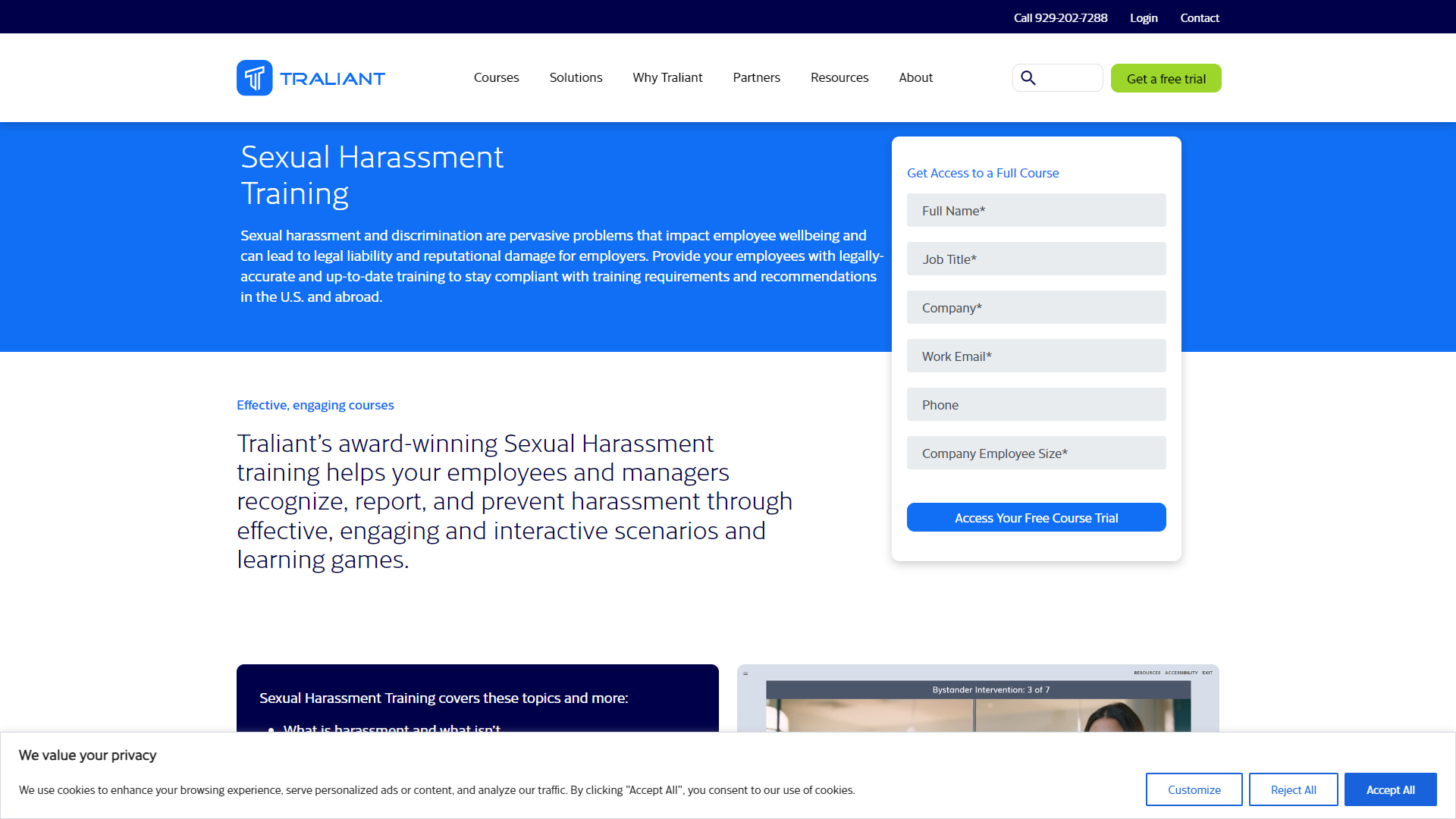
| Traliant’s Preventing Workplace Harassment Training |
|
Custom quote |
| Federal Sexual Harassment Training Requirements by EasyLlama |
|
Starts at $19.95 per training |
| Sexual Harassment Prevention Training by Compliance Training Group |
|
Starts at $19.99 (single-user e-learning enrollment) |
| Sexual Harassment Prevention Training by HIPAA Exams |
|
$14.95 to $34/user |
| NAVEX’s Workplace Harassment Training |
|
Custom quote |
| Harassment Prevention Training for Your Industry by Kantola |
|
Custom quote |
| Harassment Prevention Training by Ethena |
|
$20 to $50 per learner, annually |
| Inspired eLearning’s Anti-Harassment Training |
|
Custom quote |
| Positive Workplace: Preventing Workplace Harassment and Bullying by Clear Law Institute |
|
Custom quote |
What Is Sexual Harassment Training?
A sexual harassment training course is how that program gets delivered. It is the actual content your employees sit through: the scenarios, assessments, legal definitions, reporting procedures, and policy acknowledgments that together constitute documented compliance. The quality of that content determines whether training actually changes behavior or just generates a record that it happened.
Good courses go beyond the obvious. They cover the ambiguous situations that real complaints are built on, build a shared vocabulary for reporting, and give bystanders a clear role, not just victims and harassers. That is what separates a course that reduces incidents over time from one that produces a certificate and nothing else.
Watch: What Is Sexual Harassment Prevention Training?
Are Sexual Harassment Training Courses Legally Required in the U.S.?
Yes, and the answer is more complicated than most organizations realize.
Federal law, through the EEOC, does not mandate harassment training by statute. But courts have consistently treated the absence of training as evidence of negligence when incidents occur. That is your practical federal floor.
Several states have gone further with hard legal mandates:
| State | Who Must Be Trained | Frequency | Minimum Duration |
| California | All employees (1+ employees); supervisors on a separate track | Every 2 years | 1 hr (employees) / 2 hrs (supervisors) |
| New York State | All employees | Annually | No set minimum |
| New York City | All employees at companies with 15+ employees | Annually | 1 hour |
| Connecticut | All employees; supervisors on a separate track | Employees every 10 years; supervisors every 2 years | 2 hours (supervisors) |
| Illinois | All employees (1+ employees) | Annually | 1 hour |
| Maine | All employees | Annually | No set minimum |
If your workforce spans more than one state, you need a course built for location-based compliance, or a platform that assigns state-specific versions based on employee location.
Relying on a single generic course and expecting it to cover both California and New York requirements is how organizations end up non-compliant, even after completing the training.
The 12 Best Sexual Harassment Training Courses
I compiled this list based on hands-on experience in the training and eLearning industry, peer recommendations from HR professionals, and direct user feedback. Each program below has been evaluated against federal EEOC standards, state-specific mandates, content quality, delivery format, and how well it holds up when compliance documentation is actually needed.
Here is what made the cut.
1. Sexual Harassment Training Courses by ProProfs Training Maker
Best for: Organizations that need compliance-ready courses with strong customization and a built-in audit trail
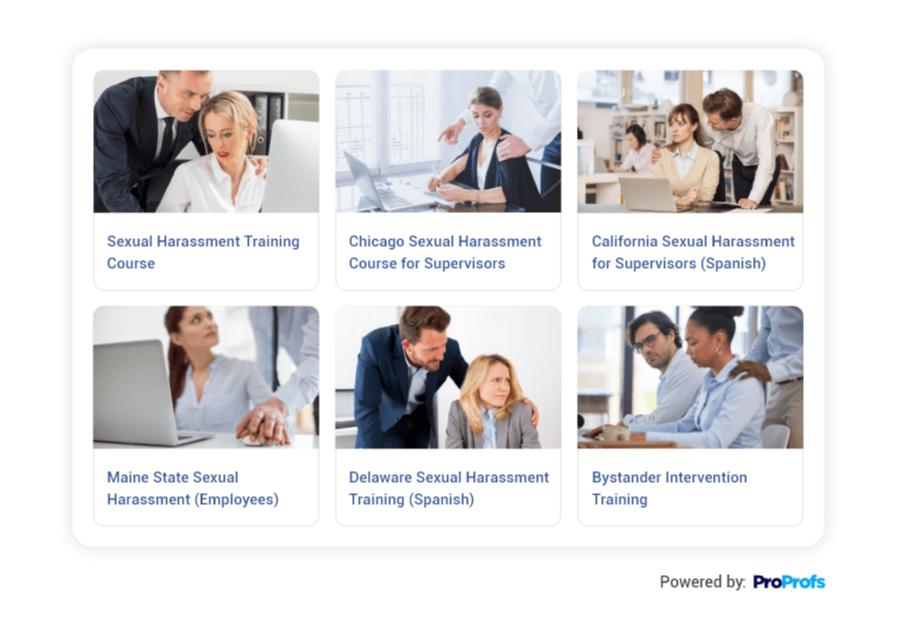
ProProfs Training Maker‘s sexual harassment prevention courses are the ones I point growing teams and enterprises to when they need something that works immediately but can also be shaped to fit their specific context.
The courses meet federal and state compliance requirements out of the box. More importantly, they are genuinely editable.
“Sexual harassment is a human rights violation and should never be tolerated.” – Tarana Burke, MeToo pioneer
You can insert your company’s actual harassment policy directly into the course. You can add location-specific scenarios, adjust content by employee type, and deliver in English or Spanish without paying extra.
The course structure includes workplace scenarios, handouts, flashcards, chapter feedback, and assessments that require real comprehension rather than just a click to advance.
Delivery runs through ProProfs’ cloud LMS, with self-enrollment, automated reminders, real-time completion dashboards, and automatically generated certificates.
Employees can train on any device, pause, and resume, which matters for shift workers and distributed teams.
What’s worth knowing:
- Separate employee and supervisor tracks
- Available in English and Spanish
- SCORM-compatible for integration with existing LMS platforms
- Real-time tracking, completion reports, and automated certification
Pros:
- Federal and state compliant out of the box
- Strong customization without requiring technical skill
- Affordable per-learner pricing with no minimums on the free plan
- Full audit trail for compliance documentation
Cons:
- No on-premise or downloadable deployment option
- No dark mode
Course duration: 1 to 2 hours, depending on the employee or supervisor track
Pricing: Free plan available for growing teams. Paid plans start at $1.99 per active learner/month
Case Study: How AppFolio delivered a compliance training program with complete flexibility & freedom
Promote a Respectful & Secure Work Environment
Train your employees with online harassment training courses.
2. Individual & Organizational Training by SexualharassmentTraining.com
Best for: Small teams or contractors who need fast, portable certification with minimal overhead
SexualHarassmentTraining.com (SHT) does one thing and does it cleanly. There is no platform to navigate, no account management complexity.
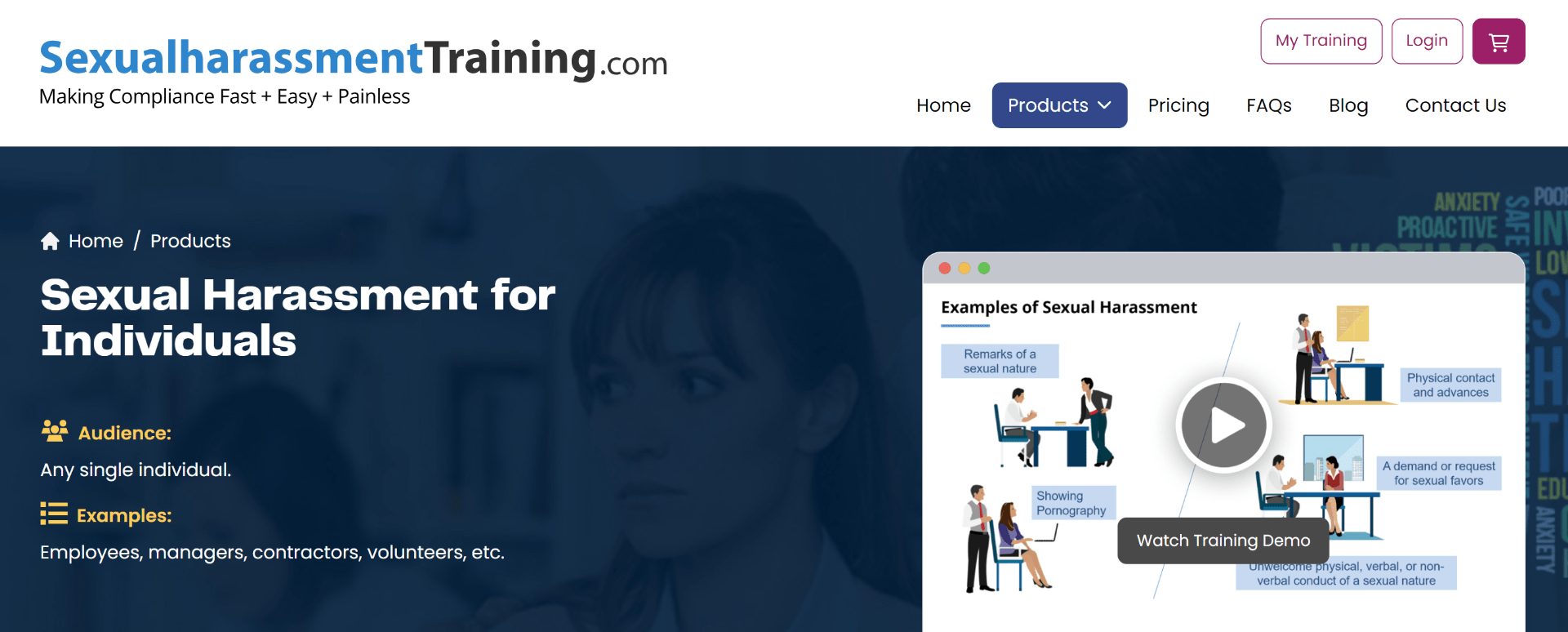
You purchase, train, and receive a nationally recognized certificate.
The zero-administration system handles registration and certification automatically, which eliminates the manual overhead that turns compliance into a day-long project for small HR teams.
The portable certificate model is something I genuinely appreciate.
Certificates remain with the individual, not the organization, making this a practical option for contractors, part-time staff, and industries with higher turnover, where traditional employer-held records can create gaps.
What’s worth knowing:
- Individual track (personal certification) and organizational track (team training) sold separately
- Spanish version included at no added cost
- Phone support in addition to email
- No contracts, minimums, or membership fees
Pros:
- Fast compliance process with minimal administrative overhead
- Portable certificates that follow the employee, not the employer
- Responsive support that includes actual phone access
Cons:
- Limited customization compared to platform-based solutions
- Fewer engagement features; primarily scenario and text-based
Course duration: 1 to 2 hours
Pricing: $14.99 to $29.99 per employee
3. Sexual Harassment Training for Employees in the Workplace by Udemy
Best for: Organizations that want flexibility across topics, formats, and price points
Udemy’s catalog includes over 200 courses related to workplace sexual harassment and discrimination.
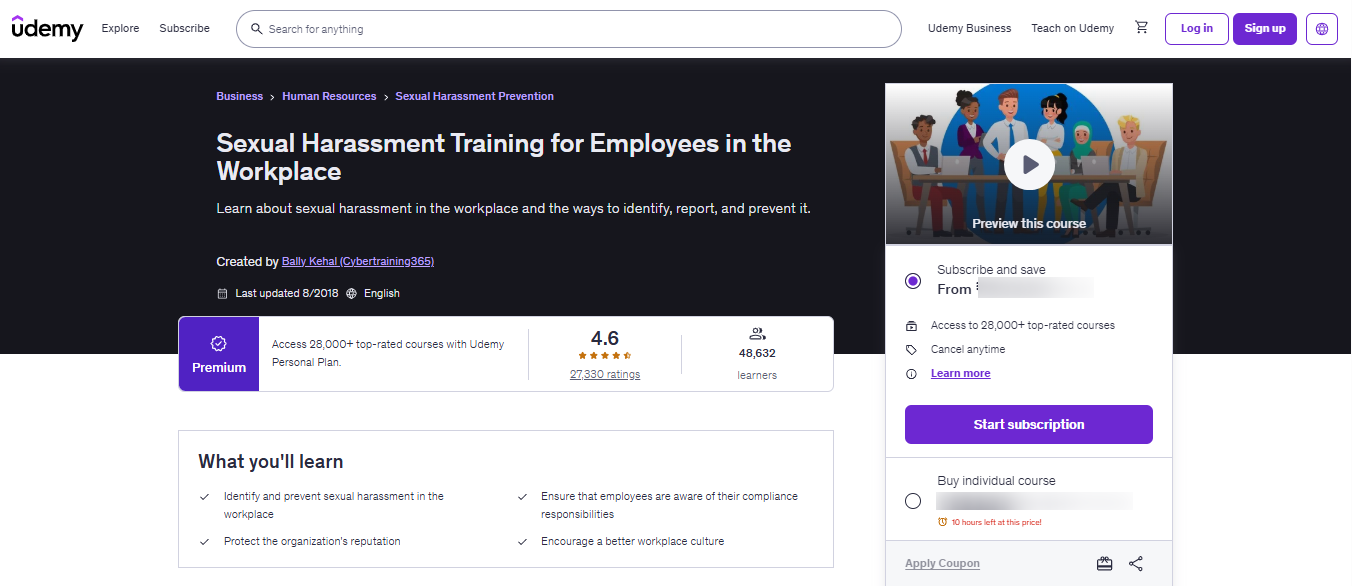
The depth of the library is its real advantage.
You can find free introductory options, paid deep dives, and courses tailored to specific industries or roles, all within a platform that many employees are already familiar with from other learning they have done independently.
I want to be honest about one limitation here: quality varies significantly across Udemy’s catalog. It is a marketplace, and not every course on workplace harassment is built to the same legal or instructional standard.
Before purchasing for organizational use, verify that the specific course explicitly covers your state’s requirements. Do not assume it does.
What’s worth knowing:
- 200+ harassment and discrimination-related courses
- Lifetime access after purchase
- Downloadable resources, mobile access, and TV access included
- 30-day money-back guarantee on paid courses
- Certificates on completion of paid courses
Pros:
- Wide selection at accessible price points, including free options
- Learners can revisit content at any time after purchase
- Content is updated regularly
Cons:
- No native organization-level tracking or completion reporting
- Compliance coverage varies by course and requires individual verification
- Not all courses meet state-specific mandates
Course duration: 34 minutes to 2 hours, depending on the course
Pricing: Free options available. Paid courses start at $4.67/learner
4. Traliant’s Preventing Workplace Harassment Training
Best for: High-turnover industries that need broadcast-quality content that employees actually engage with
Traliant was founded by former executives of leading compliance training companies, and its production quality reflects that background.
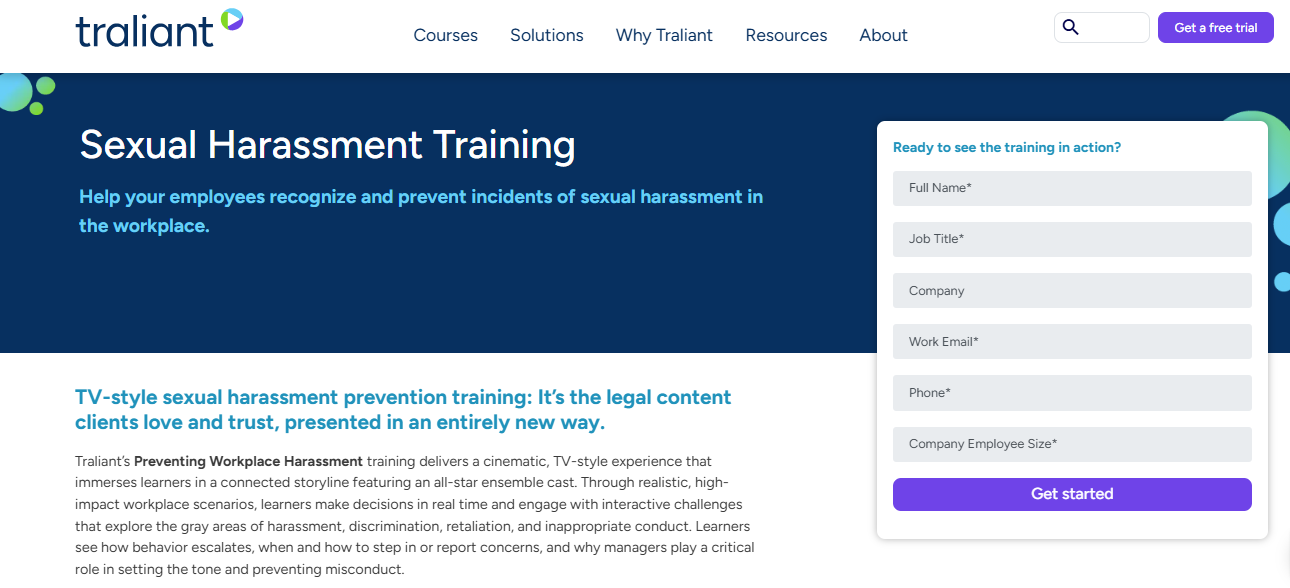
Their news-style format with real actors and actual storylines is a meaningful step above the narrated-diagram standard that still dominates compliance content. That is not a superficial distinction. Engagement drives retention. Retention is the whole point.
The bite-sized episode format is one of the more practical structural choices I’ve seen in this category.
Breaking content into episodes lets employees complete training in stages without losing progress or context, which addresses a legitimate complaint: that compliance training is a two-hour block that has to be swallowed whole.
What’s worth knowing:
- Bite-sized episode format with gamification and storytelling
- Industry-specific versions available: retail, healthcare, hospitality, financial services
- State-specific courses available
- Free full-course trial before purchase
- Fully customizable, including audio, video, company policy, and branding
Pros:
- High production quality that measurably improves completion and engagement
- Industry-specific versions reduce the “this has nothing to do with my job” reaction
- Founded by compliance training veterans; legal accuracy is solid
Cons:
- Pricing requires a custom quote; no published rate card
- Feature depth may exceed what small teams need or want to manage
Course duration: 20 minutes to 2 hours
Pricing: Custom quote
5. Federal Sexual Harassment Training Requirements by EasyLlama
Best for: Distributed, deskless, and multilingual workforces
EasyLlama is mobile-first in a way that most compliance platforms claim to be but fall short on.
The platform was designed for employees who do not sit at a desk: retail associates, hospitality workers, field staff, warehouse teams. The full course experience works on a phone, not just a desktop layout compressed into a smaller screen.
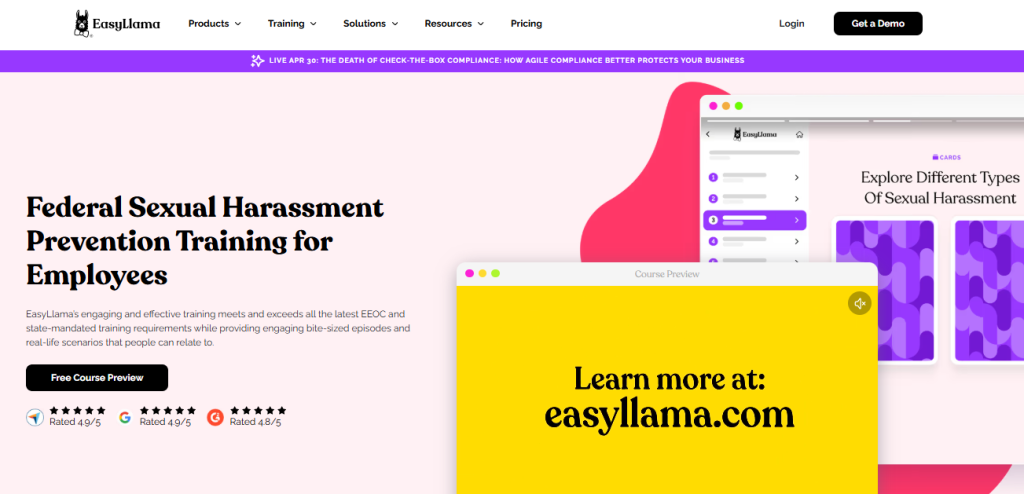
The multilingual range is also the strongest I have evaluated in this category, with support for over 100 languages.
For organizations with diverse workforces, that is not a minor feature. It is the difference between training reaching your entire workforce or creating a compliance gap in your non-English-speaking population.
What’s worth knowing:
- Available in 100+ languages
- Microlearning sessions of 5 to 10 minutes each; completable without disrupting a shift
- Covers harassment, discrimination, bullying, and retaliation in connected modules
- Real-time tracking and reporting
- Integrates with major HRIS and LMS platforms
Pros:
- Genuinely mobile-first experience, not a desktop course retrofitted for mobile
- Best language support in this category
- Content reflects the post-MeToo era rather than decade-old compliance scripts
Cons:
- 5-seat minimum purchase
- Per-course pricing adds up if you need multiple compliance modules
Course duration: 1 to 2 hoursPricing: Starts at $19.95/seat/course (5-seat minimum)
6. Sexual Harassment Prevention Training by Compliance Training Group
Best for: Organizations that need legal-grade content without long-term contracts or minimums
Compliance Training Group builds its courses with legal and HR training experts, and the curriculum shows that grounding.
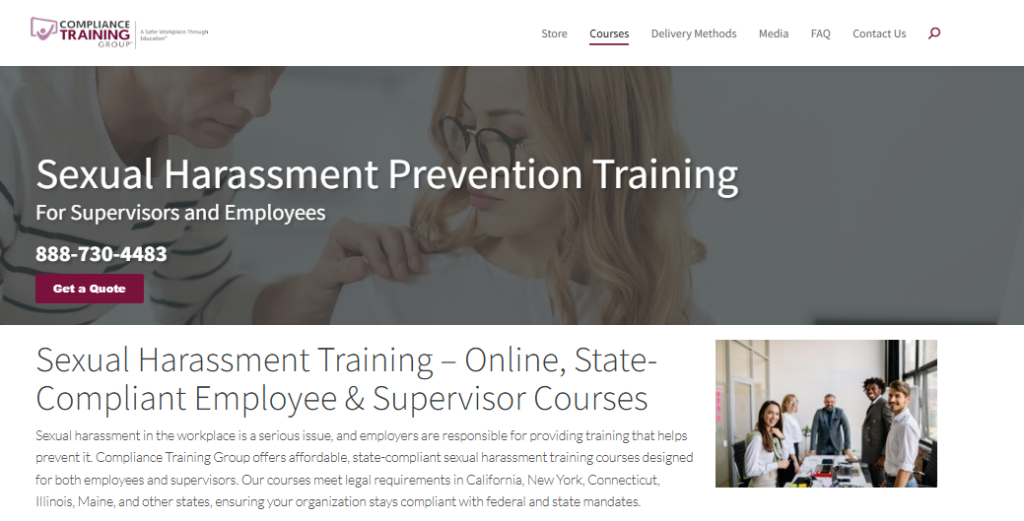
The content covers federal discrimination law and state-specific requirements in a way that is structured to reduce actual legal risk, not just produce documentation that training happened.
What I find genuinely useful here is the no-commitment purchasing model. No contracts, no minimums, no membership fees.
Single-seat enrollment is available at any time, which matters for situations outside your regular training cycle: a new hire mid-quarter, a contractor starting next week, a late addition to a compliance deadline.
What’s worth knowing:
- Nationwide and state-specific courses for employees and supervisors
- Single-seat purchase available at any time
- Clientele includes government agencies, law firms, and multinationals
- On-demand background check add-on available
Pros:
- Strong legal grounding in both federal and state content
- Genuinely flexible purchasing with no lock-in required
- Broad industry credibility across regulated sectors
Cons:
- Less interactive than newer platform-based options
- No dedicated mobile app
Course duration: 1 to 2 hoursPricing: Starts at $19.99 (single-user enrollment)
7. Sexual Harassment Prevention Training by HIPAA Exams
Best for: Healthcare organizations managing overlapping compliance requirements
HIPAA Exams is IACET-accredited, and that accreditation gives its certificates institutional weight that vendor-issued credentials do not.
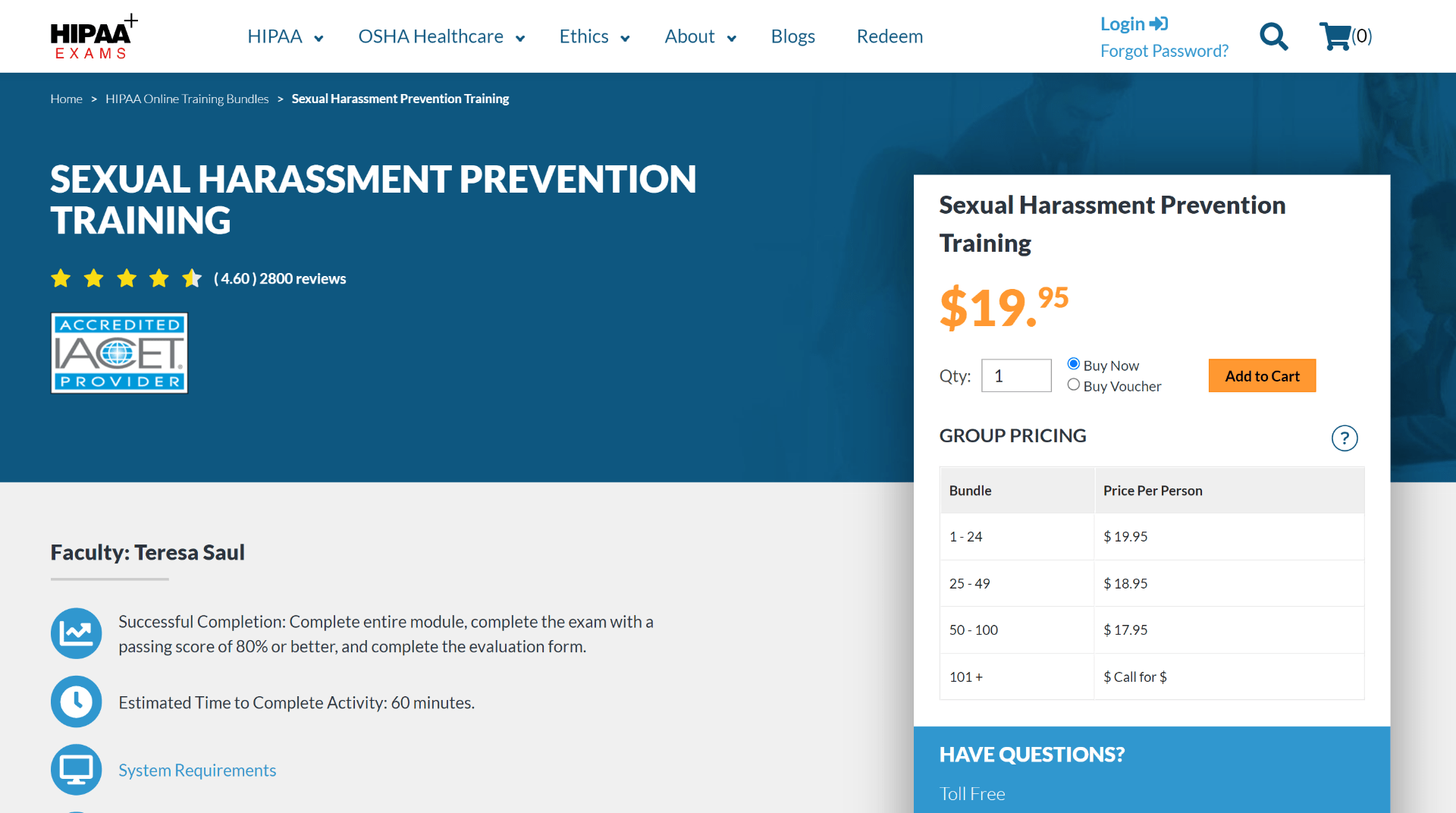
The platform primarily serves healthcare, workplace safety, and legislative compliance, and the sexual harassment course is built with that audience’s specific context in mind.
The yearly reminder system is one of the more quietly useful features on this list.
Instead of putting the burden on HR to track when training cycles are due, the platform prompts employees directly.
That automation removes one of the most consistent failure points in compliance programs: the training that was completed once and then simply forgotten until an audit surfaced the gap.
What’s worth knowing:
- IACET-accredited content
- Expert-led, self-paced delivery
- Yearly recertification reminder built in
- Live expert access via chat, email, and phone
Pros:
- Accredited credential carries more institutional weight for regulated industries
- Responsive support is included in the pricing, not an add-on
- Practical fit where HIPAA and harassment compliance requirements intersect
Cons:
- Not ideal for organization-wide learning beyond compliance training
- UX feels dated compared to newer training platforms
Course duration: 1 to 2 hours
Pricing: $14.95 to $34/user
8. NAVEX’s Workplace Harassment Training
Best for: Enterprise organizations with multi-jurisdictional GRC requirements
NAVEX has been the compliance training standard at large organizations for nearly 20 years. It is not purely a course vendor.
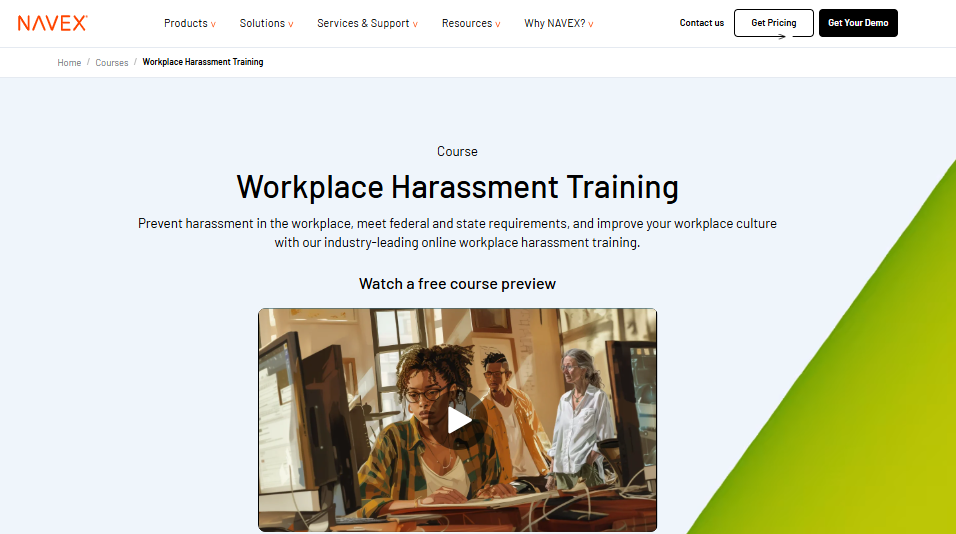
It is a governance, risk, and compliance (GRC) ecosystem that includes policy management, incident hotlines, and case management. The harassment training sits inside that broader infrastructure, which means it connects to how your organization actually handles incidents, not just trains people to avoid them.
The adaptive learning format is the feature that matters most at enterprise scale.
Employees with demonstrated knowledge are not forced through the same foundational content as someone encountering it for the first time. That directly addresses the repetition complaint without sacrificing documentation.
What’s worth knowing:
- Full-length, microlearning, and adaptive learning format options
- Culturally relevant content designed for diverse employee populations
- Aligned with current legislation across multiple jurisdictions
- Integrated hotline and case management tools included
Pros:
- Proven at enterprise scale across complex, multi-jurisdictional organizations
- Adaptive learning reduces unnecessary repetition for experienced employees
- A full compliance ecosystem means training connects to policy and incident management
Cons:
- Custom pricing with no transparency, without a sales conversation
- More infrastructure than most small-to-midsize teams need or want
Course duration: 1 to 2 hours
Pricing: Custom quote
9. Harassment Prevention Training by Kantola (now part of Traliant)
Best for: Organizations that want law-firm-backed content with SCORM flexibility
Kantola has over 30 years in the training industry and was acquired by Traliant.
Its partnership with Littler, the world’s largest labor and employment law firm, gives the curriculum a legal credibility that very few competitors can match.
Scenarios developed with Littler’s input reflect real-world case law, not a compliance writer’s interpretation of it.
SCORM and Tin Can compatibility means Kantola’s courses integrate directly into any existing LMS without friction.
You do not have to switch platforms or manage training in a parallel system to access the content quality.
What’s worth knowing:
- Legal content developed in partnership with Littler
- SCORM and Tin Can-compliant; integrates with any existing LMS
- Annually refreshed content
- Delivers in multiple languages across four eLearning formats
- Award-winning video scenarios with high production quality
Pros:
- Law firm partnership raises the bar on legal accuracy measurably
- Flexible delivery; bring your own LMS or use theirs
- Exceeds federal and state requirements across covered jurisdictions
Cons:
- Custom pricing with no published rate card
- Post-acquisition integration with Traliant may affect support consistency during transition
Course duration: 1 to 2 hours
Pricing: Custom quote
10. Harassment Prevention Training by Ethena
Best for: Tech-forward teams that want training, employees do not actively resent
Ethena has a 93% positivity score across more than 875,000 learner ratings. In a category where the standard employee response is quiet resentment and speed-clicking, that number means something.
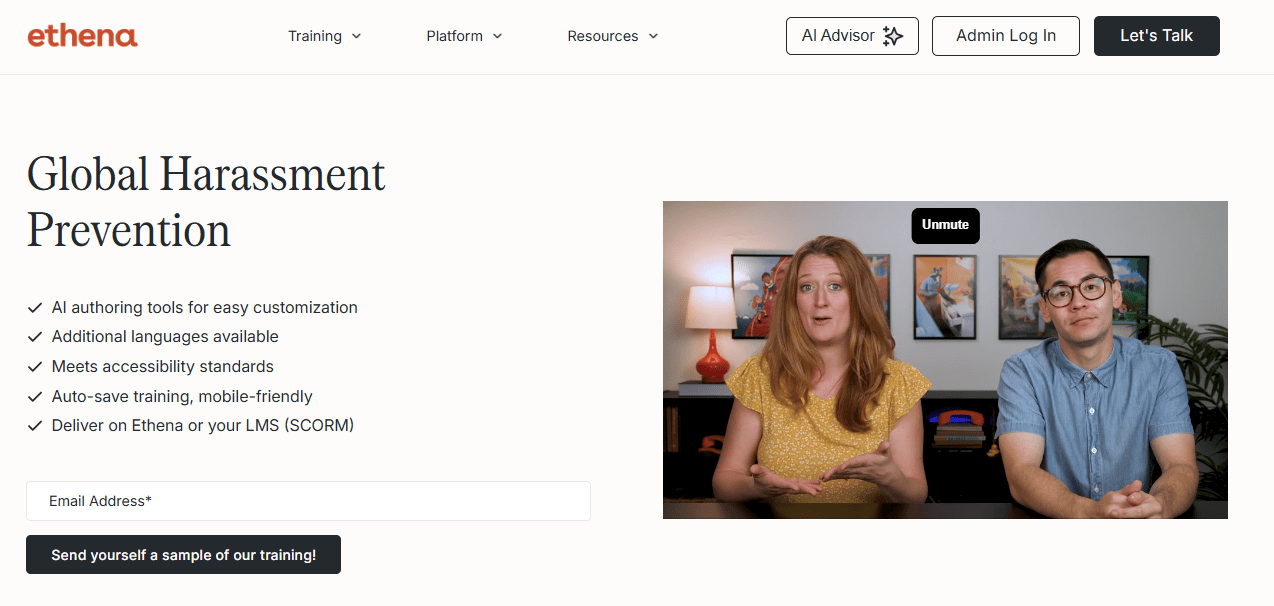
The platform delivers training that reads like it was written by someone who has actually worked in a modern office: current cultural references, inclusive tone, situations that do not feel like they were pulled from a 2009 compliance library.
The auto-administration feature is quietly one of the most practical things about Ethena. Annual training assignments go out automatically.
No HR manager manually exports a headcount list and chasing down completions. That is real administrative time saved, and over a year, it adds up.
What’s worth knowing:
- 93% positivity score from 875,000+ learner ratings
- Automatically administered on an annual cycle without manual intervention
- Hundreds of HRIS and LMS integrations
- Analytics dashboard with in-depth completion and engagement data
- Optional microlearning modules alongside full-length courses
Pros:
- Genuinely high learner satisfaction; reduces the click-through problem meaningfully
- Strong integration options that reduce administrative overhead
- Modern, relevant content that does not feel dated or performative
Cons:
- Higher price point than most alternatives on this list
- Annual pricing model may not suit one-time or ad hoc compliance needs
Course duration: 40 minutes to 3 hours
Pricing: $20 to $50/learner/year
11. Inspired eLearning’s Anti-Harassment Training
Best for: Government agencies and organizations with multilingual or globally distributed teams
Inspired eLearning backs its curriculum with Fisher Phillips, a prominent U.S. employment law firm.
That legal grounding shows in the content. Scenarios are built around how harassment actually unfolds in workplaces, not dramatized versions of it.
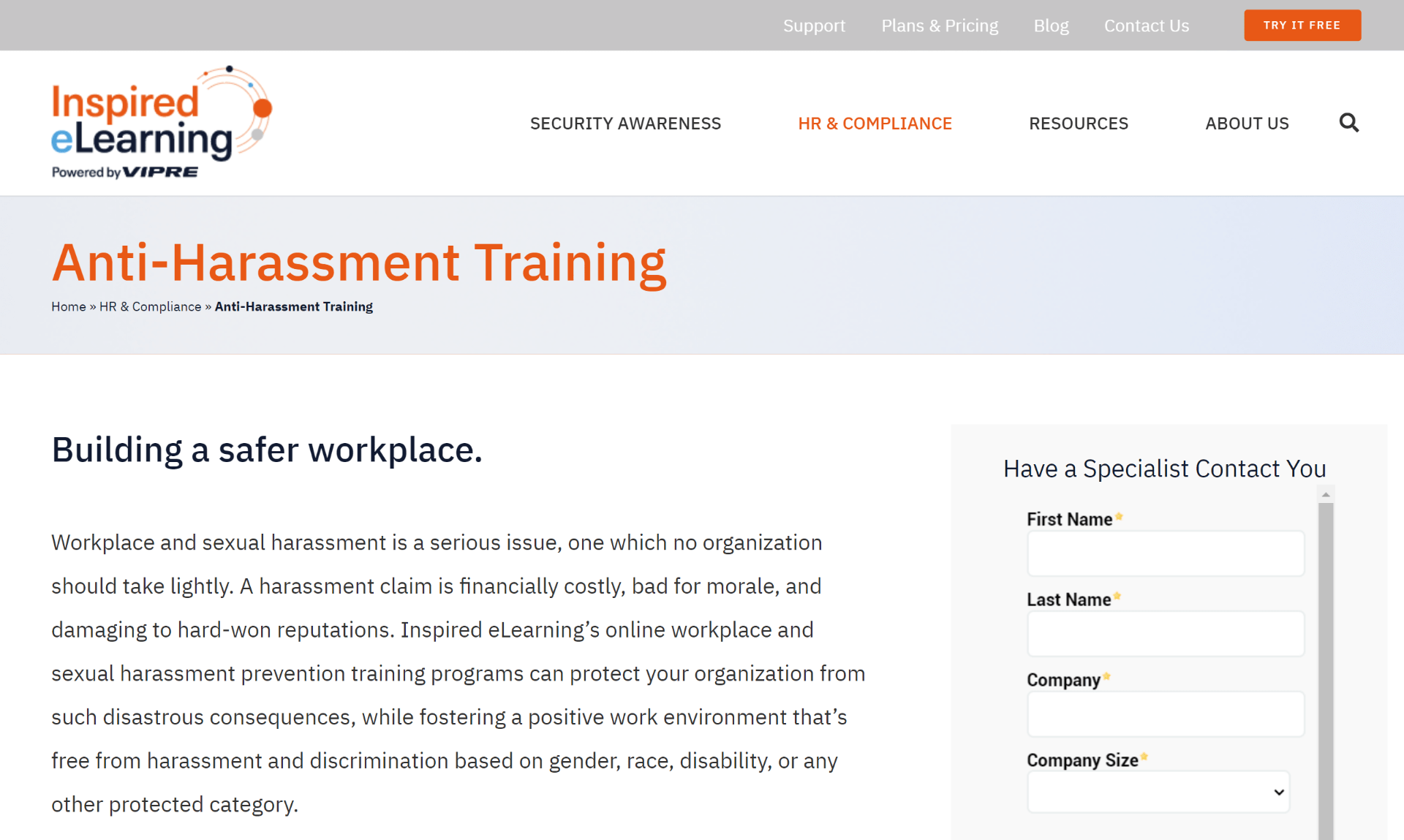
Text and voice translation in 10 or more languages, combined with final examinations that verify genuine comprehension rather than just completion, makes this one of the more complete options for organizations whose training obligations cross linguistic and geographic lines.
What’s worth knowing:
- Legal content backed by Fisher Phillips
- Text and voice translation in 10+ languages
- Developed by instructional designers with decades of field experience
- Final examinations included to verify comprehension
- Award-winning content designed for both government and private sector use
Pros:
- Law firm backing adds institutional credibility to certification
- Strong language support for multilingual or globally distributed teams
- Consistently responsive customer service
Cons:
- Custom pricing with no published rate card
- UX is less modern than newer entrants like Ethena or EasyLlama
Course duration: 1 to 2 hours
Pricing: Custom quote
12. Positive Workplace: Preventing Workplace Harassment and Bullying by Clear Law Institute
Best for: Organizations that need legal precision and depth on the gray areas employees actually face
Clear Law Institute is led by Michael W. Johnson, a former U.S. Department of Justice attorney. That background is visible throughout the curriculum.
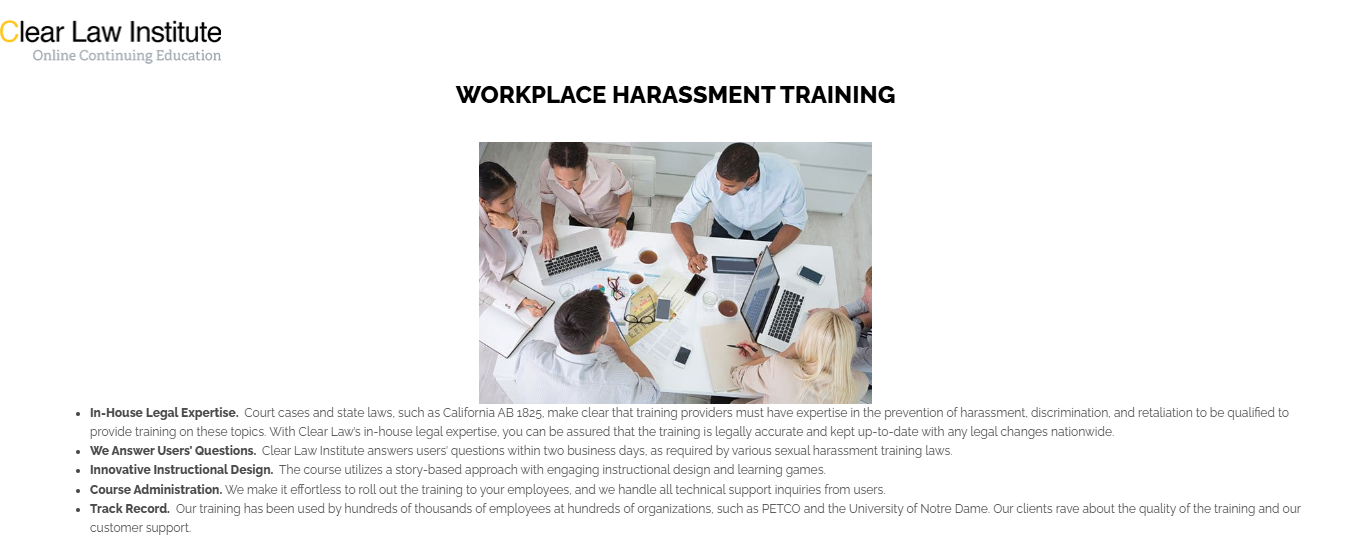
This is not a course that covers the obvious scenarios and stops. It covers the gray areas: ambiguous situations, protected characteristics in context, the cases employees encounter in real life where the right answer is not immediately obvious.
The Family Feud-style interactive learning games built into the course are unusual for compliance content, and they work.
Learners engage with protected characteristics and legal standards in a format that requires active thinking rather than passive watching. That distinction matters for retention.
What’s worth knowing:
- 50-state compliant curriculum
- Based on actual case law and real workplace scenarios
- Interactive games require active participation, not passive viewing
- Experts answer learner questions about course content at no extra cost
- Curriculum developed by a former DOJ attorney
Pros:
- Deepest legal content on this list; specifically designed for gray areas, not just clear violations
- Interactive format holds attention more effectively than standard compliance modules
- Excellent track record with regulated and government-adjacent industries
Cons:
- Custom pricing
- More formal in tone; may not fit casual or startup cultures
Course duration: 45 minutes to 2 hours
Pricing: Custom quote
How I Evaluated These Best Sexual Harassment Training Programs
I want to be upfront about what I looked for, because “compliant” is the lowest bar, not the whole evaluation.
Here is what actually went into this list:
- Legal compliance coverage: Does it explicitly meet EEOC standards and the mandates of high-requirement states, particularly CA, NY, CT, IL, and ME?
- Separate employee and supervisor tracks: Multiple states legally require different content, duration, and depth by role
- Scenario quality: Are situations drawn from how harassment actually unfolds in a real workplace, or are they dramatized edge cases?
- Tracking and certification: Does it generate audit-ready completion records and certificates?
- Engagement format: Microlearning, branched scenarios, and real assessments versus passive video with a quiz you can pass without watching
- Customization: Can you add your company’s policy, reporting procedures, and branding?
- LMS integration: SCORM compatibility for organizations with existing training infrastructure
- Accessibility: Mobile support, multi-language availability, support for deskless workers
- Trauma-informed design: Content warnings and alternative format options for sensitive scenarios
I also factored in what HR professionals and employees actually say. The most consistent complaint
I hear: employees are forced to watch the same video every year, cannot skip past content they already know cold, and walk away convinced the training exists to protect the company in a lawsuit, not to protect them.
The best programs on this list address that directly.
What Actually Separates a Good Online Sexual Harassment Training Course from a Compliance Checkbox
I want to be direct about something I see consistently. Completing training and doing training are not the same thing. If your employees are clicking through slides at 2x speed, skipping scenarios, and passing a five-question quiz they could answer cold, you have documented compliance. You have not done it.
Here is what separates courses that change behavior from those that just issue a certificate.
Do They Have Separate Tracks for Employees and Supervisors?
This is not optional in California and Connecticut. It is legally required. Supervisor-track courses must cover investigation responsibilities, third-party harassment, retaliation, and extended duration requirements.
Deploying a single course for both groups leaves your managers under-trained and your organization exposed in the states where it matters most.
Watch: How to Handle Sexual Harassment as a Supervisor in New York
Do They Use Real Scenarios or Dramatized Edge Cases?
The most consistent complaint I hear from employees is that harassment training scenarios feel nothing like their actual workplace.
Courses built around extreme, obvious misconduct do not teach employees to recognize the ambiguous situations that real complaints are built on. Look for courses that use realistic, grounded scenarios with branched decision points, not theatrical extremes.
Do They Address Bystander Responsibility?
Most older compliance courses are structured around two actors: a harasser and a victim. The more effective approach treats the entire workplace as responsible.
Bystander intervention training teaches employees what to do when they witness something, not just when something happens to them directly. That shift in framing is one of the most meaningful differences between courses built to prevent incidents and courses built to document that prevention was attempted.
Can You Use a Pre-Test for Experienced Employees?
Forcing a veteran employee through two hours of content they can pass cold before watching a single video is one of the fastest ways to destroy training credibility in your organization. A rigorous pre-test solves this. If someone demonstrates sufficient knowledge at the start, they complete a shorter refresher track rather than the full course. That is not lowering the standard. It is respecting demonstrated knowledge while maintaining the documentation trail.
Is the Content Trauma-Informed?
For employees who have experienced harassment personally, graphic scenario reenactments without content warnings can cause real harm and be counterproductive to the culture you are trying to build. The better programs offer content warnings before sensitive scenarios, alternative format options (text description versus dramatized video), and choose-your-path modules. This is not a fringe consideration. It is how you build a training program that respects the people sitting through it.
How to Prepare for a Sexual Harassment Compliance Audit
At some point, you will need to prove your training program actually happened, not just that you purchased a course. Here is what auditors look for and what you need to have ready.
What auditors typically examine:
- Individual completion records showing employee name, completion date, course title, and score
- Certificates of completion stored per employee, not just emailed and archived nowhere
- Evidence that supervisor and employee tracks were assigned correctly by role
- Training records confirming compliance with state-specific frequency requirements (annual in NY and IL; biennial in CA and CT)
- Documentation showing new hires were trained within the legally required window (some states specify 30 to 90 days from start date)
The most common audit failure points I see:
- Completion tracked only by email confirmation, with no centralized record
- One generic course delivered to both employees and supervisors in states requiring differentiated content
- Training records lost during an HR system migration or staff transition
- No documentation of when contractors or temporary workers received training
- Certificates are not renewed on the required cycle
Before an audit comes, take these steps:
- Pull a completion report directly from your LMS or training platform, not from a spreadsheet you have been maintaining manually
- Cross-reference that report against your current headcount, including part-time and remote employees
- Identify any role-based compliance gaps, particularly for supervisors who received employee-track content
- Confirm state-specific timing requirements for every jurisdiction where you have employees
- Archive all certificates in a location that survives turnover in your HR team
The organizations that fail compliance audits on harassment training almost never fail to do the training. They failed to document it in a way that holds up to scrutiny.
Free Online Sexual Harassment Training Resources Worth Knowing
Not every organization needs a premium vendor. Here are the free options that have legitimate legal standing.
California Civil Rights Department (CRD)
Free, state-compliant sexual harassment prevention training available at calcivilrights.ca.gov/shpt. Meets California’s AB 1825 and SB 1343 requirements for both employees and supervisors. It is free, it is the state’s own content, and no vendor can dispute its compliance standing.
NYC Commission on Human Rights
Free training resources for New York City employers are available directly through the Commission. Meets the NYC mandatory annual training requirement for organizations with 15 or more employees.
EEOC Training Institute
The EEOC’s “Leading for Respect” and “Respect in the Workplace” programs are federally produced and grounded in EEOC enforcement standards. These are not mandatory compliance substitutes in most states, but they are valuable supplementary content, particularly for supervisor development and reinforcing the federal legal framework.
One honest note: HR professionals who have used free state training consistently describe it as dry. It satisfies the legal requirement. It will not win a 93% positivity score from your employees, and it will not shift culture on its own.
Many organizations use free state resources as the legal floor for their lowest-risk population, and layer a paid course on top for supervisor training, new-hire onboarding, and anyone in a high-stakes client-facing or management role.
Your Pre-Deployment Compliance Checklist
Before you roll out any sexual harassment training course organization-wide, confirm the following:
- Course meets EEOC federal standards explicitly
- Coverage verified for every state where employees are based
- Separate supervisor and employee tracks assigned correctly by role
- Training time counted as compensable hours (legally required for all mandatory training)
- Completion tracking and certificate generation confirmed in your platform
- New hire training window documented per state requirement
- Certificates and records stored in an audit-ready, centralized location
- Annual or biennial reminder scheduled per state frequency requirements
- Contractor and temporary worker training documented separately
- Reporting procedure communicated alongside the course, not just within it
The Certificate Is the Beginning, Not the End
A completion certificate is proof that training took place. There is no proof that anything changed.
The organizations that get this right pair training with a reporting channel employees actually trust, build bystander responsibility into the content, and track outcomes over time, not just completion rates. The course is the foundation. What you do with it determines whether your workplace is actually safer.
If you need a platform to deliver, track, and certify sexual harassment training with state-compliant content already built in, ProProfs Training Maker is worth a look. Free plan for small teams, paid plans that scale without enterprise pricing complexity.
Pick something built for your state and your workforce. Use it consistently.
Frequently Asked Questions

Are sexual harassment training courses legally required in the U.S.?
Federal law does not mandate it by statute, but courts treat its absence as evidence of employer negligence. California, New York, Connecticut, Illinois, and Maine have explicit state mandates with defined frequency and duration requirements.
How long does a sexual harassment training course need to be?
It depends on your state and the employee's role. California requires 1 hour for employees and 2 hours for supervisors, every 2 years. New York requires annual training with no minimum duration. Connecticut requires 2 hours for supervisors every 2 years. Always verify per state.
What should a sexual harassment training course include?
At minimum: legal definitions, types of harassment, realistic workplace scenarios, reporting procedures, bystander intervention content, applicable state and federal law, and a final assessment. Supervisor courses must also cover investigation responsibilities and retaliation prevention.
Which online sexual harassment training programs are state-compliant?
ProProfs Training Maker, Traliant, EasyLlama, Kantola, Clear Law Institute, and Inspired eLearning all cover state-specific requirements. Confirm coverage for your specific states before purchasing, particularly for California, New York, and Connecticut. For California and New York specifically, ProProfs Training Maker and Traliant are strong starting points because both provide state-specific employee and supervisor training tracks without requiring custom course development.
Do employees have to be paid for sexual harassment training time?
Yes. Mandatory training is compensable work time under federal law and most state wage laws. Employees must be paid for those hours regardless of where or when they complete the course.
How often does sexual harassment training need to be repeated?
New York, Illinois, and Maine require annual training. California requires training every two years. Connecticut requires supervisors to retrain every two years. Annual refreshers are best practice even where not legally mandated.
Can I use the same course for employees and supervisors?
Not in states that legally distinguish the two. California and Connecticut require extended, supervisor-specific content covering investigation obligations, third-party harassment, and retaliation. Using one course for both groups is a compliance gap in those jurisdictions.

Let ProProfs AI create your training course

 We'd love your feedback!
What did you like & how can we make it even better?
 Thanks for your feedback!
 Ask Your Question
Have a question? Get expert help to make your decision easier.