The most fragile part of many Cornerstone setups is not the software but the one admin who understands it. That is a quiet reason behind searches for Cornerstone alternatives: a routine report that takes weeks, a configuration change that turns into a services project, and a renewal quote that lands just as that person gives notice.
Cornerstone still earns its place for deep multi-jurisdiction compliance, global scale, and teams that actively use the full talent suite. But if you license a suite and mostly use Learning, or you need results in weeks, not months, I would weigh the alternatives to Cornerstone below in terms of admin effort and total cost before the next renewal.
Each trades something away, and I say what. I would pilot one live compliance course on two of them and count the admin hours and the launch days.
Top 10+ Cornerstone Alternatives Compared
Admin effort, cost, and speed are three distinct complaints, and no platform removes all three equally well. That is why the best Cornerstone alternatives for a lean training team look nothing like the best pick for a global enterprise with a dedicated admin group.
Most Cornerstone competitors are lighter on talent-suite depth, so here is the fast version: Capterra ratings, current pricing, and the two columns that map to the loudest complaints: how visible the pricing is and how much admin effort each platform takes.
| Tool | Best For | Capterra | Pricing | Pricing Visibility | Admin Effort |
|---|---|---|---|---|---|
| ProProfs Training Maker | Easy training, compliance, assessment | 4.8 | Free (10 learners); paid from $1.99/learner/mo | Published, with a free plan | Low; trainers run it without a specialist |
| Absorb LMS | Complex training needs | 4.5 | Custom quote (~$800/mo cited) | Quote only | Moderate; setup can challenge beginners |
| Docebo | Complex enterprise training | 4.4 | Custom quote (~$25K+/yr) | Quote only | Moderate to high |
| TalentLMS | Custom employee training | 4.7 | Free plan; $149–$579/mo | Published, with a free plan | Low to moderate |
| Blackboard Learn | Community-based learning | 4.1 | Quote-based (~$9.5K/yr cited) | Quote only | Moderate to high |
| 360Learning | Collaborative learning | 4.7 | From ~$8/user/mo | Published starting rate | Low to moderate |
| Moodle | Open-source learning | 4.3 | Free (self-hosted); hosting varies | Free software | High; technical staff needed |
| Lessonly by Seismic | Training sales teams | n/a | Quote-based (limited free tier cited) | Quote only | Low; streamlined interface |
| LearnUpon | Delivering impactful training | 4.7 | Custom quote (~$599/mo cited) | Quote only | Low to moderate |
| Litmos | External training | 4.2 | Quote-based (~$3–$6/user cited) | Quote only | Moderate |
| Tovuti LMS | Learner engagement | n/a | Quote-based (~$775/mo cited) | Quote only | Low to moderate |
| Bridge LMS | Upskilling and reskilling | 4.4 | Quote-based (~$4/user/mo cited) | Quote only | Low; simple interface |
1. ProProfs Training Maker – Best for Easy Course Creation for Employee Training, Compliance & Skill Assessment
ProProfs Training Maker is where I would look if you are weighing alternatives to Cornerstone because the platform needs a specialist to run it. A trainer can build, assign, and report on a course without a service ticket, and pricing is published per learner, with a free plan to pilot first.
Say you need a forklift safety refresher for three warehouses by month end: describe it to the AI course creator, and it drafts the lessons and quiz questions, which you edit and assign the same day.

Let ProProfs AI create your training course
If the topic is standard, 500+ expert-built courses cover OSHA safety, harassment prevention, and leadership basics. Reports flag where learners fall behind, certificates mark a pass, and courses run in 70+ languages.
It is not a full talent suite, so recruiting, performance, and succession are out of scope. Among Cornerstone LMS alternatives designed solely for training, it is the one I would pilot first.
Pros:
- Drafts lessons and quiz questions from a plain description with the AI course creator
- Gives you 500+ expert-built courses on safety, harassment prevention, and leadership to assign or edit
- Lets trainers build, assign, and report on courses without an LMS specialist or a service ticket
- Supports diverse learners with WCAG 2.1 Level AA accessibility, AI-generated audio narration, and 70+ languages
- Fits your HR stack with SSO and SCORM and Tin Can support, plus Salesforce and Zoom integrations
Cons:
- No on-premises option, since the platform is cloud-only
- Dark mode is not offered for the learner interface yet
Pricing: Free for up to 10 learners; paid plans start at $1.99 per learner per month.
2. Absorb LMS – Best for Complex Training Needs
Absorb is a strong fit for organizations that want to simplify training without losing depth. The interface is easy to navigate for both admins and learners, and it supports varied content formats, including text, images, video, and interactive quizzes, which helps keep learners engaged across different learning styles.
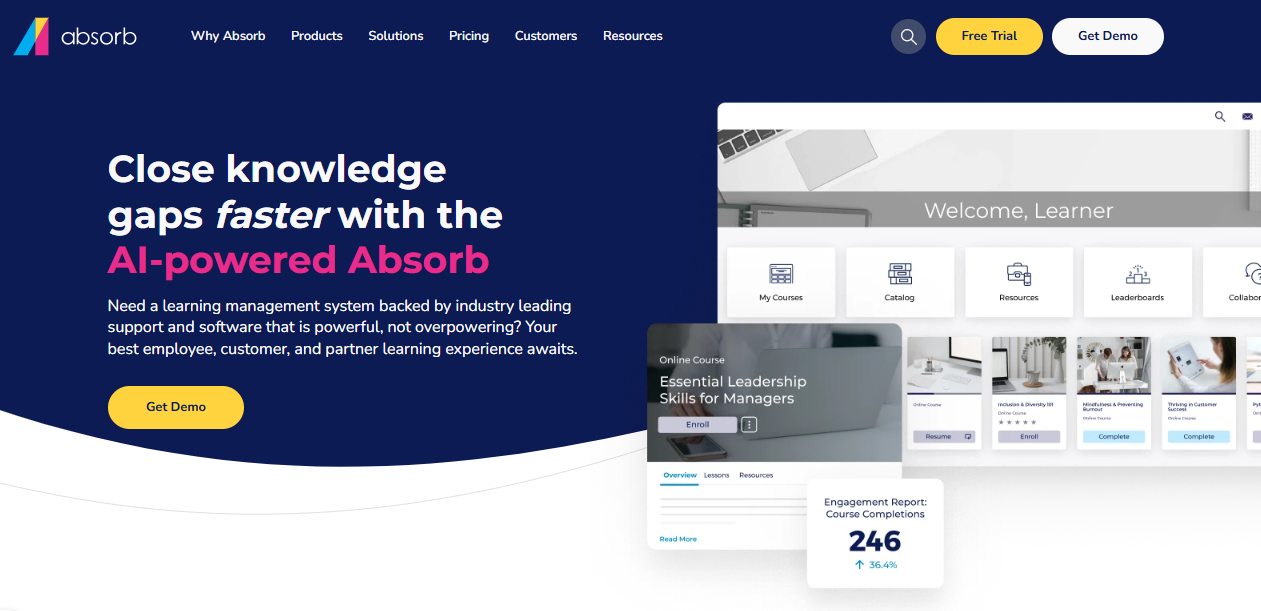
AI-powered features enable learning on the go and personalized learning paths, and integrated content libraries and other tools enrich the experience. From employee onboarding to compliance training, it adapts to different needs. Mobile-friendly design lets learners reach materials on any device.
Beginners can find setup and navigation challenging at first, and reports are awkward to download for multiple courses and people at once. There is also no way to assign courses automatically by hire date or to schedule assignments. Older listings cite roughly $800 a month. I would pick it for a larger team that needs depth and can invest in setup.
Pros:
- AI-powered personalized learning paths and adaptive content
- Mobile-friendly design for learning on any device
- Customization options for branding and training needs
- Robust reporting tools and analytics on learner progress
- Content libraries and tools that integrate smoothly
Cons:
- Setup and navigation can challenge beginners
- No automatic assignment by hire date and no assignment scheduling
Pricing: Custom quote; older listings cite roughly $800 per month.
3. Docebo – Best for Complex Enterprise Training
Docebo is the closest match to Cornerstone’s enterprise scale. As an AI-powered LMS designed for enterprises, it pairs a sharp design with strong functionality and scalability, and its AI-driven features, including virtual coaching, content suggestions, and auto-tagging, take administrative work off your team.
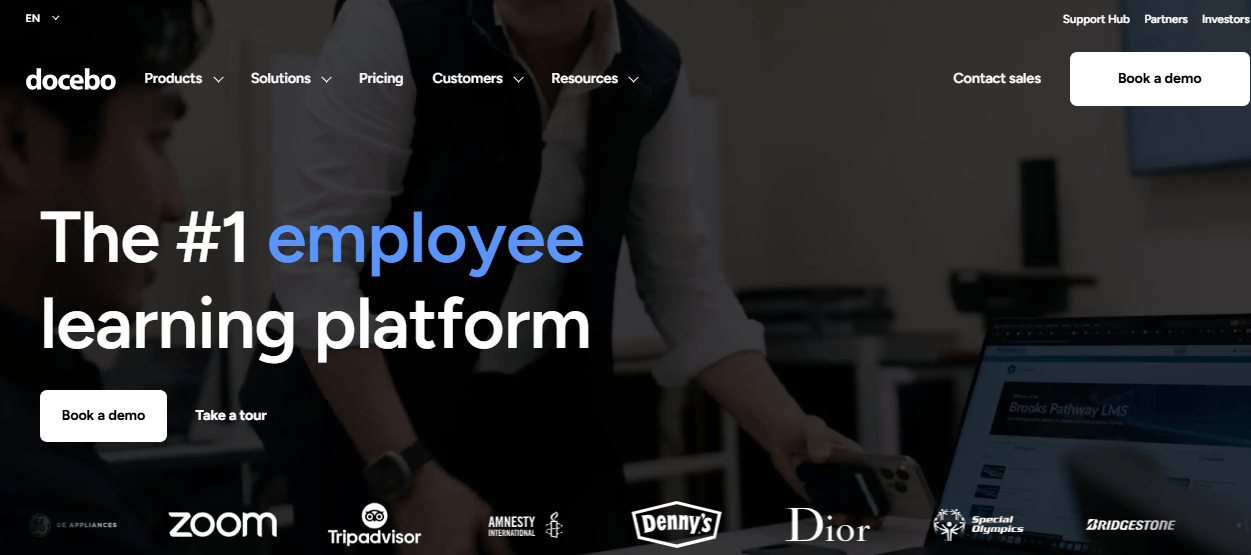
It fosters a learning culture through social learning and a mobile app, Go.Learn, which supports blended learning on the move. More than 400 integrations offer a no-code way to connect your SaaS business systems. Learners can be assigned to learning paths automatically, and branding can be personalized.
Reporting could give a fuller view of learner progress, branding customization could go further, and some teams want more integrations. Pricing is quote-based, with older listings citing about $25,000 a year. I would choose it for an enterprise that wants modern AI features but not the Cornerstone suite, and I would ask for a pilot with one program.
Pros:
- AI-driven virtual coaching, content suggestions, and auto-tagging
- 400+ integrations with a no-code approach
- Automatic assignment of learners to learning paths
- Social learning and a mobile app for blended learning
- Clean, intuitive interface for a platform of this scale
Cons:
- Reporting could provide a fuller view of learner progress
- Pricing sits at the high end of the market
Pricing: Custom quote; older listings cite about $25,000 per year.
4. TalentLMS – Best for Custom Employee Training
TalentLMS makes course building simple with drag-and-drop, so you can add videos, presentations, and documents, and it can pull content from different sources, which gives you more design flexibility. Detailed learning paths and completion rules keep learners on track and focused on development.
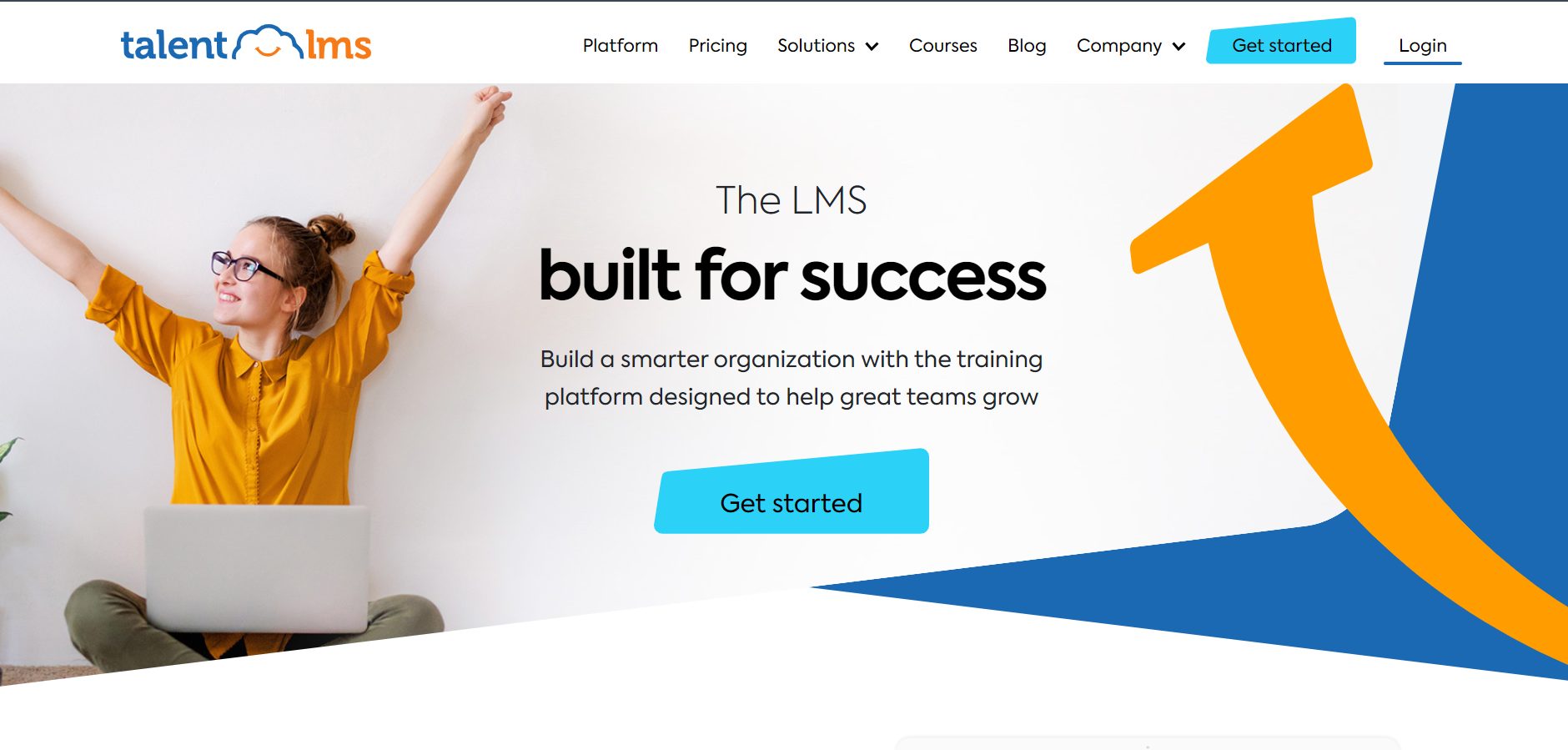
Course management is a strength, with easy organization across file types and support for SCORM, xAPI, and cmi5 files. The platform is mobile-ready, supports white labeling for branding, and offers learning paths that give learners a guided experience.
Reviewers note that the discussion forum needs improvement, navigation can be complex for first-time users, customization can be hard for beginners, and search for users and courses could be simpler. A free plan exists, and Core starts at $149 a month for up to 100 users. I would choose it for a team that wants published pricing and quick deployment, accepting a lighter admin interface.
Pros:
- Drag-and-drop course building with varied media
- Learning paths and completion rules for guided progress
- Support for SCORM, xAPI, and cmi5 files
- Mobile-ready platform with white labeling
- Published pricing with a free plan
Cons:
- Discussion forum and search need improvement
- Navigation and customization can challenge first-time users
Pricing: Free plan available; Core starts at $149 per month for up to 100 users, scaling to $579 per month for 1,000 users.
5. Blackboard Learn – Best for Community Based Learning
Blackboard Learn serves learners at all levels, from K-12 to higher education and beyond, and its learner-centric approach fosters engagement and interaction. Discussion boards, group projects, and real-time collaboration tools encourage participation and knowledge sharing, which makes it a fit for collaborative learning experiences.
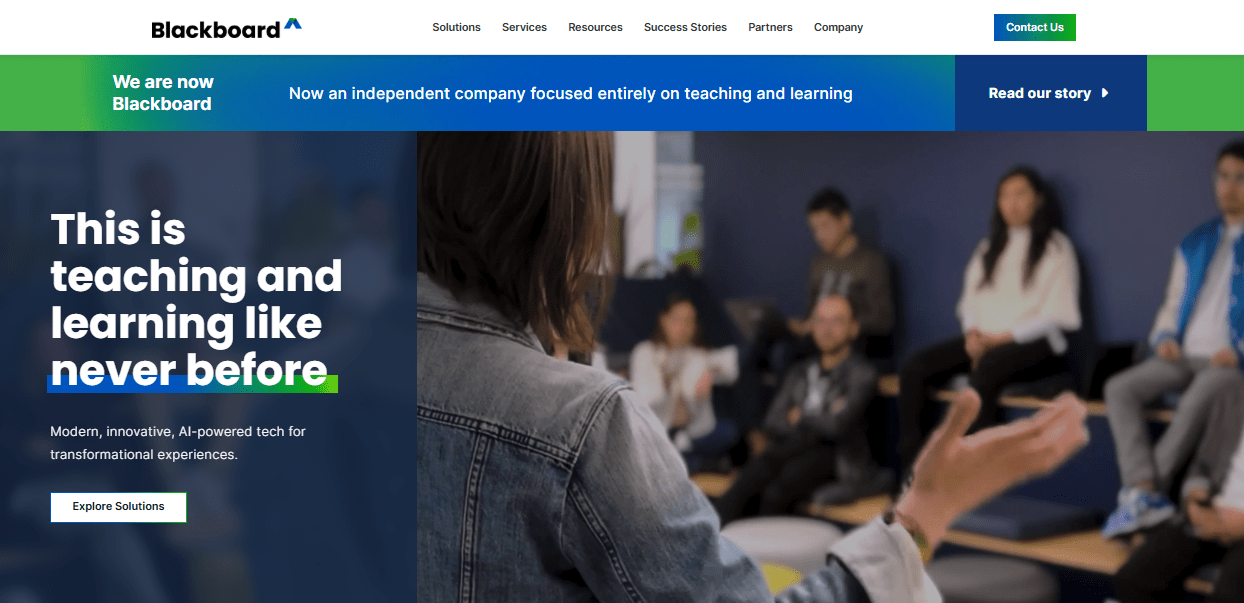
Its social and mobile learning capabilities let learning happen from anywhere on any device. A robust import tool makes it easy to bring in content from various sources, and online tasks and quizzes are straightforward to administer and grade. The platform is easy to navigate.
Reviewers mention frequent sign-on errors that disrupt learning, a layout that lacks appeal, and assignments that are hard to locate and manage. Pricing is quote-based, with older listings citing about $9,500 a year. I would choose it for an organization with an academic or collaborative training model, and I would pilot the sign-on and assignment flow before committing.
Pros:
- Robust import tool for content and resources
- Discussion boards, group projects, and real-time collaboration
- Straightforward administration and grading of quizzes
- Easy navigation that creates a familiar environment
- Zoom and Panopto integration for remote learning
Cons:
- Sign-on errors are common and disrupt learning
- The layout lacks appeal and assignments are hard to locate
Pricing: Quote-based; older listings cite about $9,500 per year.
6. 360Learning – Best for Collaborative Learning
360Learning offers automation that removes time-consuming tasks, and its award-winning authoring tool lets you use internal expertise to create relevant training quickly, which reduces reliance on external content providers.
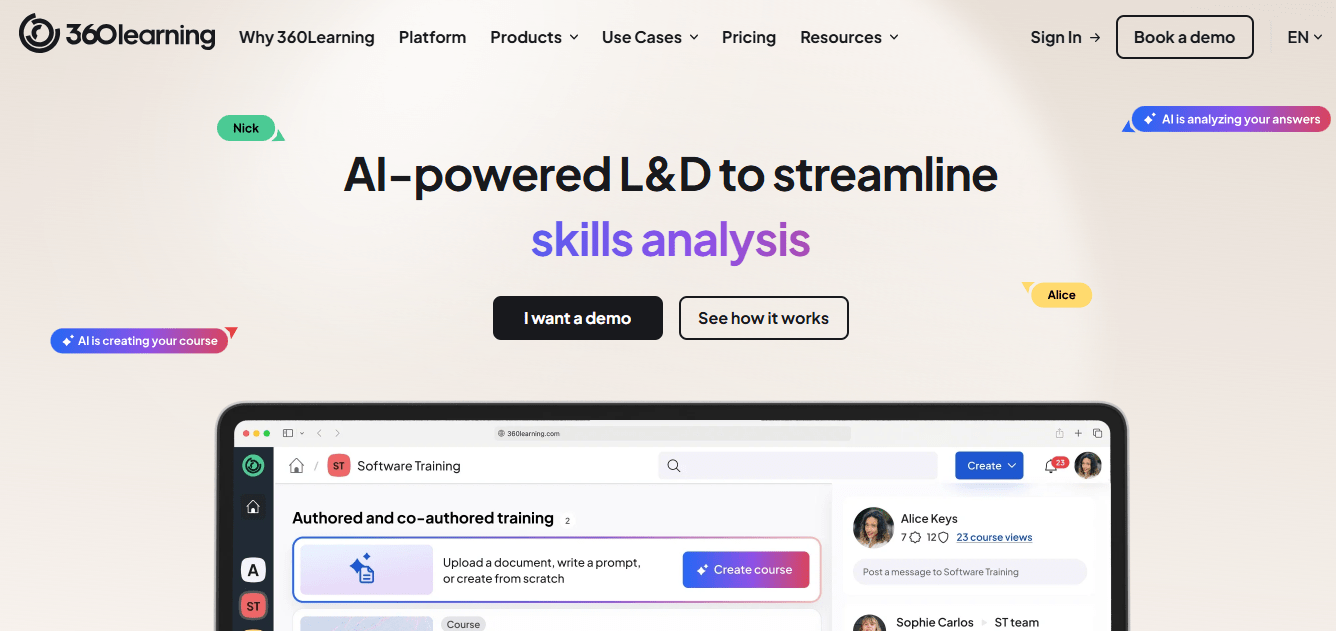
Compliance training becomes easier to manage with automation of mandatory training and retraining. That end-to-end orchestration covers automated enrollments, reminder notifications, certificate expiration alerts, and audit-proof reporting. Flexible delivery options let you personalize learning paths, integrate online courses, and run instructor-led training, and translations can be created and managed from a single interface.
Reporting spans groups, users, courses, and paths, and integrations include Salesforce, Microsoft Teams, and Zoom. The limits are specific: videos recorded in the platform cannot be edited afterward, courses cannot be marked complete manually for a group, and graded quizzes are created one question at a time. Pricing starts around $8 per user per month. I would choose it when automation and collaborative authoring matter most.
Pros:
- Automation for mandatory training, retraining, and reminders
- Certificate expiration alerts and audit-proof reporting
- Award-winning authoring tool for internal expertise
- Translations managed from one integrated interface
- Integrations with Salesforce, Microsoft Teams, and Zoom
Cons:
- Recorded videos cannot be edited within the platform
- Cannot mark courses complete manually for a group
Pricing: Starts around $8 per user per month.
7. Moodle – Best for Open Source Learning
Moodle is a fully customizable platform for diverse learning environments, from K-12 classrooms to corporate training. Instructors can deliver content in various formats, set deadlines, and update learners through alerts, and accessibility features, integrated content checkers, and text-to-speech tools support diverse learners.
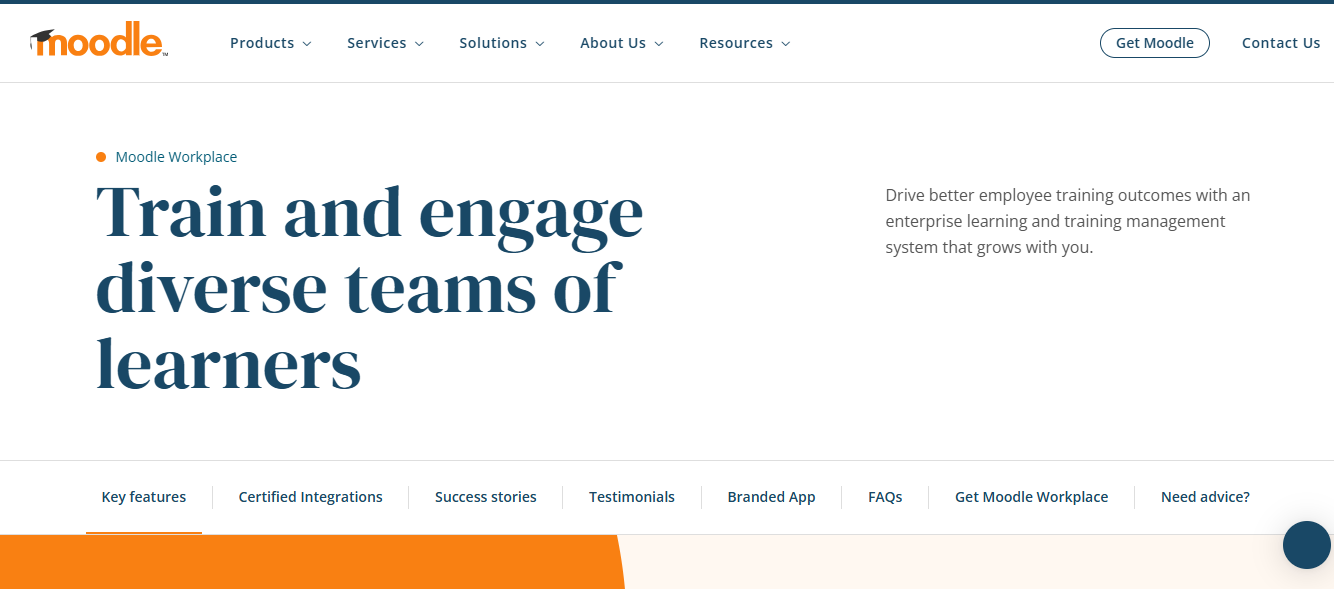
The Moodle App lets learners reach courses anytime, anywhere. It gives instructors a lot of room to shape the experience. Managing learner profiles and enrollment keys helps restrict access to valid users, and asynchronous learning gives flexibility.
The trade is effort. Reporting is limited, so administrators may need to collate data from learning groups manually, there is no dedicated technical support or automatic updates, and it demands considerable server resources at scale. The software is free, with hosted plans from about AUD 180 a year. I would choose it for a team with technical staff and a need for control, and I would budget the maintenance hours.
Pros:
- Free, fully customizable platform
- Wide range of learning materials and formats
- Moodle App for learning anywhere
- Accessibility features, content checkers, and text-to-speech
- Enrollment keys to restrict access to valid users
Cons:
- Reporting is limited and often needs manual collation
- No dedicated technical support or automatic updates
Pricing: Free; hosted plans through Moodle partners start around AUD 180 per year.
8. Lessonly by Seismic – Best for Training Sales Teams
Lessonly, now part of Seismic, makes content creation and updates quick, so courses can be customized without the cumbersome feel some teams report with Cornerstone. It is built to ramp new sales hires faster and guide teams to the right resources for systematic skill development.
Coaching is made easier with data-driven plans that pinpoint knowledge gaps, and the vendor reports results such as faster ramp-up and more closed-won deals. You can build interactive training for retention, create personalized certificates, and monitor progress in real time.
Reviewers mention that sound editing on screen recordings needs work, that images and text sometimes swap when moving from edit mode to preview mode, and that there is no discussion capability. Pricing is quote-based, with older listings citing a limited free tier for 25 users. I would choose it for sales and customer-facing teams, and I would pilot with one cohort first.
Pros:
- Quick content creation and updates
- Interactive training that supports retention
- Personalized certificates for completion
- Real-time progress monitoring
- Data-driven coaching plans that pinpoint knowledge gaps
Cons:
- Sound editing on screen recordings needs improvement
- No discussion capability at present
Pricing: Quote-based; older listings cite a limited free tier for 25 users.
9. LearnUpon – Best for Delivering Impactful Training
LearnUpon offers an intuitive platform for fast, efficient training that even learners with limited tech knowledge can navigate with minimal help.

It automates user creation and enrollment even with large numbers of learners, through bulk uploads and API integration with CRM or HRIS systems. Users can be organized into groups that get tailored content and group-specific reports, and different user types and permissions let you delegate tasks. You can host multiple portals for different audiences, create learning paths, and build assessments.
Admins find course search hard when there are multiple versions, standard reports cannot run for bundles, and certificate generation can be clunky. Pricing is a custom quote, with older listings citing about $599 a month. I would choose it for an organization that trains several audiences and wants strong branding and course settings, and I would ask to see reports for bundles in the pilot.
Pros:
- Navigable by learners with limited tech knowledge
- Bulk upload and API integration with CRM or HRIS systems
- Multiple portals for different audiences
- Strong test creation and implementation
- Extensive branding and course settings
Cons:
- Admin course search is hard with multiple versions
- Standard reports cannot run for bundles
Pricing: Custom quote; older listings cite about $599 per month.
10. Litmos – Best for External Training
Litmos is a corporate learning platform for faster, smarter employee training, and it serves sales, service and support, operations, compliance, customers, and employees. A vast library of off-the-shelf content covers compliance, leadership, communication, and social skills, so a first course can launch quickly.
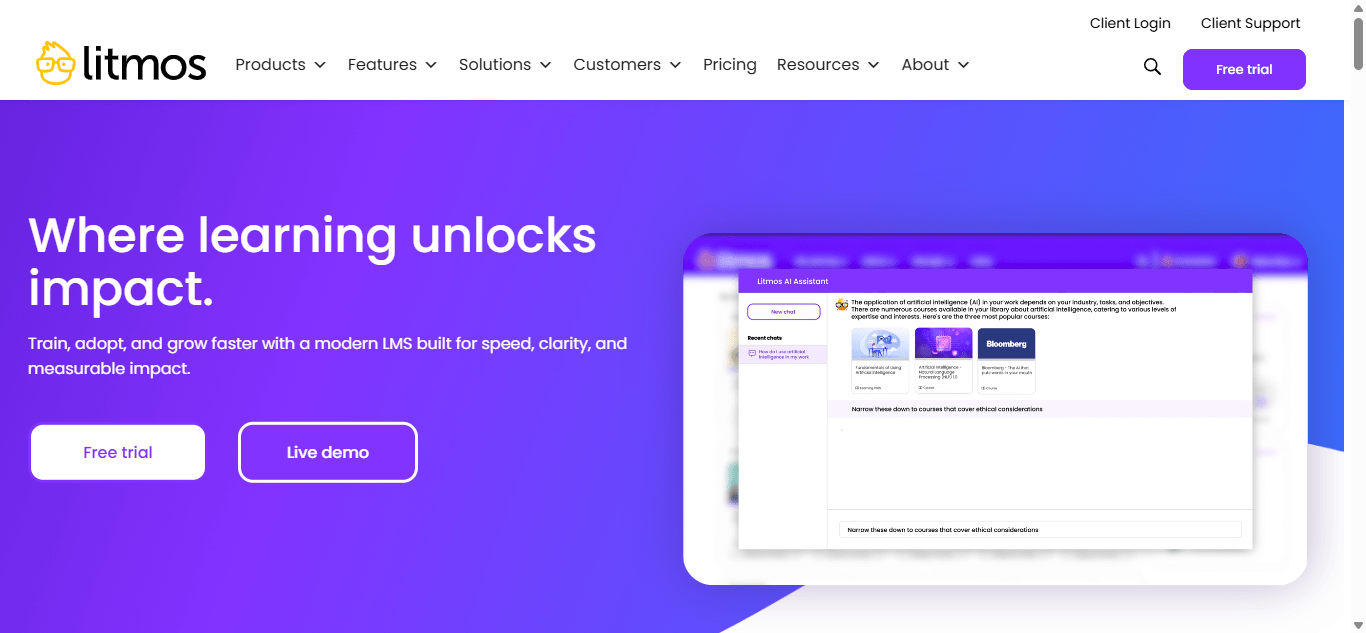
Robust reporting and analytics track performance and course completion. Strong virtual classroom capabilities enable real-time interaction between trainers and learners, with live sessions, discussions, shared materials, and assessments run in one place.
Reviewers mention manual work where integrations are missing, a mobile app with limited usability and no offline access, user management that cannot assign different roles or permissions, and learning paths that cannot be tagged. Pricing is quote-based, with older listings citing about $3 to $6 per user per month. I would choose it for a team that trains external audiences and wants a ready content library, and I would test the mobile app before committing.
Pros:
- Extensive off-the-shelf content library
- Robust reporting on performance and completion
- Virtual classroom for real-time trainer and learner interaction
- Engaging learning paths for guided learning
- Gamification that boosts engagement
Cons:
- Limited mobile app usability and no offline access
- User management lacks role and permission assignment
Pricing: Quote-based; older listings cite about $3 to $6 per user per month.
11. Tovuti LMS – Best for Learner Engagement
Tovuti offers a fast, user-friendly platform for engaging learners, with easy course creation and efficient team training. Visually appealing, interactive learning experiences adapt to any screen size, and its all-in-one system simplifies managing and analyzing training.
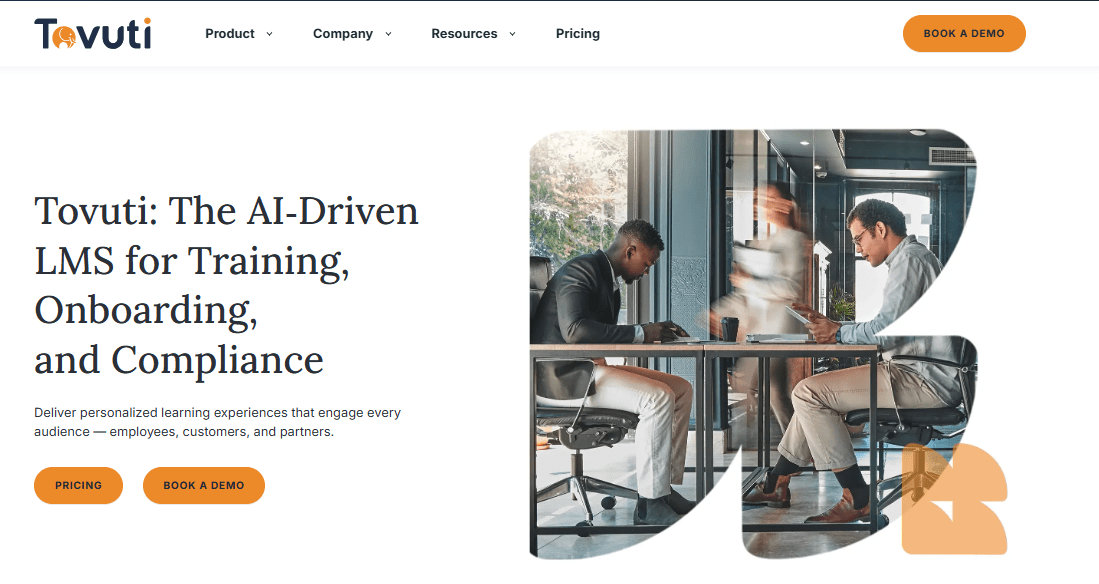
Tovuti provides enterprise-scale security with end-to-end data encryption and privacy protections, and it works as a learning experience platform that supports collaborative remote learning through whiteboards, surveys, and screen sharing. User transcripts, video conferencing, language localization, and live learning options round out the set. Reporting and analytics give detailed insight into learner activity.
The drawbacks: colors and sizes are hard-coded and hard to customize, prebuilt content is relatively expensive if you do not use all of it, and documentation lacks clarity on deeper questions. Pricing is quote-based, with older listings citing about $775 a month. I would choose it for a team that values engagement and responsive support.
Pros:
- Visually appealing, interactive experiences on any screen size
- Enterprise-scale security with end-to-end encryption
- Whiteboards, surveys, and screen sharing for remote learning
- Comprehensive reporting on learner activity
- Straightforward course design without developer skills
Cons:
- Design functionality is hard-coded and hard to customize
- Prebuilt content is relatively expensive
Pricing: Quote-based; older listings cite about $775 per month.
12. Bridge LMS – Best LMS for Upskilling and Reskilling
Bridge is a learning and performance platform that simplifies employee development, and its strength is combining learning with doing. It is easy to use for both learners and administrators, and Bridge Skills, powered by AI, identifies skills gaps and recommends relevant courses so employees can upskill and reskill.
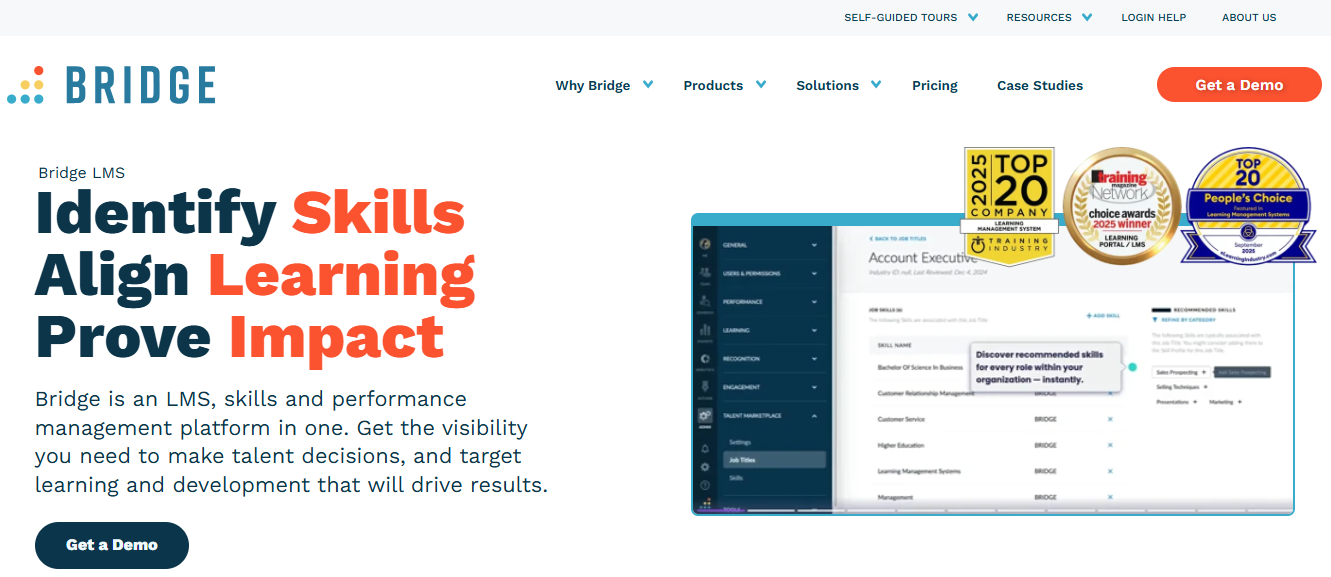
Its integrations with HRIS, SSO platforms, and content providers add flexibility. The authoring tool creates polished content easily, it accepts various raw SCORM data for compatibility, and you can combine courses and checkpoints for personalized experiences.
The limits are real: text formatting options are thin, course content cannot be exported, the quizzing engine needs to be more robust, and the text editor is basic. Pricing is quote-based, with older listings citing about $4 per user per month billed annually. I would choose it for a team focused on skills development and performance, and I would test content export before signing.
Pros:
- AI-powered Bridge Skills that identifies skills gaps
- Authoring tool for polished content
- Raw SCORM data compatibility
- Courses and checkpoints combined for personalized learning
- Integrations with HRIS, SSO, and content providers
Cons:
- Course content cannot be exported
- Text formatting options and the quizzing engine are limited
Pricing: Quote-based; older listings cite about $4 per user per month billed annually.
My Top Picks Among the Cornerstone Alternatives
If you read nothing else, start here. Among all the Cornerstone alternatives above, these three cover the three jobs people actually switch for: simple administration, scalable depth, and enterprise-grade personalization.
1. ProProfs Training Maker
My pick if the platform needs a specialist and you want your trainers to run it themselves. A course goes from idea to assigned in an afternoon, reports flag who is falling behind, and a free plan lets you pilot with real employees. It is not a talent suite, so keep a separate tool for recruiting and performance.
2. Absorb LMS
My pick among Cornerstone competitors if you need depth and scalability with a friendlier interface. AI-powered paths, customization for branding, and robust reporting suit larger teams. Plan for setup effort, and check the report download and assignment limits before you sign.
3. Docebo
My pick if enterprise scale and AI personalization matter most. Virtual coaching, auto-tagging, and 400+ integrations suit a global program, and multilingual support serves distributed audiences. Budget for a quote-based contract, and ask for a pilot scoped to one program.
How I Evaluated These Cornerstone Alternatives
I did not rank these alternatives to Cornerstone on feature lists alone. Here is what shaped the order:
- User reviews and ratings from Capterra, weighted toward platforms with a meaningful volume of recent reviews, since any list of the best Cornerstone alternatives is only as good as the reviews behind it
- Admin effort and time to launch, meaning whether a trainer can run the platform without a specialist or a long implementation, the loudest reason people look at Cornerstone competitors
- Total cost of ownership, including licenses, implementation, content subscriptions, and admin staffing, since suite pricing often hides LMS-only value
- Reporting that works without tickets, including self-service reports and clean SCORM and xAPI tracking, which separates genuine Cornerstone LMS alternatives from heavy configuration projects
- Learner experience, including navigation, mobile access, and engagement features
- Integrations, especially HRIS, HCM, and SSO connections that do not need paid change requests
- Migration realities, meaning content and compliance history portability and how long a move takes
Price the Admin, Not Just the License
A platform is only as simple as the person who has to run it.
Cornerstone remains a strong choice for deep multi-jurisdiction compliance, large global scale, and full talent-suite integration when those are actively used. Leave when the failing piece is admin effort, reporting, cost, or speed. Among all these Cornerstone alternatives, none wins every category, and even the best Cornerstone alternatives will not fix a program with no clear owner, so decide which complaint is yours before you start demos.
Migration is slower and messier than the sales decks suggest, so plan for it: export compliance records and completion history first, confirm how content and SCORM packages move, and keep Cornerstone running until the new platform is proven. When you compare Cornerstone LMS alternatives, ask each vendor for an implementation timeline in writing, a live demo of a self-service report, and a three-year cost. For training teams, I would run a pilot on ProProfs Training Maker too, since a free plan lets you test it with real learners. Plenty of Cornerstone competitors will quote a low license and add services later, so anyone weighing alternatives to Cornerstone should price the full three years.
Frequently Asked Questions
What are the best Cornerstone alternatives for mid-sized companies?
Among Cornerstone alternatives, TalentLMS, ProProfs Training Maker, 360Learning, and LearnUpon suit mid-sized teams that want lighter administration and clearer pricing. Absorb and Docebo fit larger programs. Pilot two with one live compliance course before choosing.
Which Cornerstone competitors publish their pricing?
TalentLMS and ProProfs Training Maker publish pricing and offer free plans, and 360Learning lists a per-user starting rate. Most others quote on request, so ask for a three-year total including implementation and content subscriptions. Compare like for like.
Which Cornerstone LMS alternatives launch the fastest?
Among Cornerstone LMS alternatives, cloud platforms such as ProProfs Training Maker, TalentLMS, and LearnUpon are built to launch in weeks, not months. Ask each vendor for an implementation timeline in writing, and test a real course before you commit.
What should I look for in alternatives to Cornerstone?
Start with admin effort and time to launch, then compare total cost, self-service reporting, integrations, and support. Run one live compliance course on two platforms and count the admin hours before you decide, and ask for references.
Can I move compliance records off Cornerstone without losing history?
Usually yes, with planning, whichever of the Cornerstone alternatives you choose. Export completion records and certificates first, confirm how SCORM content transfers, and keep Cornerstone running until the new platform proves it. Ask each vendor what it cannot import.
Do I need the full talent suite or an LMS-only option?
If you actively use recruiting, performance, and succession, Cornerstone's suite can justify its price. If you mostly use Learning, an LMS-only platform often costs less and takes less to run. Count which modules you actually use before you decide.
Let ProProfs AI create your training course

 We'd love your feedback!
What did you like & how can we make it even better?
 Thanks for your feedback!
 Ask Your Question
Have a question? Get expert help to make your decision easier.