
I’ve seen workers sign safety sheets they never read and get sent straight to equipment they don’t know how to use. Then something goes wrong, and nobody can find the training records. That’s daily life on a lot of construction sites.
The construction industry has the second-highest rate of workplace fatalities in the country. That number doesn’t move because of bad luck. It moves because training in this industry has been treated as a formality for decades. Sign here, file it somewhere, move on.
If you’re looking for the best construction LMS software to fix exactly that cycle, this guide breaks down what actually works in the field.
What Is a Construction LMS?
Unlike a general-purpose platform, a construction training software is designed around the realities of field work: workers who are never at a desk, job sites where connectivity drops out, and compliance requirements that don’t forgive gaps. It puts certification management, mobile learning, and audit-ready reporting at the center of how training gets done, not as optional add-ons buried in a settings menu.
Here’s what a well-built LMS for the construction industry actually helps you manage:
- OSHA and regulatory compliance training
- Equipment operation and heavy machinery certifications
- New hire and subcontractor onboarding
- Toolbox talks and recurring safety refreshers
- Multi-site workforce training from a single admin dashboard
- Audit-ready records for inspections and incident investigations
If you’ve ever scrambled to pull together training records before an inspection, or realized a worker’s forklift certification lapsed three months ago without anyone catching it, this is the system that prevents that from happening again.
10 Best Construction LMS Platforms for the Construction Industry
Finding the best construction LMS means choosing a system your crews can actually use on-site, even with poor connectivity, limited time, and constant job-site pressure.
I’ve evaluated these tools to determine how easy they are for crews who are not sitting in front of a computer to actually complete.
Here’s the quick comparison before we get into detail.
| Construction LMS | Best For | Mobile | Offline | Compliance Tracking | Starting Price |
| ProProfs Training Maker | Employee training & LMS | Yes | Yes | Yes | Free / $1.99/learner/mo |
| Bridge LMS | Onboarding & skill building | Yes | Yes | Yes | Custom (tiered) |
| Absorb LMS | Complex training needs | Yes | Limited | Yes | Custom |
| Docebo | Enterprise training | Yes | Limited | Yes | Custom |
| iSpring Learn | eLearning & training | Yes | Yes | Yes | $3.70/user/mo |
| 360Learning | Collaborative learning | Yes | No | Yes | $8/user/mo |
| SAP Litmos | Off-the-shelf training | Yes | No | Yes | Custom |
| LearnUpon | Corporate & eLearning | Yes | No | Yes | Custom |
| Axis LMS | Live class training | Yes | No | Yes | Custom |
| Vector LMS | Mobile-ready OSHA training | Yes | Yes | Yes | Contact for pricing |
1. ProProfs Training Maker – Best for Employee Training and LMS
ProProfs Training Maker is the first platform I’d point most construction teams toward, especially if you need something operational fast without a dedicated LMS administrator. The setup is genuinely simple, and that matters when your workers are in the field rather than at a desk.
What I appreciate most is how it handles the full compliance cycle: AI-assisted course creation, pre-built OSHA and safety templates, real-time completion tracking, and automatic certification reminders.

Let ProProfs AI create your training course
Mobile access works well on-site, and 70+ language support isn’t a checkbox feature here; it actually covers the languages construction crews speak, with AI-generated voiceovers useful for crews who’d rather listen than read on a job site. The single sign-on removes password friction that kills adoption on most platforms.
White-labeling lets you build branded training portals for different sites or divisions. For small to mid-sized contractors who need construction workforce training without enterprise-level complexity, this is the construction LMS that earns its place at the top of the list.
Pros:
- Simple setup with no technical expertise required
- 500+ expert-made courses available for immediate use, with AI handling customization edits on request
- AI course creation with pre-built OSHA and compliance templates
- Real-time reporting and audit-ready records
- Mobile-friendly with SSO and white-labeling options
- 70+ language support for multilingual crews
Cons:
- No downloadable or on-premise version for fully offline sites
- Free plan does not include a dedicated account manager
Pricing: Free for small teams. Paid plan starts at $1.99/active learner/month. Business Plan at $3.99/active learner/month (billed annually). Enterprise from $499/year.
Capterra Rating: 4.8/5
2. Bridge LMS – Best for Onboarding New Hires and Skill Building
Bridge LMS is what I’d recommend to construction companies that want to move beyond compliance checkboxes and build something more structured around workforce development.
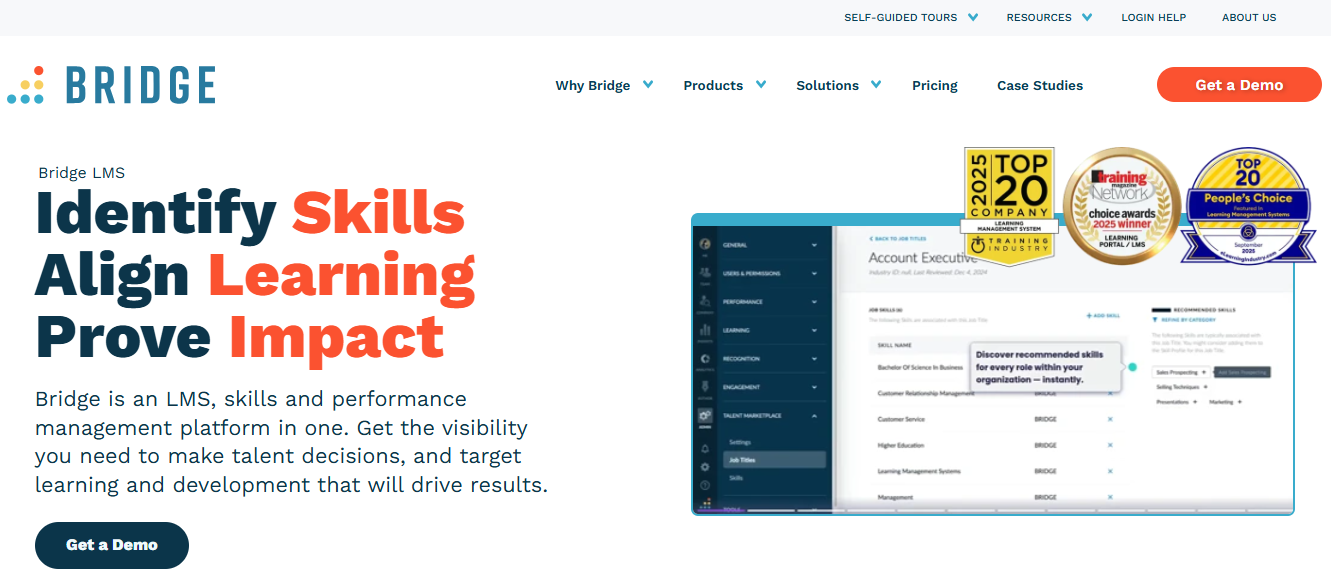
The platform’s Journeys feature automates onboarding, which removes the inconsistency that comes from relying on individual managers to run new hire orientation across multiple sites.
SafetyNow courses keep compliance training current without manual updates from your side. The blended learning support handles the reality of construction schedules, mixing online modules with live sessions without forcing workers into rigid formats.
One-click translation covers multilingual crews, and mobile and offline learning keep construction safety training accessible when connectivity is unreliable. For larger contractors focused on retention and skill development alongside compliance, Bridge is built for that scope.
Pros:
- Automated onboarding through Journeys removes manual, inconsistent processes
- Skills database of 30,000+ job titles for gap identification by role
- Blended learning supports construction scheduling realities
- Mobile and offline access for field workers
Cons:
- Adding Google Meet to the training calendar creates unnecessary extra steps
- Survey customization is limited; reordering questions requires more effort than it should
Pricing: Custom annual agreements. Three tiers: Learn, Learn & Develop, and Learn, Perform & Develop.
Capterra Rating: 4.5/5
3. Absorb LMS – Best for Complex Training Needs
Absorb LMS is what I’d look at when your construction training program has grown complex enough that a simpler platform starts showing its limits.
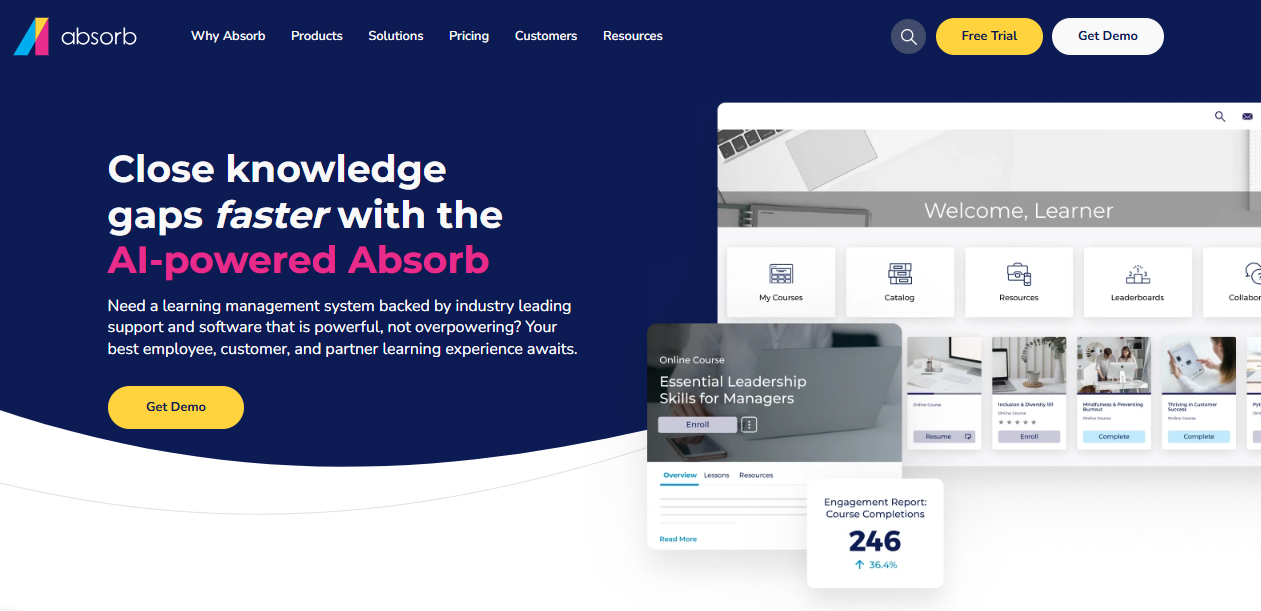
The AI-driven learning paths adjust based on each worker’s progress, which is genuinely useful when your workforce ranges from newly hired laborers to experienced project managers with very different training requirements.
Automated course enrollment by role removes the admin overhead of manually assigning construction safety training across large, rotating crews. Custom branding supports multi-site operations where different teams need distinct training environments.
The eCommerce capability lets you sell training to subcontractors or trade partners if that’s part of your model. As a construction training software, it integrates well with HR, payroll, and performance management systems across the board.
Pros:
- AI-driven learning paths adapt to individual worker progress
- Automated enrollment by role reduces admin overhead significantly
- Strong HR and payroll integration options
- eCommerce capability for selling training to subcontractors
Cons:
- Offline learning support is limited, a real gap for remote job sites
- Admin tasks must follow Absorb’s internal logic, which frustrates flexible teams
Pricing: Custom quotes based on learner count, training type, and feature set.
Capterra Rating: 4.4/5
4. Docebo – Best for Complex Enterprise Training
Docebo is the platform I’d consider when your construction operation is large enough that training infrastructure needs to function like enterprise software.

The modern interface holds up better than most legacy systems in this space, and the AI-powered features reduce the manual workload that bogs down L&D teams managing thousands of learners across dozens of sites.
Adaptive learning paths adjust dynamically based on user progress, which helps when your workforce spans roles from site laborers to senior project directors. The real-time collaboration tools, including discussion boards and peer reviews, work well for connecting distributed teams on shared construction safety training content.
Where Docebo runs into construction-specific friction is offline learning, which is limited, and the webinar registration experience, which is clunkier than what your team already uses for live sessions.
For large firms with a dedicated L&D function, the infrastructure justifies the investment.
Pros:
- AI-powered content curation and adaptive learning paths at scale
- Robust white-labeling and custom branding options
- Strong real-time collaboration tools for distributed teams
- 24/7 customer support with fast response times
Cons:
- Offline learning and field activity tracking are limited
- Webinar registration is less intuitive than standalone tools like Zoom
Pricing: Three plans: Engage, Elevate, and Enterprise. All custom-priced.
Capterra Rating: 4.4/5
5. iSpring Learn – Best for eLearning and Content-Heavy Training Programs
iSpring Learn is the platform I’d recommend if your construction training program runs heavily on existing content, particularly PowerPoint-based safety briefings that need to become trackable online courses without being rebuilt from scratch.
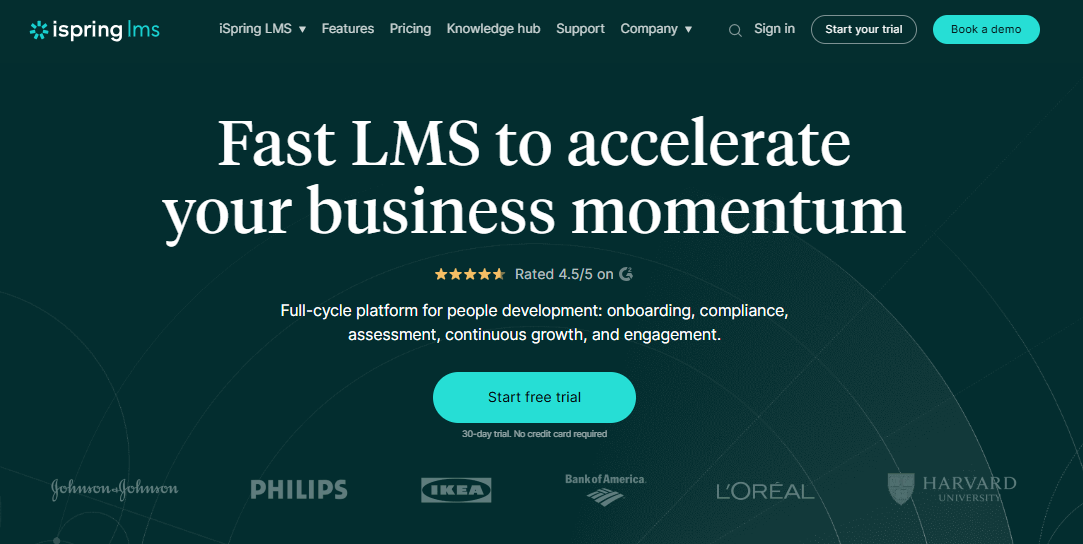
The PowerPoint-to-HTML5 conversion is fast and the output is clean enough to send to crews without embarrassment. SCORM 1.2 and SCORM 2004 support handles proper tracking across all module types.
The certification and recertification management keeps OSHA credentials and equipment licenses current with automatic renewal reminders. Version control tracks previous iterations of safety content, useful when regulations update and you need to confirm which version a worker completed.
The events calendar integrates live sessions alongside online modules to keep your construction training software calendar unified in one place.
Pros:
- Fast PowerPoint-to-HTML5 conversion for existing safety materials
- SCORM 1.2 and 2004 support with content version control
- Certification and recertification management with renewal reminders
- Pay-per-active-user pricing fits fluctuating construction crew sizes
Cons:
- No built-in course marketplace or off-the-shelf content library
- Reporting functionality needs improvement
Pricing: Start Plan at $3.70/user/month. Business Plan at $4.10/user/month. Both pay-per-active-user.
Capterra Rating: 4.7/5
6. 360Learning – Best for Collaborative Learning
360Learning is the platform I’d recommend when your best construction training content is already sitting inside your experienced workers’ heads, and you need a way to get it out and into a repeatable format.
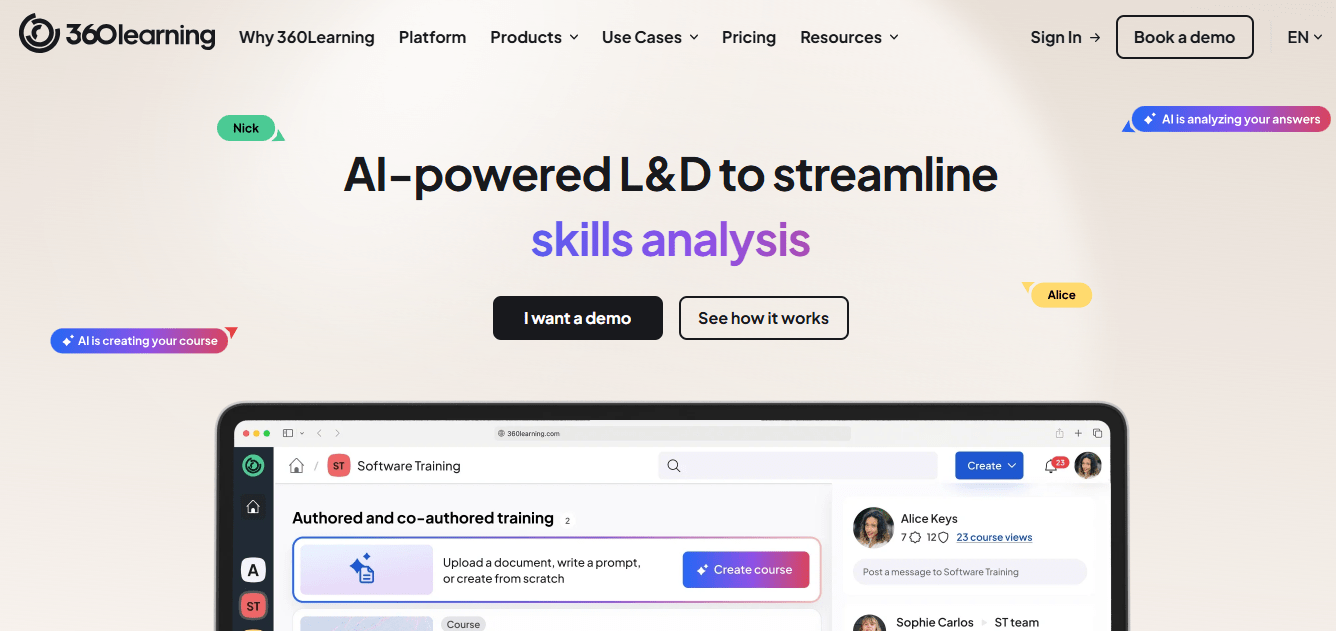
The platform makes it easy for foremen, safety officers, and trade leads to build training modules without needing a course designer or instructional design background. AI-powered course creation directly from PDF documents means your existing safety manuals and site-specific SOPs become interactive modules with minimal effort.
Automated enrollment and reminders remove manual tracking from your admin workload entirely. Custom learning paths by role, location, and tenure keep construction workforce training content relevant to whoever is receiving it.
Gamification features, discussion boards, and peer upvotes improve completion rates on content that workers might otherwise click through without retaining.
Pros:
- Internal expert-driven content creation requires no design background
- AI course generation directly from PDFs and existing safety documents
- Gamification and discussion features improve engagement and retention
- Audit-proof compliance records with automated enrollment
Cons:
- No offline learning support, a significant gap for remote job sites
- Course organization lacks a proper folder system for large content libraries
Pricing: Team Plan at $8/registered user/month (up to 100 users). Business Plan with custom pricing for larger teams.
Capterra Rating: 4.7/5
7. SAP Litmos – Best for Off-the-Shelf Training Content
SAP Litmos is the platform I’d look at first when you need a large library of ready-made compliance and safety training content and don’t have the bandwidth to build everything internally.
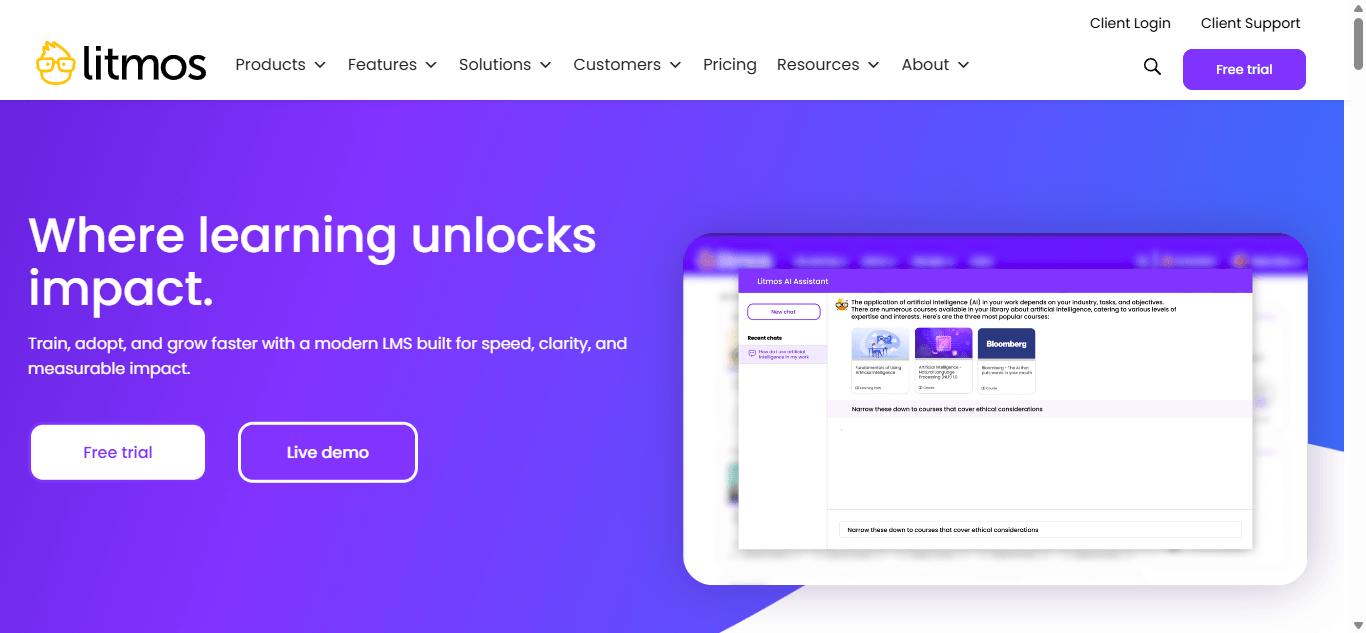
With over 98,000 courses covering OSHA, safety protocols, regulatory updates, and soft skills, you can deploy meaningful construction safety training across your crews without starting from a blank slate.
The AI-generated personalized playlists serve relevant content to individual workers based on role and progress. Gamification through leaderboards, badges, and challenges helps with engagement on mandatory construction training software content that workers would otherwise rush through.
The mobile app works for on-site and remote access. The honest caveat is that users report platform glitches and browser compatibility issues, and inconsistent support has frustrated teams on tight compliance schedules.
For teams that can tolerate some platform quirks in exchange for a large ready-made content library, Litmos is still worth evaluating – particularly for organizations that need breadth of OSHA content without the build time.
Pros:
- 98,000+ off-the-shelf courses covering OSHA and safety compliance
- AI-personalized learning playlists by role and progress
- Gamification improves engagement on mandatory training
- Full mobile app for on-site and remote access
Cons:
- Reported platform glitches and browser compatibility issues
- Support experience has been inconsistent for some users
Pricing: Three tiers: Foundation Suite, Premier Suite, and Platinum Suite. All custom-priced.
Capterra Rating: 4.2/5
8. LearnUpon – Best for Corporate and eLearning
LearnUpon is the platform I’d recommend for construction companies training more than just their direct workforce. If your operation involves subcontractors, trade partners, and client-facing teams all needing separate training programs from a single system, the multi-portal capability handles that cleanly without mixing records or audiences.

The AI-powered automation handles repetitive admin tasks from enrollment to reminders to learning path assignment, so your training coordinator isn’t spending their week on manual processes. As a construction training software option for multi-audience operations, the interface is clean enough that non-technical crew members can navigate it without admin support on day one.
Integrations with Salesforce, Zoom, and major HR platforms work well if your existing tech stack is already built around those tools.
Pros:
- Multi-portal capability for employees, subcontractors, and trade partners
- AI-powered automation handles enrollment, reminders, and learning paths
- Clean interface with low learning curve for non-technical users
- Strong integrations with Salesforce, Zoom, and HR platforms
Cons:
- Course and learning path navigation can be confusing for learners
- Integration timelines can run longer than expected
Pricing: Essential (up to 150 users), Premium (up to 500 users), and Enterprise (500+). All custom-priced.
Capterra Rating: 4.8/5
9. Axis LMS – Best for Delivering Live Class Training
Axis LMS is the platform I’d choose for construction companies that still run a significant portion of their training through scheduled, instructor-led sessions and need those live sessions to integrate cleanly with online coursework rather than exist as a separate paper process.
The live training scheduling handles in-person sessions, tracks attendance, and connects completed sessions to each worker’s training record automatically. CEU tracking and recertification management replaces a lot of manual spreadsheet work for companies with complex certification requirements under their construction workforce training program.
Over 5,000 system integrations cover most CRM and HR tools already in use. AI tools for quiz generation, content translation, and presentation creation reduce build time on new training materials considerably.
Pros:
- Live training scheduling with attendance tracking and online course integration
- Advanced CEU and recertification management
- 5,000+ system integrations including CRM and HR tools
- AI tools for quiz generation and content translation
Cons:
- Bulk content uploading is tedious and time-consuming
- Version control for content updates is weak
Pricing: Axis LMS Lite for small teams, Axis LMS for up to 100,000 employees, and Axis LMS for Government. All include AI-powered tools.
Capterra Rating: 4.3/5
10. Vector LMS – Best for Mobile-Ready OSHA and Compliance Training
Vector LMS is the platform I’d recommend to safety-first operations, particularly those managing workers across multiple states with different licensing requirements.
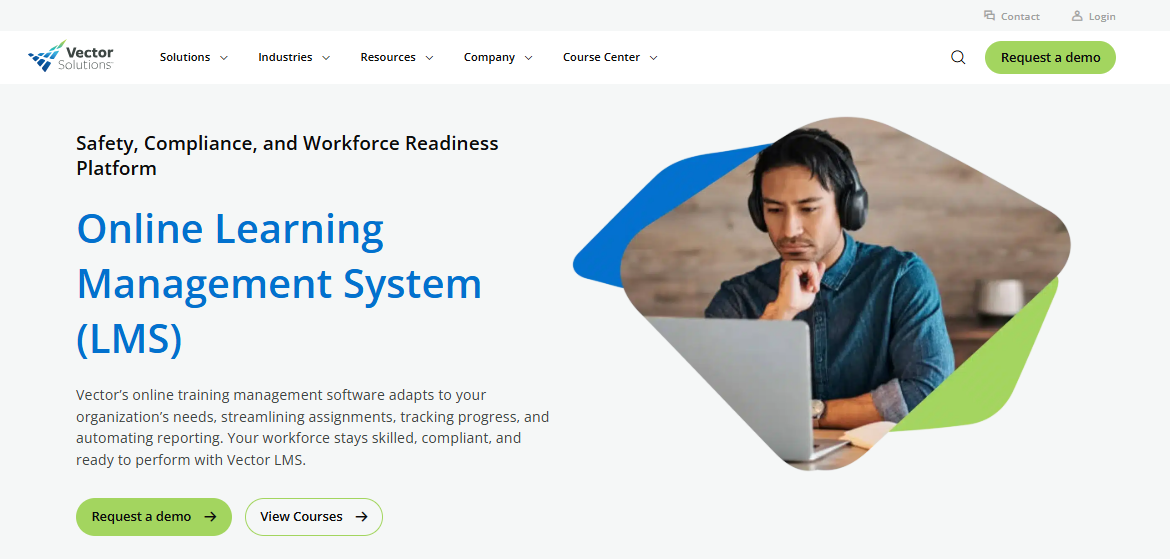
It’s one of the best LMS for construction industry teams that operate under heavy regulatory pressure, supporting over 900 AEC license types across all 50 states, a depth that generalist platforms simply cannot match.
Integrated tracking covers OSHA, EPA, and industry-specific safety regulations without requiring separate tools for different compliance frameworks. The mobile platform delivers real-time safety alerts and risk intelligence to workers on-site, not just training modules.
Career development pathways covering trade skills and leadership give the platform a useful second layer beyond pure construction safety training compliance. For multi-state contractors, this is the construction LMS that removes the patchwork.
Pros:
- 900+ AEC license types supported across all 50 states
- Integrated OSHA, EPA, and industry-specific compliance tracking
- Real-time mobile safety alerts and risk intelligence for field workers
- Automated certification renewal reminders and tracking
Cons:
- No built-in timelines for training task lists
- Spanish-language course library needs significant expansion
Pricing: Contact Vector Solutions directly. Pricing not listed publicly.
Capterra Rating: 4.6/5
My Top 3 Picks for Construction Teams
After evaluating these platforms against real construction conditions, here’s where I land when someone asks me to just point them in the right direction.
Best Overall for Most Construction Companies: ProProfs Training Maker
It handles compliance tracking, mobile learning, multilingual delivery, and certification management without requiring a dedicated LMS administrator or a lengthy implementation. Most construction teams don’t need enterprise complexity. They need a construction LMS that works reliably on a phone at a job site. ProProfs delivers that, and the pricing scales cleanly as crew size grows.
Best for Large Multi-Site Contractors: Docebo or Bridge LMS
If you’re managing hundreds of workers across multiple projects and need advanced reporting, HR integrations, and structured development pathways, these are the best LMS for construction industry operations at scale. The implementation investment pays off when your compliance exposure and workforce complexity reach a certain size.
Best for Small Construction Teams on a Tight Budget: iSpring Learn
The pay-per-active-user model means you’re not paying for workers who aren’t in training that month. Easy content conversion means you can turn existing safety materials into proper courses quickly. Straightforward enough that someone who is not a training professional can manage it without a manual. For smaller operations, it’s a practical construction training software that doesn’t overcomplicate the job.
How I Evaluated These Construction LMS Platforms
I didn’t rank these tools by feature count or interface polish. I evaluated them against the conditions that actually determine whether a construction LMS succeeds or fails in the field.
The criteria I applied:
- Mobile usability on job sites because field workers are not trained at desks
- Offline learning with automatic sync for remote locations where connectivity drops out
- Ease of onboarding field workers with no expectation of technical literacy
- OSHA and compliance tracking with automated certification renewal reminders and audit-ready export
- Multi-language support that covers the actual languages your crews speak
- Speed of deployment from sign-up to first training assigned
- Scalability across fluctuating crew sizes and multiple active projects
- Reporting for supervisors so a site manager can check compliance status without calling the training team
One thing this evaluation confirmed: a construction training software can look excellent in a demo and fail completely when workers try to use it on-site. Adoption is the metric that matters. A system no one finishes doesn’t protect your workers or your compliance record, regardless of what the feature page says.
Why Traditional Construction Training Breaks Down
Toolbox talks have their place, but they’re not a training system. Here’s where most traditional approaches stop working at scale:
- Safety knowledge stays tribal. When experienced workers leave, their knowledge leaves with them. There’s no documented, repeatable version of what they knew.
- Paper records create audit chaos. Finding a specific worker’s OSHA completion certificate from two years ago should not require digging through a filing cabinet.
- Inconsistent subcontractor training raises your liability. If a sub brings workers onto your site without completed safety training, that risk sits with you.
- One-time orientation isn’t enough. Workers forget procedures. OSHA regulations update. Equipment changes. Construction workforce training that doesn’t repeat and reinforce doesn’t stick.
- Supervisors waste hours on manual tracking. Every hour a foreman spends chasing certification records is an hour not spent running the job.
A construction LMS solves most of these not by adding complexity but by replacing manual, inconsistent processes with automated, trackable ones.
What Kind of Training Do Construction Teams Actually Need?
A lot of platforms will claim to support construction safety training. Fewer understand what that means when the crew is on-site at 6 a.m., and the training has to actually land.
Construction teams need training mapped to the real hazards, the real equipment, and the regulatory environment they actually operate in. Here’s what that looks like in practice:
- OSHA compliance so every crew member is audit-ready and no one gets caught off-guard by an inspector
- Equipment operation and safety for forklifts, cranes, aerial lifts, and any high-risk machinery where errors aren’t recoverable
- Hazard recognition and site-specific safety protocols because preventing incidents is always cheaper than managing them
- Blueprint reading and project management basics, especially for leads handling multiple teams and shifting timelines
- Trade-specific upskilling, whether that’s carpentry, electrical, masonry, or roofing, every trade carries its own certification requirements
- Emergency response drills so workers know exactly what to do before something goes wrong, not during
- Onboarding for subcontractors because your liability doesn’t stop at your direct payroll
The right construction training software supports all of this, not just the checkbox compliance items that keep inspectors satisfied on paper.
How to Choose the Right LMS for Your Construction Company
The right construction LMS depends on the specific nature of your operation. Here’s a quick framework to match your situation to the right choice:
Small contractors (under 50 workers): Prioritize ease of setup, mobile access, and affordable pricing. You need compliance tracking and fast onboarding, not enterprise features. ProProfs Training Maker or iSpring Learn are the best LMS for construction industry teams at this size.
Specialty trades: Prioritize trade-specific content libraries and certification management for the licenses your trades require. Vector LMS and iSpring Learn are strong here.
Multi-site operations with rotating crews: Prioritize advanced reporting, multi-site administration, and subcontractor training management. Bridge LMS or Docebo handles this well.
Safety-first operations in hazardous environments: Prioritize OSHA content depth, incident response training, and real-time compliance tracking. Vector Solutions or SAP Litmos.
Companies with high subcontractor reliance: Prioritize multi-portal capability and external training management. LearnUpon handles this better than most construction training software options on this list.
Common Mistakes Construction Companies Make With LMS Training
Getting the platform right is only half the job. Here’s where implementation typically falls apart:
- Making modules too long. Workers will not sit through 45-minute courses on a phone at a job site. Keep modules short, specific, and immediately applicable to the work they’re doing that week.
- Using a desktop-only system. If your construction LMS doesn’t work well on a phone, your crews won’t use it. Adoption collapses fast.
- Treating compliance as the finish line. Completing OSHA training is a legal requirement, not the goal. The goal is for workers to recognize hazards and respond correctly. Build construction safety training toward that.
- Ignoring supervisors in the rollout. If foremen don’t understand the system and don’t reinforce it on-site, workers won’t take it seriously, regardless of what the platform can do.
- Setting it and forgetting it. Regulations change. Equipment changes. Your construction workforce training program should, too. Build a review cycle into your calendar from day one.
Stop Running Construction Training on Good Intentions
The best construction LMS is not the one with the most features. It’s the one your crews will actually complete, on a phone, between tasks, in real job-site conditions. Every day you’re running on paper records, ad-hoc toolbox talks, and manually chasing certification files is a day your compliance exposure and safety liability are both higher than they need to be.
Pick the platform that matches your operation’s size and complexity. Run a pilot with actual crews on actual devices. Measure completion rates, time-to-onboard, and how your next compliance audit goes. The right LMS for the construction industry doesn’t just check boxes. It changes how training actually lands on-site.
Start with ProProfs Training Maker and see how it fits your site before committing to anything else.
Frequently Asked Questions
How can a construction LMS improve safety on job sites?
A construction LMS delivers consistent, trackable safety training across all crews and locations. It automates compliance reminders, logs completion records, and generates audit-ready reports, reducing the risk of training gaps that lead to on-site incidents or failed inspections.
What does construction training software typically cost?
Pricing varies widely. Some platforms charge per active user per month, starting as low as $1.99, while others use annual contracts with custom pricing. Always confirm whether pricing covers both admin accounts and field workers before committing.
Can an LMS for the construction industry work without reliable internet?
The best platforms include offline learning that lets workers download modules before heading to a remote site and syncs progress automatically when connectivity returns. Confirm this capability with any vendor before signing.
What OSHA training can a construction LMS deliver?
Most platforms support OSHA 10 and OSHA 30 content for construction, along with equipment certifications, hazard recognition, PPE training, and fall protection modules. Vector Solutions covers over 900 AEC license types across all 50 states.
How long does it take to implement a construction LMS?
Cloud-based platforms like ProProfs Training Maker can have your first training assigned within a day. Enterprise platforms like Docebo typically require a longer onboarding process measured in weeks depending on integration complexity.
Is a construction LMS suitable for managing subcontractor training?
Yes, and it's one of the strongest use cases. A good construction training software lets you assign required safety training to subcontractors before they access your site, track completion, and maintain records in case of an audit or incident investigation.
What's the difference between a construction LMS and a general LMS?
A general LMS handles training delivery for any industry. A construction LMS is built specifically for the field: mobile-first design, offline access, OSHA and certification tracking, and content built around construction hazards and trade requirements. A general platform being marketed toward construction usually means workarounds, not solutions.
Let ProProfs AI create your training course

 We'd love your feedback!
What did you like & how can we make it even better?
 Thanks for your feedback!
 Ask Your Question
Have a question? Get expert help to make your decision easier.