

I’ve sat in enough post-training reviews to know the face. You ask how the module went. Someone says “fine.” Someone else nods. Nobody mentions anything specific because nobody remembers anything specific. The course got completed. The boxes got ticked. And three weeks later, you’re dealing with the exact same behavior the training was supposed to fix.
That’s not a content problem. That’s an engagement problem. And LMS gamification, when it’s designed with any actual intention, is one of the few structural fixes that works.
When it’s not? You get a leaderboard, three people dominate, badges nobody looks at twice, and completion rates that look fine on a report and mean absolutely nothing in practice.
I’ve tested gamified LMS platforms with real teams under real deadlines. I know what breaks, what quietly gets ignored, and what genuinely changes how people show up to training. This is the honest version of that.
What Is LMS Gamification?
Here’s what I’d tell anyone who’s been burned by a gamification rollout that went nowhere: the problem almost certainly wasn’t the platform. It was the underlying design assumption.
The first wave of gamification in LMS gave us points for clicking Next, badges for logging in, and leaderboards that three competitive people dominated while everyone else quietly stopped caring. Learners figured it out fast. A lot of them still roll their eyes at the word.
The version that actually works looks different. Points reflect skill criticality, not just effort. Badges signal demonstrated mastery, not seat time. Leaderboards are team-based and reset weekly, so they don’t permanently lock out anyone who started late or had a bad month.
I use a simple test: remove every gamification element from a course. If the learning content still functions identically, the gamification was decorative. If removing it breaks the experience because decisions have consequences, because branching paths require real engagement, because the assessment can’t be pattern-clicked through in four minutes, it was substantive.
That line between cosmetic and substantive is what the rest of this guide is built around.
How Does Gamification in LMS Actually Work?
Gamification in LMS works by connecting game mechanics to learning behavior in ways that make progress feel real rather than forced. The mechanics themselves aren’t magic. What matters is whether they’re attached to something learners care about.
Here’s what I’ve seen hold up past the first two weeks.
1. Points That Reflect What Matters

A point system that awards the same number for a safety certification as it does for a trivia question sends a clear message to learners: this platform doesn’t know the difference between critical skills and filler. I’ve seen weighted scoring, where safety training earns 100 points, and company trivia earns 10, change the entire implicit message of a training program without a single content change.
2. Badges Tied to Mastery, Not Presence
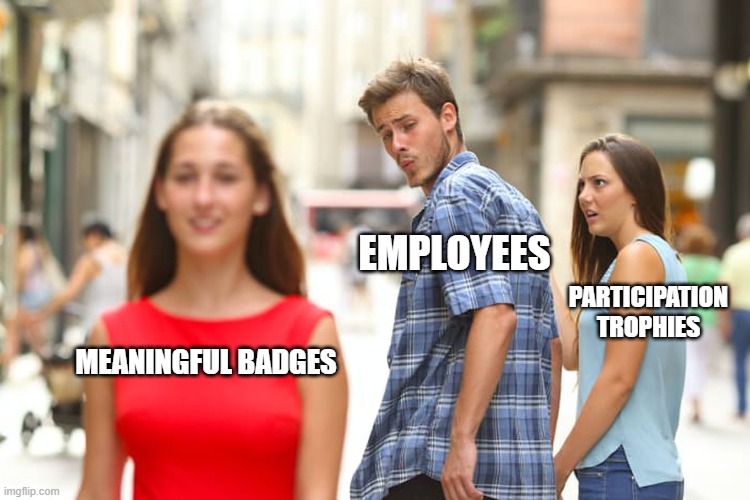
I’ll be blunt: a badge for logging in is a participation ribbon. It signals nothing. What works is a stackable badge for completing three advanced customer service modules, displayed on an internal profile or email signature, that signals real expertise to the people around you. The difference is whether the badge means anything outside the gamified LMS. Credentials that travel carry weight that internal-only badges never will.
3. Scenarios Where Wrong Answers Cost Something
The weakest gamified assessments I’ve encountered show the correct answer the moment a learner gets one wrong. Learners memorize the pattern. They click through. They “pass” without processing anything. The strongest ones let the wrong answer play out: the transaction gets flagged, the customer calls to complain, the manager has a conversation. The learner experiences the cost of the mistake before they understand why it was a mistake. That sequence changes things.
4. Leaderboards That Don’t Punish the Already-Behind
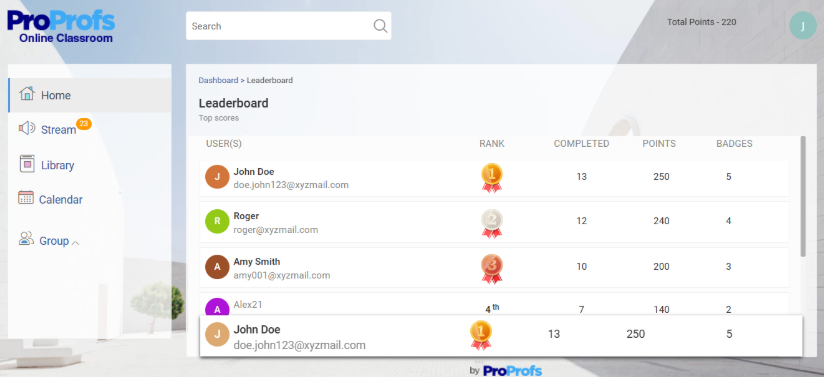
Classic individual rankings consistently demotivate the majority of a workforce. The people you most need to engage are usually the first to disengage when a leaderboard shows them they’re 400 points back with no realistic path forward. Team-based competition, progress-improvement scoring, and weekly resets fix most of this. When anyone can win, more people try.
5. Social Visibility
Peer recognition, team missions, and forum leaderboards that reward helpful contributors. Intrinsic motivation is genuinely hard to manufacture. Peer recognition is the closest reliable shortcut I’ve found.
These are the mechanics behind the best gamified learning management system implementations I’ve seen. Not the flashiest. The ones that hold up.
Real LMS Gamification Examples That Changed Behavior
I want to be specific here because “real examples” in most guides means vague case study summaries with no actual mechanic named. Each example below points to a specific design. Here are the rewritten sections, named companies only, no stats without primary sourcing:
IBM: The Badge That Travels Beyond the Platform
IBM’s digital badge program did one thing differently from most credential systems: it let employees post badges directly to LinkedIn and other social platforms the moment they earned them. The badge wasn’t locked inside a dashboard that nobody checked. It was visible to managers, colleagues, and recruiters.
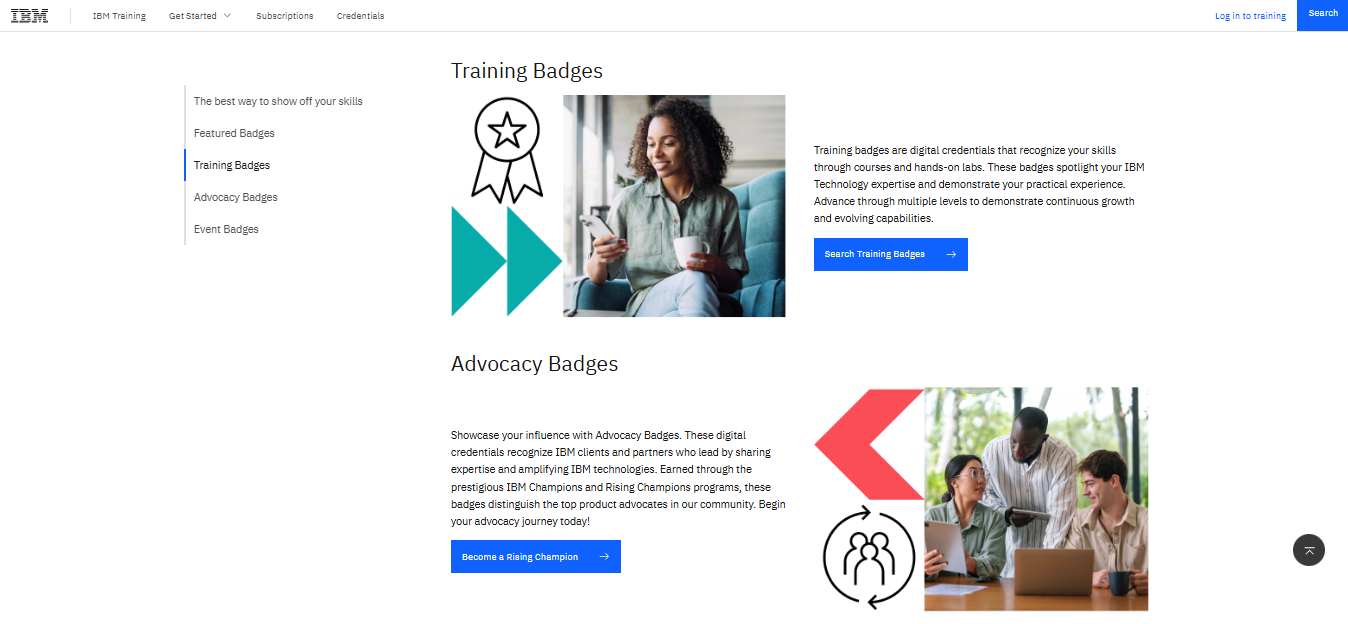
That design choice changed the implicit value of the credential. A badge that signals expertise only within the LMS is decorative. A badge that appears on a professional profile is career evidence. IBM built the second kind, and participation followed.
The mechanic: externally portable, shareable credentials. This is the single most underused idea in LMS gamification design, and IBM is the clearest example of what it looks like when it’s done right.
Deloitte Leadership Academy: Leaderboards That Don’t Punish Late Starters
The Deloitte Leadership Academy‘s leaderboard design made one decision that most implementations skip entirely: it reset every seven days, and competition was limited to users at the same level. A newcomer was never looking at a score gap they couldn’t close. They were looking at people in the same position they were in.
The Academy also used what they called “Snowflake” badges, secret credentials unlocked only by collective action. If every member of a department watched the same video in the same week, they all earned one. The badge couldn’t be earned alone. That structure made training a shared activity without announcing it as one.
The mechanic: peer-level competition with temporal resets, and surprise rewards tied to group behavior. Both are design decisions that require intention. Neither is a default LMS setting.
SAP Roadwarrior: Simulation Where the Consequence Is the Lesson
SAP built a training tool for its sales representatives called Roadwarrior. Instead of slides or click-through modules, reps were placed inside simulated customer meetings. They had to choose how to respond to questions, handle objections, and navigate the conversation. Getting it wrong didn’t produce a correction screen. The meeting continued with that outcome.
New content unlocked as reps progressed. Scores were visible across the team. The simulation covered different industries and customer types, so reps practiced variance, not just a single script.
The mechanic: consequence-driven simulation with progressive unlocks. The moment a learner knows their answer has an effect downstream in the scenario, they stop guessing and start thinking. That shift is what sales training is actually trying to create, and most compliance click-throughs never get there.
Walmart: When the Scenario Runs Faster Than the Classroom
Walmart’s training problem in 2016 was specific: how do you prepare associates to handle complex, high-pressure customer situations across thousands of locations without pulling everyone into a classroom? The answer was immersive simulation, VR environments where associates practiced customer interactions by living through them, not by reading about them.
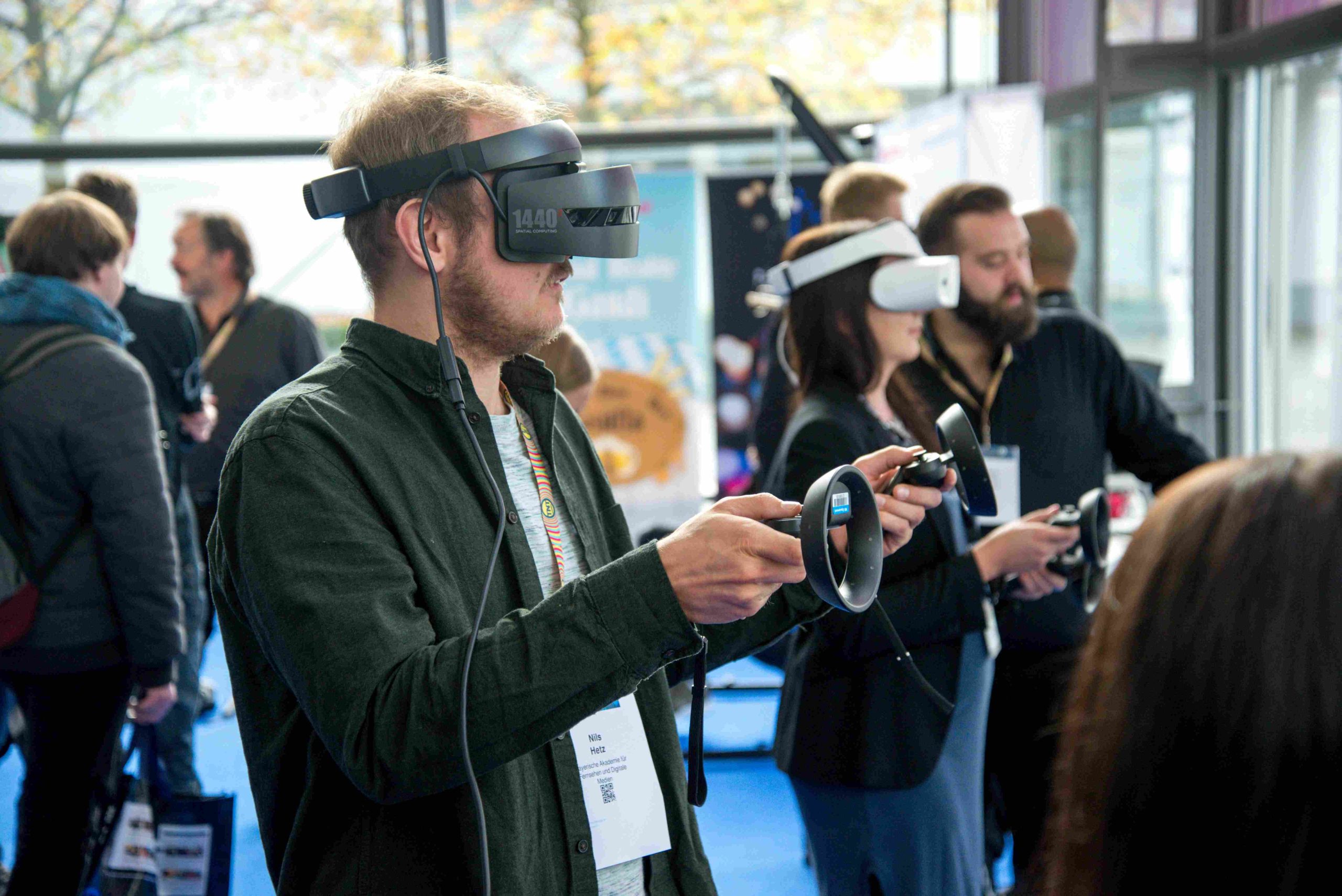
The training compressed what had been long classroom sessions into shorter, more intensive practice runs. Associates encountered difficult scenarios, made decisions, and dealt with outcomes before they ever faced a real customer.
The mechanic: immersive, time-compressed consequence learning. The scenario creates stakes. The stakes create attention. The repetition creates retention in a way that passive content doesn’t.
LMS Gamification Best Practices
There’s a reason most gamification rollouts peak in week two and flatten out. The mechanics weren’t wrong. The design decisions around them were.
These are the practices I’d stand behind based on what I’ve seen work.
1. Design the gamification before the course, not after it. Points and badges dropped onto passive content don’t transform it. They make it louder. If the gamification layer isn’t shaping the learning structure itself, from how decisions are framed to what consequences look like, it’s decoration. I’ve seen teams spend weeks configuring a gamified learning management system and then wonder why engagement didn’t move. The platform wasn’t the problem. The sequence was.
2. Tie rewards to outcomes, not activity. Completing a module and demonstrating a skill are not the same thing. When a point system treats them identically, learners notice, even if they can’t articulate why the whole thing feels hollow.
3. Keep leaderboards opt-in or team-based. Individual public rankings motivate a small competitive minority. For everyone else, they’re a reason to quietly disengage. I’ve seen this pattern so consistently across different organizations and industries that I’d call it close to a rule.
4. Don’t deploy during high-stress periods. This came up repeatedly in practitioner communities and it matches my own observation. Introducing new LMS gamification features during a restructure, a major system change, or a high-pressure quarter reads as tone-deaf. Timing matters as much as design.
5. Build accessibility in from the start. Colorblind-friendly badge design, keyboard-navigable branching scenarios, screen reader compatibility for progress elements. Retrofitting accessibility onto a gamified LMS implementation after the fact is substantially harder than building it in at the beginning. And the learners who need it most are usually the ones who disengage silently when you don’t.
6. Make stakes visible before feedback appears. This is the highest-leverage single design change I’d recommend to most training teams. Stop showing the correct answer immediately after a wrong one. Let the consequence play out first. That brief experience of cost is where real learning happens.
5 Best LMS Platforms With Gamification
I evaluated these five platforms on gamification depth, ease of setup, learner experience quality, reporting that connects engagement to outcomes, and integration fit with existing HR and CRM tools. Ratings are from Capterra.
| Platform | Capterra Rating | Best For | Pricing |
| ProProfs Training Maker | 4.8 | AI-powered employee training + gamification | Free plan; paid from $1.99/active learner/month |
| Tovuti LMS | 4.6 | Deep native gamification + interactive content | Custom pricing |
| iSpring Learn | 4.7 | Social learning + existing content libraries | From $3.58/user/month |
| Docebo | 4.3 | Enterprise AI + social gamification | Custom pricing |
| LearnUpon | 4.6 | Multi-audience training from one platform | From $599/month |
1. ProProfs Training Maker – Best for Easy AI-Powered Training Development and Scalable Employee Training
ProProfs Training Maker is a cloud-based, AI-powered LMS that I’ve found really helpful for corporate training, compliance, and employee development.
What I like most is how fast you can create courses. You can type a simple prompt, and the AI builds a complete training program for you. Try it yourself:

Let ProProfs AI create your training course
And if you don’t want to start from scratch, you get access to 500+ expert-built, editable courses on topics like sexual harassment prevention, leadership, communication, and workplace safety.
You can build lessons using videos, presentations, handouts, and interactive questions, which makes the learning experience more dynamic. Features like gamification, flashcards, and branched scenarios help keep learners engaged instead of just clicking through slides. Plus, everything works smoothly on mobile, and the platform supports 70+ languages, so your global or remote teams can learn without barriers.
The analytics are another thing I rely on. You can instantly see completions, performance, and where people are getting stuck. It makes it easier to spot skill gaps and align your training with real performance goals.
Pros:
- Helps you build training much faster since the AI can create course content for you, which saves a lot of time and effort
- Lets you launch full training programs instantly with a large library of expert-made courses, so you don’t have to create everything on your own
- Makes assessments more reliable with built-in quizzes, flexible question types, and strong anti-cheating settings that keep results accurate
- Makes it easier to track learners with clear reports, real-time progress updates, and insights you can actually use to improve training
Cons:
- No downloadable or on-premise setup
- No dark mode for low-light use
Pricing: A Free plan is available for growing businesses. Paid plans start at $1.99/active learner/month, followed by Business at $3.99/active learner/month.
Capterra Rating: 4.8/5
2. Tovuti LMS – Best for Deep, Native Gamification
If LMS depth is your primary criterion, Tovuti is where I’d start. It was built for engagement from the ground up. Points, badges, leaderboards, and progress maps are native features, not plugins configured after the fact.
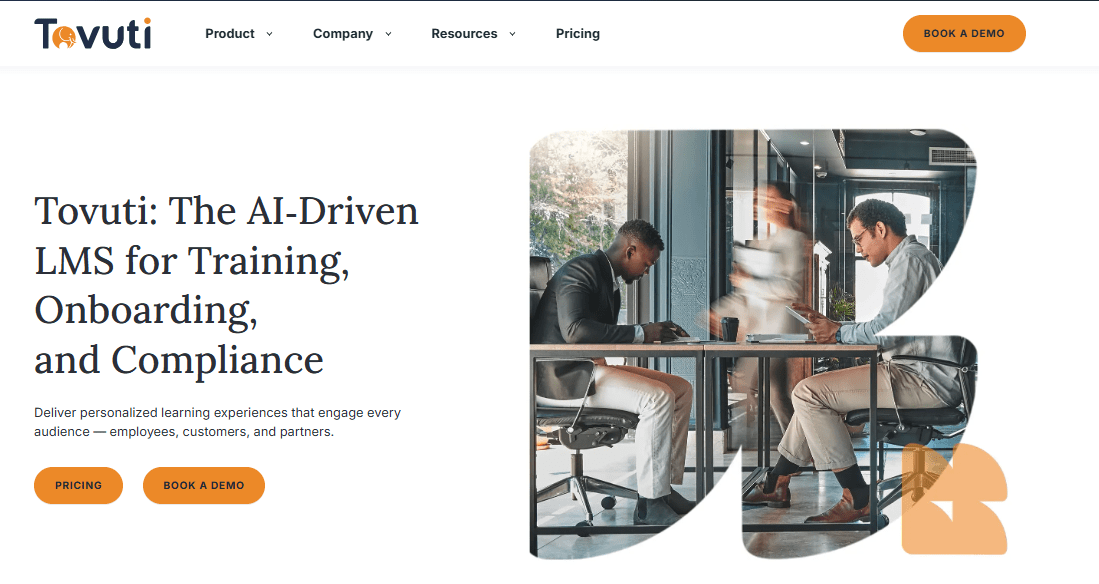
The interactive content library covers 40+ module types, including branching scenarios and simulations, meaning the gamification layer has genuinely engaging content to wrap around rather than just dressing up passive slides.
What separates Tovuti from tools that mention gamification in a feature list is the combination of mechanics depth and content flexibility. You can build the kind of scenario-based, consequence-driven training described in the real examples above without a custom development budget.
For L&D teams whose core challenge is learner engagement rather than compliance auditing, this platform addresses that problem most directly.
Pros:
- Native gamification with points, badges, leaderboards, and progress visualization as core, not add-on, features
- 40+ interactive content types, including branching scenarios and simulations
- Team-based mechanics and social learning tools built in from the start
Cons:
- Custom pricing requires a sales conversation before you can evaluate fit against budget
- Feature depth creates setup complexity; not a fast-deploy option for lean teams
- May be more than an SMB needs if compliance tracking matters more than engagement depth
Pricing: Custom pricing. Contact Tovuti directly.
Capterra Rating: 4.6/5
3. iSpring Learn – Best for Teams With Existing Content Libraries
iSpring Learn is the right call for organizations sitting on years of training material in PowerPoint that needs to become interactive without starting over.
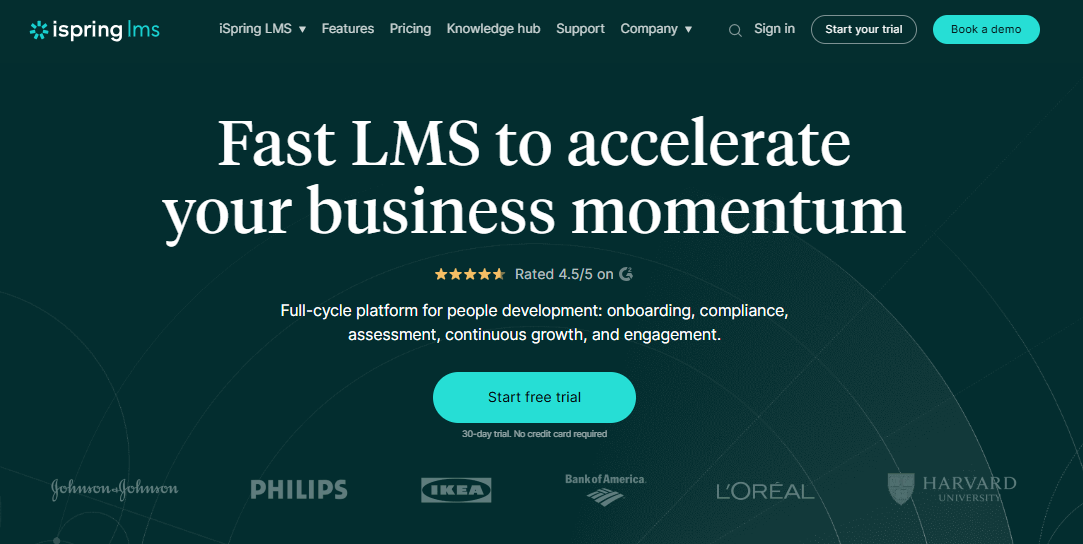
The platform converts slides to HTML5 and layers on an LMS with assignments, tracking, and a social learning environment including news feeds, peer feedback, and team channels. That social visibility functions as its own gamification mechanic, one that the platform doesn’t always name explicitly but that drives peer engagement consistently.
The skills appraisal feature closes a loop most tools leave open: connecting training completion to measurable competency tracking over time, visible to both admins and learners.
Pros:
- Best-in-class PowerPoint-to-HTML5 conversion preserving animations, audio, and interactions
- Social learning layer with news feeds, peer feedback, and channels that create peer visibility
- Skills appraisal connects course activity to demonstrated competency tracking
Cons:
- Gamification mechanics are narrower than platforms built around engagement as a primary feature
- Branding and customization options are more limited than enterprise-grade alternatives
- Pricing can feel rigid for teams with variable learner counts
Pricing: Starts at $6.91/user/month (100 users, billed annually).
Capterra Rating: 4.7/5
4. Docebo – Best for Enterprise AI Learning With Social Gamification
Docebo sits at the intersection of AI-driven learning and social engagement. For enterprise organizations with the budget and implementation runway, that combination delivers something most platforms can’t replicate.
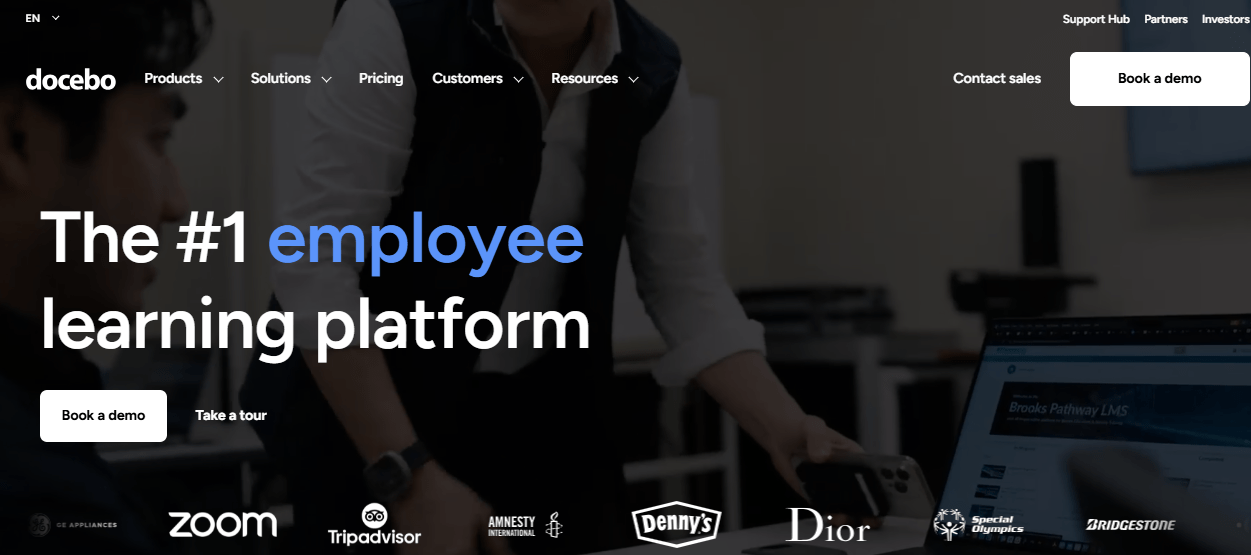
The AI layer personalizes learning pathways based on individual behavior. The Coach & Share module creates a social environment where gamification includes peer recognition, collaborative knowledge sharing, and a community feed that reflects real professional visibility dynamics.
For enterprise teams where individual leaderboards have stopped working, Docebo’s social gamification approach is worth the investment. Learners earn recognition from colleagues they respect, not from an algorithm they’ve figured out how to game.
Pros:
- AI-powered learning paths that adapt to individual behavior rather than serving static sequences to everyone
- Social learning and peer recognition that extend meaningfully beyond individual points and badges
- Built for enterprise scale across multiple regions and audience types
Cons:
- Typically starts around $25,000/year, which removes it from consideration for most SMBs
- Implementation complexity requires dedicated L&D and IT resources; not a fast deployment
- Platform sophistication requires meaningful onboarding before full value is realized
Pricing: Custom pricing. Typically starts around $25,000/year.
Capterra Rating: 4.3/5
5. LearnUpon – Best for Training Multiple Audiences From One Platform
LearnUpon’s defining feature is its portal architecture: separate branded LMS environments for employees, customers, and partners running from a single platform, each with its own gamification layer, learning paths, and reporting.

For organizations running customer education alongside internal training, this eliminates the operational mess of managing two tools with two data sets.
Each portal supports its own points, badges, and leaderboards, so it is contextually appropriate for each audience rather than forcing a one-size-fits-all engagement design.
Gamification depth is functional rather than deep, but the operational value of multi-audience delivery from one platform frequently outweighs that for the teams this is built for.
Pros:
- Multi-portal architecture runs separate LMS environments for different audiences from one account
- Clean, intuitive learner interface that requires no training to navigate
- Consistently strong customer support reputation in user reviews
Cons:
- Gamification mechanics are adequate but not a differentiator; limited depth vs. Tovuti
- Starting at $599/month, expensive for single-audience or small-team use cases
- Admin-side experience is noticeably less refined than the learner-facing interface
Pricing: Starts at $599/month.
Capterra Rating: 4.6/5
How I Evaluated These Platforms
I didn’t choose these platforms just because they had gamification on their features page. I picked tools that are actually useful for teams looking to keep people engaged and improve training.
Here’s what I looked for:
- Built-in gamification that works – Points, badges, leaderboards, progress tracking, these features had to be part of the main product, not hidden or complicated to set up.
- Real user feedback – I checked reviews on Capterra & G2 to see what people liked, what they didn’t, and how these tools performed in real situations.
- Ease of use – I preferred tools that are easy to set up and manage without needing a tech expert. If a tool is too confusing, no one will use it.
- Training flexibility – Good platforms let you create different types of content, build challenges, and guide learners through a path, not just dump all materials in one place.
- Support and help when needed – Whether you’re a small team or running training for a large company, quick and helpful support can save a lot of time.
- Price and long-term value – I looked for fair pricing with features that justify the cost. Some tools offer good basics for small teams, while others scale well as you grow.
- Integrations that make life easier – I made sure the tools worked well with other software like HR systems, CRMs, or Single Sign-On, so it all connects without more manual work.
This mix of research, real feedback, and firsthand experience helped me pick platforms that don’t just look good, but actually help you build better training with gamification.
The Points Don’t Matter. The Progress Does.
The organizations getting real results from LMS gamification aren’t the ones with the most complex point systems. They’re the ones who figured out what their learners actually care about and built mechanics that reflect it.
Sometimes that’s team competition. Sometimes it’s a credential that travels outside the platform. Sometimes it’s a scenario that finally makes a compliance module feel like something is actually at stake.
I’ve seen all three work. I’ve also seen expensive, feature-rich gamified LMS platforms produce exactly nothing because the design decisions underneath the mechanics were never thought through. The platform matters less than you think. The question you ask before you build matters more.
Whatever platform you end up on, keep asking it: if you stripped the gamification out, would the training collapse?
It should.
Frequently Asked Questions
What is LMS gamification?
LMS gamification applies game mechanics, such as points, badges, leaderboards, and branching scenarios, inside a learning management system to increase engagement and knowledge retention. It works best when mechanics connect to real learning outcomes, not just course completion activity.
What's the difference between cosmetic and substantive gamification in LMS?
Cosmetic gamification sits on top of passive content and can be removed without changing anything about the learning experience. Substantive gamification is structural: decisions have consequences, progress is tied to demonstrated skill, and the learning design itself depends on the mechanics. The second type produces real behavior change. The first produces completion theater.
Does gamification actually improve learning outcomes?
Yes, when designed correctly. Gamified learning management system implementations that tie mechanics to real skill application consistently improve completion rates and retention. Cosmetic gamification, points and badges layered onto passive content, produces short-term novelty and no lasting change.
What is the best gamified LMS for employee training?
For most organizations, ProProfs Training Maker offers the best balance of gamification features, ease of setup, and pricing. For teams where deep engagement mechanics are the primary priority, Tovuti LMS offers the most comprehensive native gamification layer. The right answer depends on whether your core challenge is engagement depth or operational simplicity.
Why do leaderboards demotivate learners?
Individual leaderboards consistently motivate a small competitive minority while signaling to everyone else that they've already lost. Team-based rankings, progress-improvement scoring, and opt-in participation fix most of this by making the question "who improved most" rather than "who already knows the most."
What is a gamified learning management system best used for?
Compliance training, onboarding, safety training, and sales enablement are the highest-impact use cases. Any training where learner attention is low and completion is mandatory benefits most from well-designed gamification mechanics in an LMS.
How do I know if my LMS with gamification is actually working?
Look beyond completion rates. Track assessment scores before and after gamification rollout. Measure on-the-job behavior change, not just module finishes. Check whether the same employees are dominating your leaderboard while everyone else flatlines, which is a sign the mechanics need redesigning, not reinforcing.
Can gamification work for compliance training?
Yes, and it's one of the strongest use cases for gamification LMS design. Scenario-based assessments with visible consequences, branching paths that simulate real decisions, and certification mechanics tied to demonstrable competency all turn passive compliance modules into training people actually process.
Let ProProfs AI create your training course

 We'd love your feedback!
What did you like & how can we make it even better?
 Thanks for your feedback!
 Ask Your Question
Have a question? Get expert help to make your decision easier.