

You’ve probably seen this happen. A new agent joins your team, starts with a lot of energy, reaches out to friends and family, and then… things slow down. Within months, they’re unsure what to do next, and many eventually drop off.
According to Tom Ferry, a leading authority in real estate coaching, 87% of new real estate agents fail within five years in the US. From what I’ve seen, this isn’t about talent. It’s about how we approach training for real estate agents.
Effective training for real estate agents combines structured onboarding in the first 90 days with ongoing coaching, covering prospecting, sales skills, contracts, negotiation, and technology, delivered through LMS platforms like ProProfs Training Maker that tracks completion and measures understanding.
In this guide, I’ll walk you through the real estate training topics and coaching ideas that actually help agents stay consistent and grow.
This guide is for:
- Real estate team leaders trying to retain and scale their agents
- Brokers who want a structured training system instead of ad hoc sessions
- Trainers and coaches building real estate agent training programs
- Growing teams that need consistent onboarding and continuous training
- Anyone looking for practical, real-world training ideas that actually work
Why Most Real Estate Agent Training Fails
Before building anything, it helps to name what’s broken in most programs.
| Problem | What it looks like in your office |
|---|---|
| Training is scattered | Content lives in email, PDFs, OneNote, and old Zoom links nobody can find |
| No repeatable onboarding | Each manager trains differently; new agents get inconsistent starts |
| Content isn't role-specific | A buyer's agent and a listing specialist get the same generic modules |
| No tracking or accountability | You have no idea who watched what, or who's actually ready for a client |
| Reinforcement is missing | Information gets dumped in week one and never revisited |
| Mentorship isn't structured | Shadowing happens once, informally, and is never followed up |
The fix isn’t more content. It’s a structure that delivers the right content, at the right time, with the ability to see what’s working.
How to Structure a Real Estate Agent Training Program
Knowing the topics is step one. The structure is where most programs fall apart.
The First 90 Days: A Week-by-Week Roadmap
| Timeframe | Focus | Delivery Format |
|---|---|---|
| Week 1 | Systems, tools, brokerage intro, compliance | Self-paced modules + manager walkthrough |
| Week 2 | Prospecting fundamentals, CRM setup, daily routine | Workshop + role-play |
| Week 3 | Buyer consultations, showing process, offer writing | Shadowing + scenario practice |
| Week 4 | Listing presentations, CMA basics, objection handling | Role-play + feedback session |
| Month 2 | Live deal support, contract literacy, negotiation | Deal debrief + coaching calls |
| Month 3 | Personal brand, lead nurturing, market knowledge | Peer workshop + individual review |
The goal of the first 90 days isn’t to cover everything. It’s to get agents to their first deal without making an avoidable mistake, and to build habits that stick.
Onboarding vs. Ongoing: Two Different Programs
Most brokerages treat onboarding as the entire program. It isn’t. These are two separate needs.
| Onboarding Training | Ongoing Training | |
|---|---|---|
| Goal | First deal, safely | Consistently better performance |
| Duration | 4 to 8 weeks | Continuous |
| Format | Structured modules + shadowing | Workshops, coaching, market updates |
| Content driver | Standard curriculum | Performance data and team gaps |
| Who needs it | All new agents | All agents, at every level |
Ongoing real estate training topics should be driven by what your team’s numbers actually show. If agents are losing deals at the offer stage, that’s a negotiation training problem. If leads are going cold after the first contact, that’s a nurturing problem. Your training calendar should be driven by real data, not a preset schedule.
Build Role-Specific Learning Paths
One-size-fits-all programs frustrate experienced agents and overwhelm new ones. If your team has any real size or specialization, the content needs to branch.
- New buyer’s agents need a different track than listing specialists
- Property managers need different content than residential sales agents
- Luxury agents need different market knowledge and presentation training than entry-level agents
- Support staff and transaction coordinators need their own technical track
Real Estate Coaching Topics for Recurring Sessions
Beyond core onboarding, these work well as monthly or quarterly workshop sessions. Keep them focused: 45 minutes with practical exercises beats a two-hour lecture every time.
| Session Topic | Format | Who It's For |
|---|---|---|
| Objection handling live drills | Role-play pairs | All agents |
| Listing copywriting workshop | Write and critique real listings | All agents |
| CMA presentation practice | Present to the group, get feedback | Agents under 1 year |
| Prospecting bootcamp | Build a 30-day daily routine | Agents in first month |
| Deal rescue scenarios | Work through a real deal that nearly fell apart | All agents |
| Client follow-up system setup | Build a CRM nurture sequence live | All agents |
| Tech tools walkthrough | Run through a full transaction workflow | New agents |
| Market update and strategy | Review local data, adjust approach | All agents, monthly |
Record every session. Agents who can’t attend live get access afterward, and you build a library over time without extra effort.
How to Create a Real Estate Training Course on ProProfs Training Maker
If you’re managing training across a team and still relying on shared drives and email threads, moving into a structured platform changes the day-to-day reality of running a program. Here’s the exact workflow for building a real estate course in ProProfs Training Maker.
Step 1: Set Up Your Account and Workspace
- Create your account at proprofstraining.com
- Set up your brokerage as the organization and upload your logo for branded training
- Add team members: assign admin roles to managers, instructor roles to senior agents who will contribute content
Step 2: Choose Your Starting Point
ProProfs gives you two options. You can build from scratch or start from the library.
- Build from scratch: Use the AI course builder by typing a prompt like “Create a 4-week onboarding program for new buyer’s agents” and letting it generate a module structure you then customize

Let ProProfs AI create your training course
- Use the library: Browse 500+ pre-built courses and filter for real estate, sales, and compliance topics. Edit any course to match your brokerage’s specific workflows, forms, and market
Step 3: Build Your Course Modules
Structure each course around a logical sequence, not a content dump.
- Break each topic (prospecting, contracts, negotiations) into standalone modules of 10 to 15 minutes each
- Upload existing content: PDFs, slide decks, recorded Zoom sessions, and videos all import directly
- Add interactive elements to each module: quizzes, scenario-based questions, and branching situations where agents choose how to handle a live situation
- Use flashcards for high-recall content like contract terms or objection responses
Step 4: Create Learning Paths by Role
- Set up separate paths for new buyer’s agents, listing agents, property managers, and support staff
- Assign the correct path to each team member when they join
- Set prerequisite rules so agents can’t skip ahead: Week 2 content unlocks after Week 1 is completed and passed
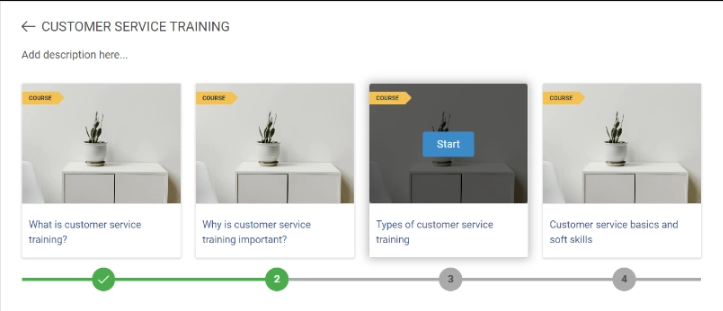
Step 5: Add Assessments That Actually Measure Understanding
- Add a quiz at the end of every module (not just the course)
- Use scenario questions, not just multiple choice: “Your buyer wants to waive the inspection contingency. What do you do?” with branching answer choices
- Set passing scores and allow retakes with randomized question pools so agents can’t memorize the order
- Enable certificates for completed learning paths; agents get tangible proof of completion, and you get documentation.
Step 6: Assign, Track, and Follow Up
- Assign courses to individuals or groups with a completion deadline
- Monitor the dashboard: completion rates, assessment scores, time spent per module, and which questions are getting consistently wrong answers
- Use the wrong-answer data to identify where your training content needs to be clearer, not just where agents are struggling
- Set automated reminders so agents get nudged without you having to chase them manually
Step 7: Update Content Without Starting Over
- When NAR guidelines update, state forms change, or your brokerage adopts a new tool, update only the affected module
- All agents on active paths get the updated version automatically
- Archive outdated versions so you have a record of what was taught and when
What Are the 10 Training Topics Every Real Estate Agent Needs?
These are the core areas your training program has to cover. Each one includes what most brokerages skip, because knowing the gap is more useful than knowing the topic exists.
1. Prospecting and Lead Generation
Most agents exhaust their personal network within 60 days and have no system after that. Training here needs to go beyond theory.
- Daily prospecting routines (calls, door knocking, video outreach)
- CRM setup and consistent use from day one
- How to build a geographic farm or niche market
- Scripts and frameworks for cold outreach that don’t sound scripted
What brokerages skip: Agents leave onboarding knowing what prospecting is, but without a working daily method. Build the habit, not just the awareness.
Watch: How to Get Leads
2. Sales Training for Real Estate Agents
Sales training for real estate agents is about buyer and seller psychology, not pitch scripts. Agents need to understand why someone hesitates, what an objection actually means, and how to move a conversation forward without putting pressure on the customer.
- Objection handling frameworks for buyers and sellers
- How to qualify leads early so agents stop wasting time on non-buyers
- Running a listing presentation with confidence and structure
- Reading the room during showings and consultations
What brokerages skip: This is almost always covered by reading material alone. Role-play and live scenario practice are what actually build the skill.
3. Negotiation Skills
Negotiation in US real estate is as emotional as it is financial. The seller who won’t budge on the garden shed. The first-time buyer who’s terrified of losing the house and overbidding themselves into stress. Agents need to handle both sides.
- How to anchor, counter, and close without damaging the relationship
- Reading both parties in a transaction and knowing when to push vs. hold
- Keeping a deal together when inspection findings threaten to blow it up
- How to negotiate repairs, credits, and contingency removals
What brokerages skip: Most negotiation training is tactical. The emotional intelligence side, reading a scared buyer or a stubborn seller, is what agents actually need in the field.
Watch: How to Master Persuasion & Negotiation
4. Local Market Knowledge
Agents who know their market win more listings. In the US, this means hyper-local knowledge, not just general MLS awareness.
- Neighborhood trends, school district ratings, and HOA landscapes
- How to pull and present a CMA that clients actually trust
- Tracking active, pending, and sold inventory to spot shifts early
- Understanding which micro-markets are appreciating vs. cooling
What brokerages skip: Market knowledge training is treated as a one-time orientation. It needs to be a recurring real estate coaching topic because the market moves constantly.
5. Contract Literacy
Agents who don’t understand contracts make errors that kill deals and create liability. This is true of the NAR forms used across the US and state-specific addenda that vary significantly.
- Offer writing: contingencies, earnest money, timelines, and escalation clauses
- Common addenda and when each one is required
- What happens when a contingency deadline is missed
- How to explain contract language to a client without sounding unsure
What brokerages skip: Contract training is given once during onboarding and never revisited. Agents need to be walked through actual live scenarios, not just read the form.
6. Technology and Tools
45% of brokers report that keeping agents current on technology is their biggest training challenge. Don’t assume agents will figure out the tools on their own.
- MLS listing systems and how to set up accurate client searches
- E-signature platforms (DocuSign, DotLoop) and transaction management
- 3D tour tools and listing marketing tech
- CRM platforms and how to use them for actual lead nurturing, not just contact storage
What brokerages skip: Generic “here’s the platform” walkthroughs. Train each tool inside a real workflow scenario so agents see exactly when and how to use it.
7. Marketing and Personal Brand
An agent who can market themselves doesn’t need the brokerage to hand them leads indefinitely. This is one of the most underdeveloped real estate agent training ideas in most programs.
- Property copywriting that generates inquiries, not just descriptions
- Social media content that builds trust over time without being spammy
- Email campaigns and how to stay relevant to a database
- Building a referral system that compounds over years, not months
What brokerages skip: Agents are told to “build their brand” with no practical instruction on how to write a listing description, what to post, or how often.
8. Time Management and Business Mindset
New agents in the US often don’t realize they’ve become self-employed business owners. The absence of a boss telling them what to do every hour is disorienting and quickly becomes dangerous.
- Daily and weekly schedule templates tied to income goals
- How to prioritize when everything feels urgent
- Accountability systems that don’t require a manager to police
- Understanding income variability and how to manage it psychologically
What brokerages skip: This is treated as soft skills content that can wait. It should be week one material, because agents who don’t manage their time in month one rarely recover.
Watch: How to Master Time Management
9. Presentation Skills
Whether it’s a listing appointment or a buyer consultation, agents who present with clarity and confidence win more business. This is not just about slides.
- How to open a listing presentation and establish credibility quickly
- Framing a price recommendation so sellers accept it rather than push back
- Handling objections during presentations without becoming defensive
- Closing a meeting with a clear next step, both parties commit to
What brokerages skip: Agents are expected to develop presentation confidence through exposure alone. Structured practice with feedback accelerates this by months.
Watch: How to Make Strong Presentations
10. Lead Nurturing
Most agents only chase leads who are ready right now. The ones who build sustainable businesses in the US market stay connected through 12-month and 24-month timelines.
- What a CRM nurture sequence actually looks like, step by step
- How to stay relevant through market updates, check-ins, and local content
- Identifying where each contact sits in their buying or selling timeline
- How past clients become referral engines if you stay in contact consistently
What brokerages skip: Agents are taught the CRM exists, but not how to build a nurture sequence that feels personal rather than automated spam.
Watch: How to Nurture Sales Leads
Make Your Training for Real Estate Agents a Competitive Advantage
Training for real estate agents doesn’t have to be complicated. But it does have to be intentional, sequenced, and built around what agents actually need in the field, not what’s easiest to put into a PDF.
The brokerages retaining agents, building strong teams, and consistently outperforming their markets aren’t doing it with better people. They’re doing it with better systems. A first-90-days roadmap. Role-specific paths. Recurring coaching sessions tied to real performance gaps. Content that lives somewhere agents can actually find it.
Start with what you have. Audit your existing content this week, map it to a timeline, and identify the single biggest gap in your first 30 days of onboarding. Fix that first. Build from there.
Frequently Asked Questions

How long should real estate agent training take?
Onboarding training typically runs for 4 to 8 weeks, covering what an agent needs to reach their first deal without making avoidable mistakes. Ongoing training is indefinite. The top-performing agents in the US continue building specific skills throughout their careers. Think of onboarding as the floor, not the ceiling.
What is the difference between real estate agent training and real estate coaching?
Training is structured learning through courses, modules, and workshops that build specific, repeatable skills. Coaching is personalized: regular one-on-ones between a manager or mentor and an agent focused on performance, mindset, and solving real problems they’re facing right now. Strong programs include both. Training provides the foundation; coaching helps agents apply it to actual transactions.
How do I train real estate agents remotely?
Remote training works well when it is self-paced and structured. Use a platform that delivers modules agents can complete on their own schedule and return to when something comes up mid-transaction. Supplement with regular video calls for coaching, group Q&A, and live role-play. The key is not treating remote as a second-class version of in-person. With the right platform and cadence, it can be more effective because agents can learn exactly when they need to.
Can I add multiple instructors in an AI LMS?
Yes. Platforms like ProProfs Training Maker support multiple instructors and administrators, so you can assign different team members to build, manage, and deliver specific courses. A sales lead can own the prospecting modules. A senior agent can run contract literacy. A tech-forward agent can own the tools walkthrough. Each course can have its own owner without giving everyone access to everything.
Let ProProfs AI create your training course

 We'd love your feedback!
What did you like & how can we make it even better?
 Thanks for your feedback!
 Ask Your Question
Have a question? Get expert help to make your decision easier.