


Compliance is no longer just about avoiding penalties. It’s a strategic imperative that touches everything—from hiring and retention to company culture and employer brand.
In 2026, HR is at the center of it all.
New state mandates, stricter harassment laws, evolving data privacy regulations, and AI oversight are rewriting the rules.
The risk is not just penalties—but lawsuits, bad press, and lost talent.
Yet, with the right strategy, compliance can become your competitive edge.
In this article, I’ll cut through the noise and show you:
- The must-know legal changes for 2025
- What they mean for HR leaders
- How you can build a compliance program that drives culture, not just checkboxes
2026 Compliance Shifts That Demand HR’s Attention
1. Sexual Harassment Prevention Training
As of 2025, California, Connecticut, Delaware, Illinois, Maine, and New York continue to mandate that employers provide harassment training to employees and supervisors. The frequency and content of the training vary across states.
What’s new:
- California’s filing window is 3 years from the last incident of harm for complaints submitted to the Civil Rights Department.
- The EEOC’s April 2024 guidance expands what qualifies as unlawful harassment, including virtual and digital interactions, making updated training essential.
- States without mandates continue to strongly encourage harassment training as part of a proactive workplace culture.
Even in states where it’s not a legal requirement, many others strongly encourage this training as part of a proactive workplace culture.
HR Takeaway:
- Check sexual harassment training requirements for your state.
- Add harassment prevention training to onboarding, internal communications, and regular compliance audits.
? Explore ready-to-use, fully compliant & customizable anti-harassment courses
2. Pay Transparency Mandates
Starting in 2025, Illinois, Minnesota, Vermont, Massachusetts, and New Jersey require employers to disclose salary ranges and, in some cases, benefits in job postings. These laws aim to boost fairness and transparency in hiring.
What’s new:
- Illinois (Jan 1, 2025): 15+ employees must disclose salary and benefits in postings and notify internal teams about promotions.
- Minnesota (Jan 1, 2025): Employers with 30+ employees must publish a fixed salary or pay range in job postings.
- New Jersey (June 1, 2025): 10+ employees must disclose pay for new roles and promotions.
- Vermont (July 1, 2025): 5+ employees must add salary details to job postings.
- Massachusetts (Oct 29, 2025): 25+ employees must provide pay ranges in postings and promotion discussions, with tiered penalties for repeated violations.
- Delaware (Effective Sep 26, 2027): 26+ employees must disclose salary ranges and benefits, with a longer preparation window.
HR Takeaway: Update job posting templates, align recruiting teams, and conduct internal pay equity reviews.
3. Consumer Data Privacy Laws
Eight new state privacy laws are now in effect in 2025. Each introduces unique requirements covering consent, profiling limits, data access, and security controls. HR teams play a crucial role in ensuring employees complete updated privacy and security training.
What’s New:
Here are the major State Privacy Laws that Took Effect in 2025
- New Hampshire SB 255 – Jan 1, 2025
- Delaware Personal Data Privacy Act – Jan 1, 2025
- Iowa Consumer Data Protection Act – Jan 1, 2025
- Nebraska Data Privacy Act – Jan 1, 2025
- New Jersey SB 332 – Jan 15, 2025
- Tennessee Information Protection Act – Jul 1, 2025
- Minnesota Consumer Data Privacy Act – Jul 31, 2025
- Maryland Online Data Privacy Act – Oct 1, 2025
The scale of the risk here isn’t theoretical: the February 2024 ransomware attack on Change Healthcare exposed the data of 192.7 million people, the largest healthcare data breach in US history, and stemmed partly from gaps in basic access controls rather than a novel attack method. Privacy and security training that only covers the letter of a new state law without addressing basic access hygiene misses where the actual risk sits.
HR Takeaway: Include data privacy and security training for your people. Update the right people in your org to update the data consent processes, privacy policies, and system access protocols.
Explore ready-to-use data protection & cyber security training courses
4. Workplace Violence Prevention Laws
States continue strengthening workplace violence requirements, especially for healthcare and frontline environments. These laws focus on structured prevention plans, stronger incident reporting, and mandatory annual training.
What’s New: In Oregon:
- Oregon: The HB 2552 and SB 537 package, which requires healthcare employers to establish safety committees, conduct regular safety assessments, provide annual training, and report incidents, is now scheduled to take effect January 1, 2026.
- Massachusetts: Proposed legislation (H.2655 and H.2364) that would mandate comprehensive prevention plans, annual risk assessments, and required training remains pending. Although not yet enacted, healthcare employers are encouraged to prepare voluntarily as similar laws have gained momentum nationwide.
HR Takeaway: Implement or enhance workplace violence prevention measures, especially in healthcare settings. Prioritize annual training, risk assessments, clear incident reporting channels, and safety committees to stay aligned with emerging state requirements.
? Ready-to-use Online Workplace Violence Prevention Training Course
5. OSHA Safety Standards
OSHA is rolling out major safety updates in 2025, and construction companies must act now to stay compliant. These changes focus on three key areas: properly fitting PPE, heat illness prevention, and stricter lead exposure limits.
What’s New:
- PPE Fit (Effective Jan 13, 2025): Construction employers must ensure PPE fits each worker properly, addressing longstanding issues affecting women and workers with diverse body types.
- Heat Illness Prevention: A national heat standard is still in the proposal stage, with requirements expected to include guaranteed access to water, rest breaks, shade, and a written Heat Injury and Illness Prevention Plan (HIIPP). Finalization is anticipated after 2025.
- Lead Exposure (California, Jan 1, 2025): California significantly reduced allowable lead exposure levels, setting the permissible exposure limit at 10 µg/m³ and lowering the action level to 2 µg/m³, triggering enhanced monitoring and medical protections.
HR Takeaway: Coordinate with operations and safety teams to update training, conduct PPE fit checks, and prepare for a federal heat safety standard.
? Ready-to-use OSHA Training Courses
6. AI and Bias in Hiring Algorithms
As artificial intelligence (AI) becomes more integrated into hiring processes, several U.S. states have enacted or are planning laws to ensure these technologies promote fairness and transparency. Notably, some of these regulations are set to take effect from 2025 onwards.
What’s New
- Texas (HB 149): Requires impact assessments, documentation, and applicant notices for high-risk hiring tools beginning January 1, 2026.
- Colorado (SB24-205): Establishes strict governance, risk management, and annual impact assessment requirements for employers using high-risk AI systems, effective June 30, 2026.
- Illinois (HB 3773): Expands anti-discrimination protections and requires notice when AI is used in employment decisions, effective January 1, 2026.
- Existing laws in New York City and Utah remain active, while California’s proposed bill (AB 2930) is still under consideration.
HR Takeaway: Review and map every AI system used in screening, interviewing, or selection. Prepare for disclosure, documentation, and audit requirements by aligning your vendors and internal processes with evolving state regulations.
Here is a comprehensive overview of these regulations:
| State/Locality | Legislation & Status | Key Provisions | Effective Date |
|---|---|---|---|
| California | AB 2930 (Proposed) | Requires developers/deployers of automated decision systems to perform impact assessments before deployment and annually, submitting to CA Civil Rights Dept. | TBD |
| Colorado | SB 205 (Enacted) | Employers using high-risk AI for employment must prevent discrimination via risk management, annual assessments, and consumer notices. | Feb 1, 2026 |
| Illinois | HB 3773 (Enacted) | Amends Human Rights Act to prohibit discriminatory AI in employment; requires notices to employees/applicants. | Jan 1, 2026 |
| Illinois | AI Video Interview Act (Enacted) | Regulates AI video analysis: applicant consent, AI explanations, data limits. | Jan 1, 2020 |
| Maryland | HB 1202 (Enacted) | Mandates signed waivers for facial recognition in interviews. | Oct 1, 2020 |
| New York City | Local Law 144 (Enacted) | Bans unaudited automated tools; requires bias audits, public disclosure, candidate notices. | July 5, 2023 |
| Texas | HB 149 (Enacted) | TRAIGA: Ethical guidelines for high-risk AI in employment, including assessments and notices. | Jan 1, 2026 |
| Virginia | HB 214 (Proposed; refiled from 2094) | Requires measures to prevent discrimination in high-risk AI systems. | TBD |
| Utah | AI Policy Act (Enacted) | Clear notices for generative AI interactions; $2,500 fines for non-compliance. | May 1, 2024 |
| New Jersey | AB 4909 (Proposed) | AI Act: Impact assessments and risk policies to prevent discrimination. | TBD |
| Massachusetts | SB 2559 (Proposed) | Notices for automated systems; regular audits for fairness. | TBD |
| Washington | HB 1655 (Proposed) | Applicant notices for AI in hiring; regular bias audits. | TBD |
The Colorado AI Act’s own rollout shows how fast this area moves: after being delayed twice, the law is now facing a federal court challenge that stayed its enforcement in April 2026, just before its scheduled effective date. Any AI-hiring compliance program needs to be built to track litigation status, not just statutory effective dates.
7. Data Security Standards in Finance
Financial institutions face phased compliance obligations under PCI DSS 4.0, with additional requirements tied to hardware lifecycles and payment technology transitions.
What’s New:
- January 1, 2025: TR-31 key block requirements are in effect for secure cryptographic key management.
- March 31, 2025: PCI DSS 4.0 best-practice controls became fully mandatory for all institutions.
- April 30, 2027: The expiration date for PCI PTS 5 hardware has been extended, giving institutions more time to migrate to PCI 6-compliant systems.
- October 13, 2026: Support for Windows 10 LTSC 2016 will end, requiring operating system updates.
- 2027–2033: Mastercard begins the U.S. phase-out of magnetic stripes, promoting full EMV/contactless adoption.
HR Takeaway: Partner with compliance and IT teams to train employees on new PCI requirements and support long-term planning for hardware and OS upgrades tied to security standards.
Documentation, Accessibility, and What ‘Global’ Adds
Recordkeeping isn’t one rule, it’s whichever rule is strictest for you
Every regulation above sets its own retention clock: HIPAA requires six years for training and compliance documentation (45 CFR §164.530(j)), EEOC-related records fall under a separate one-year baseline (two years for educational institutions and government contractors) under 29 CFR §1602, and pay transparency and privacy laws generally don’t specify a number at all, which means falling back to your state’s general employment-records statute. The practical fix: default to your single longest applicable retention period across every regulation that touches your organization, and keep the same four things regardless of which law you’re documenting for, who completed training, when, what content they saw, and their assessment results if any.
Accessibility and language access aren’t optional add-ons
If you have any healthcare operations or federal funding, Section 1557 of the ACA already requires free interpreter services for patients with limited English proficiency and staff training on that policy within 30 days of adoption. Beyond that specific rule, ADA obligations around reasonable accommodation apply to how you deliver training generally, not just to the workplace itself, screen-reader compatibility, caption availability, and language options aren’t nice-to-haves for a workforce with any linguistic or ability diversity.
This guide is US-focused. If you have people outside the US, here’s the short version
The UK Bribery Act 2010 reaches any company doing business in the UK regardless of where bribery occurs, and names training explicitly as part of an adequate-procedures defense. The EU’s Pay Transparency Directive (2023/970) had a transposition deadline of June 2026, with most member states still rolling out their own versions. Canada and Australia both regulate harassment prevention at the sub-national or guideline level rather than through one federal law. None of this maps cleanly onto the US state-by-state model above, so if a meaningful share of your workforce is outside the US, that’s worth its own dedicated compliance review rather than an extension of this one.
Are You Ready to Lead the Charge?
2025 is calling for bold, proactive HR leadership—and you’re in the driver’s seat.
New laws demand more than annual check-the-box training. They require a cultural shift. A mindset change. And a readiness to act fast.
Whether it’s anti-harassment, pay transparency, AI fairness, or data protection, you need training programs that are:
- ✅ Legally up-to-date
- ? Easy to roll out
- ? Trackable in real-time
- ?? Tailored for every role and risk
Here’s How to Launch Compliance Training in 3 Simple Steps
Step 1. Pick a course from the ProProfs Library
Search from our ready-to-use, fully customizable, expert-taught compliance courses that match your needs (e.g., sexual harassment prevention, workplace safety, data privacy).
Start with the most pressing one – Sexual Harassment Training in the Workplace.
Here are the exact steps you can follow to launch this training instantly.
Watch this 3-minute video that walks you through how to set up your training program.
ProProfs courses are fully editable, so you can tweak the content to match your internal policies or region-specific regulations (optional).
You can also create your own training content using ProProfs’ built-in AI course creator—just input your details, and it’ll generate a training module in minutes. Watch this quick video tutorial on how you can create a course with AI in minutes.
Step 2. Assign it by employee role, department, or location
Once you’ve chosen the course, add your instructors who create and manage training in the future, add your learners, and create groups based on job roles, teams, or office branches. You can also create user groups in a virtual classroom to make future assignments easier.
I’ve created a video tutorial for you. It teaches how to do all the above:
Step 3. Track completions, automate reminders & prep for audits
Go to the Reports dashboard to view who all have taken your course and who are yet to. You can also view group or department reports and recent activities.
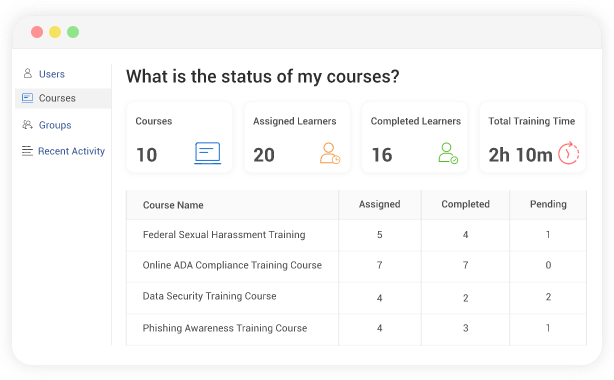
Turn on auto-reminders to follow up with your teams who haven’t started or finished the training. All data stays saved in one place, so you’re always audit-ready—no scrambling for documentation later.
Completion rate alone tells you people finished, not that anything changed. A few better indicators to track alongside it: time-to-completion for new hires against your required deadline, assessment pass rate on the first attempt, whether hotline or reporting-channel volume shifts after training rollouts, and repeat-training completion rates for annual refreshers. If incident or complaint volume in a specific location or department isn’t moving despite high completion rates, that’s a signal the content isn’t landing, not that the program is done.
Here’s a video guide that explains all the different types of training reports:
And that’s how you can create a compliance training course in just a few minutes.
Explore More Ready-to-Use Compliance Training
Here is a list of more expert-curated compliance training courses for your reference:
Cybersecurity Training
Cybersecurity training educates employees on how to recognize and respond to cyber threats like phishing, ransomware, and data breaches. It encourages safe online practices and helps protect sensitive organizational data from unauthorized access.
? Check out the Cybersecurity Awareness Training Course
Diversity Training
Diversity training increases awareness of cultural sensitivity, unconscious bias, and inclusive behavior in the workplace. It helps create an environment where employees from all backgrounds feel valued and respected.
? Check out Diversity, Equity & Inclusion Training Course
Occupational Safety and Health (OSHA) Training
OSHA training ensures employees understand workplace hazards, injury prevention, and safety procedures. It helps meet legal compliance standards and builds a safety-first mindset across the organization.
? Check out OSHA Compliance Training Course
Data Protection and Privacy Training
This course educates staff on how to securely handle personal and company data in accordance with data privacy regulations like GDPR or HIPAA. It reduces risk and builds customer trust.
? Check out Data Protection Training Course
Anti-Bribery and Corruption
This training teaches employees how to recognize, avoid, and report bribery, kickbacks, and other corrupt practices. It helps protect organizational integrity and aligns with global anti-corruption laws.
? Check out Anti-Bribery and Corruption Training Course
Ethics Training
Ethics training promotes moral responsibility by guiding employees in making honest and fair decisions. It covers topics like conflicts of interest, whistleblower protection, and ethical leadership.
? Check out Workplace Ethics Training Course
Healthcare Training
Healthcare compliance courses focus on patient privacy (HIPAA), infection control, and clinical best practices. It helps healthcare professionals meet regulatory standards and provide safer care.
? Check out the HIPAA Compliance Training Course
Workplace Violence
This training prepares employees to identify early warning signs of violence, respond effectively to threats, and create a safe work atmosphere. It’s essential for both prevention and emergency readiness.
? Check out the Handling Workplace Violence Training Course
Create a Future-Ready Workforce through Compliance Training
2025 compliance isn’t just a legal mandate; it’s your HR playbook for building a resilient, ethical, and future-proof workforce. As an HR leader, you’re responsible for rolling out training modules and shaping behaviors, influencing culture, and strengthening the foundation of organizational trust.
The future of compliance is proactive, personalized, and deeply human. It touches every part of the employee experience—from onboarding to leadership development. When done right, it will reduce risk, elevate performance, safeguard reputation, and attract top talent.

Let ProProfs AI create your training course

 We'd love your feedback!
What did you like & how can we make it even better?
 Thanks for your feedback!
 Ask Your Question
Have a question? Get expert help to make your decision easier.