

The development goal season comes around, and I watch the same thing happen every year. Someone sends the calendar invite. Everyone shows up having written something that morning. By the end of the meeting, there are goals typed into a system that no one will mention again until the next cycle.
For a long time, I thought that was a motivation problem. It isn’t. It’s a design problem, and the design is almost always the same: goals built to satisfy a process rather than to actually change something.
This guide is for:
- HR professionals building a development framework that gets used past January
- Team leaders preparing for review conversations where at least half the room is skeptical
- L&D professionals trying to connect individual goals to real outcomes
- Managers who have a mix of ambitious employees and people who are excellent at their jobs and simply do not want a promotion
- Anyone who has watched a well-written goal get forgotten by Q2
What Are Employee Development Goals?
They are not performance targets. Performance targets measure what you delivered. Development goals measure how you have grown your capacity to deliver. A good employee development goal sits at the intersection of what the person actually wants and what the business genuinely needs. Finding that intersection is most of the work. Most goal-setting conversations skip it entirely.
A development goal can be technical, behavioral, or structural. What it cannot be is vague. “Improve communication skills” is not a goal. It is a placeholder that protects everyone from accountability.
Why Do So Many Employee Development Goals Go Nowhere?
I have a theory about this, and it’s not popular.
The goals don’t fail because employees aren’t motivated. They fail because the process is designed to produce goals that look good in a review system, not goals that are actually useful to anyone.
Here’s what I keep noticing:
- The “workhorse” dilemma: Many employees are content in their current roles and have no desire for leadership or higher responsibilities. Forcing ambition-track goals onto them doesn’t motivate them. It alienates them.
- Vague management: Telling someone development “happens naturally” isn’t leadership. It is a way of avoiding a real conversation about where someone actually is and where they genuinely need to go. I have seen this produce years of aimless annual reviews where nothing changed.
- Burnout and apathy: Employees dealing with disillusionment or high stress cannot muster genuine engagement with corporate milestones. Goal-setting season lands at the worst possible time for a significant number of people on most teams.
- Unpaid scope creep: People are scared that ambitious goals just mean more work for the same pay. That fear is rational. Until you address it directly, you will keep getting safe, forgettable goals.
None of this is catastrophic. It’s all fixable. But not by writing better goal templates. The fix is structural.
What Actually Makes an Employee Development Goal Work?
The SMART framework gets most of the credit here. Specific, Measurable, Achievable, Relevant, Time-bound. It’s a reasonable starting point and I’m not going to argue with it.
| Letter | Stands For | In Practice |
|---|---|---|
| S | Specific | Names the exact skill, behavior, or outcome |
| M | Measurable | Has a metric or deliverable you can verify |
| A | Achievable | Realistic given the role and actual bandwidth |
| R | Relevant | Connected to business priorities or the person’s career path |
| T | Time-bound | Has a deadline or milestone |
Two things I’d add that the framework doesn’t mention.
Make it difficult enough to require growth. A goal achievable without any stretch isn’t a development goal. It’s a task. “Attend one webinar this quarter” is a task. “Lead our next cross-functional project kickoff” requires something the person doesn’t fully have yet. That gap is the point.
Separate input goals from output goals. Input goals are behaviors: complete a course, run a weekly feedback loop, shadow someone in a different function. Output goals are results: improve resolution time by 20%, deliver reports without analyst support. Input goals are more in the employee’s control. That makes them less anxiety-inducing and more likely to actually happen. Output goals matter more to the business. A real development plan has both.
| Input Goals | Output Goals | |
|---|---|---|
| Definition | A behavior the employee performs | A result the behavior produces |
| Examples | Complete a course; run a weekly feedback loop; shadow someone in a different function | Improve resolution time by 20%; deliver reports without analyst support |
| Who controls it | Mostly the employee | Shaped by other factors too |
| Why it matters | Less anxiety-inducing, more likely to actually happen | Matters most to the business |
Your situation may be different. Some roles don’t lend themselves to clean input/output separation. That’s fine. The principle holds even if the categories blur.
25 Employee Development Goals Examples by Category
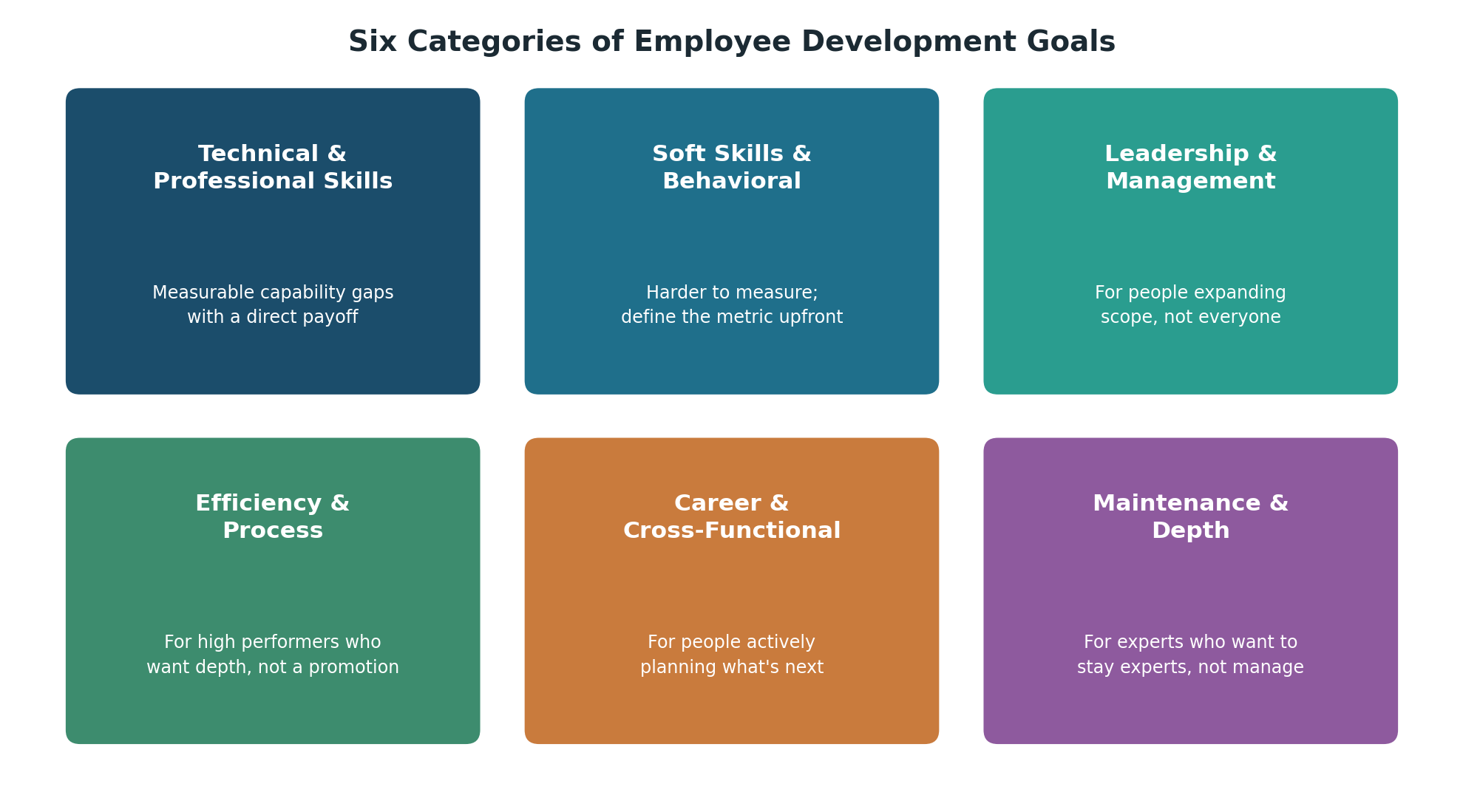
Technical and Professional Skills
These work well when the capability gap is measurable, and upskilling has a direct payoff on performance.
- Complete the Google Data Analytics Certificate by [date] and apply the learnings to at least two monthly reporting decks.
- Build Power BI proficiency by completing an intermediate course and delivering one self-serve dashboard for the ops team by the end of Q3.
- Earn the PMP certification within 12 months by completing 35 contact hours of project management education and taking the exam.
- Integrate AI productivity tools into the weekly workflow and document three tasks that became measurably faster or more consistent by [date].
- Improve SQL skills by completing an intermediate course and independently pulling weekly performance reports without analyst support by Q4.
Soft Skills and Behavioral Development
These are harder to write well because the measurement is harder. The key is to define the metric upfront, before anyone tries to assess it at the end of the year.
- Lead at least two team meetings per quarter with written post-meeting summaries to build structured facilitation skills.
- Complete a conflict resolution course and apply the framework in one documented workplace situation by [date].
- Reduce average response time on cross-team requests from 48 hours to 24 hours, tracked over one quarter.
- Present one project update to senior leadership this quarter to build executive communication skills.
- Request 360-degree feedback from three peers by [month] and produce a written action plan from the results.
Leadership and Management Development
For individual contributors moving toward people management, or managers expanding their scope. Worth noting: not everyone is moving in that direction. Assuming they are is a reliable way to get defensive goal-writing.
- Mentor one junior team member this quarter with weekly 30-minute check-ins and a documented development plan by week two.
- Build a succession readiness plan for your own role by Q2: document key responsibilities, identify a potential backup, and start a monthly knowledge-transfer practice.
- Run two structured retrospectives on team projects before end of Q3 using a documented format and share findings with leadership.
- Shadow one cross-functional leader for a half day this quarter and document three process observations worth piloting.
- Complete a foundational management course, such as LinkedIn Learning’s Managing a Team or a comparable SHRM module, by [date].
Efficiency and Process Improvement Goals
This is the most underused category in most development frameworks, and probably the most valuable one for employees who are good at their jobs, care about their work, and have no interest in a promotion track. Those people exist on most teams. Treating their contentment as a problem to fix is a mistake I have seen teams make repeatedly.
Process improvement goals give them something genuinely useful to work on without asking them to want something they do not want.
- Identify one recurring workflow that takes more than two hours per week and build an automated or semi-automated alternative by [date]; document the time saved.
- Reduce time spent on monthly status reports by 30% by standardizing the template and data sources by the end of Q2.
- Create or update an internal knowledge base entry for the three most common questions you receive from teammates each month.
- Audit the current onboarding checklist for new team members and propose an updated version with at least three concrete improvements by the end of next quarter.
Career Development and Cross-Functional Goals
For employees actively thinking about what comes next, whether that is a lateral move, a promotion, or a quiet transition toward something new.
- Attend one industry conference or equivalent virtual event this year and share three actionable takeaways with the team within two weeks.
- Complete one cross-departmental project this half, outside your core role, to build exposure to [target function].
- Research two or three internal roles you are interested in, identify the skill gaps between your current profile and those roles, and create a 12-month plan to address them.
- Identify one certification that directly supports your next career move and complete it by [date].
Maintenance Goals for High Performers Who Want Depth, Not Promotion
Most goal frameworks do not include this category. That is a problem.
Some people are excellent at what they do, are genuinely invested in their craft, and have no desire to manage anyone or move up. Setting ambitious goals for them is not supportive. It reads as tone-deaf, and it produces the kind of checkbox compliance that quietly poisons the whole development process. These goals serve them better, and they often deliver more real business value than a management-track goal would.
- Become the documented team expert in [specific domain] by completing two advanced courses and writing one internal best-practices guide by Q4.
- Build three external professional relationships through industry associations, LinkedIn groups, or peer networks to stay current on field developments.
How Do You Set Employee Development Goals That People Actually Follow Through On?
The goals themselves matter less than the conversation that produces them. A well-written goal from a perfunctory meeting goes nowhere. A decent goal from an honest conversation gets followed up on.
A few things that actually change the dynamic:
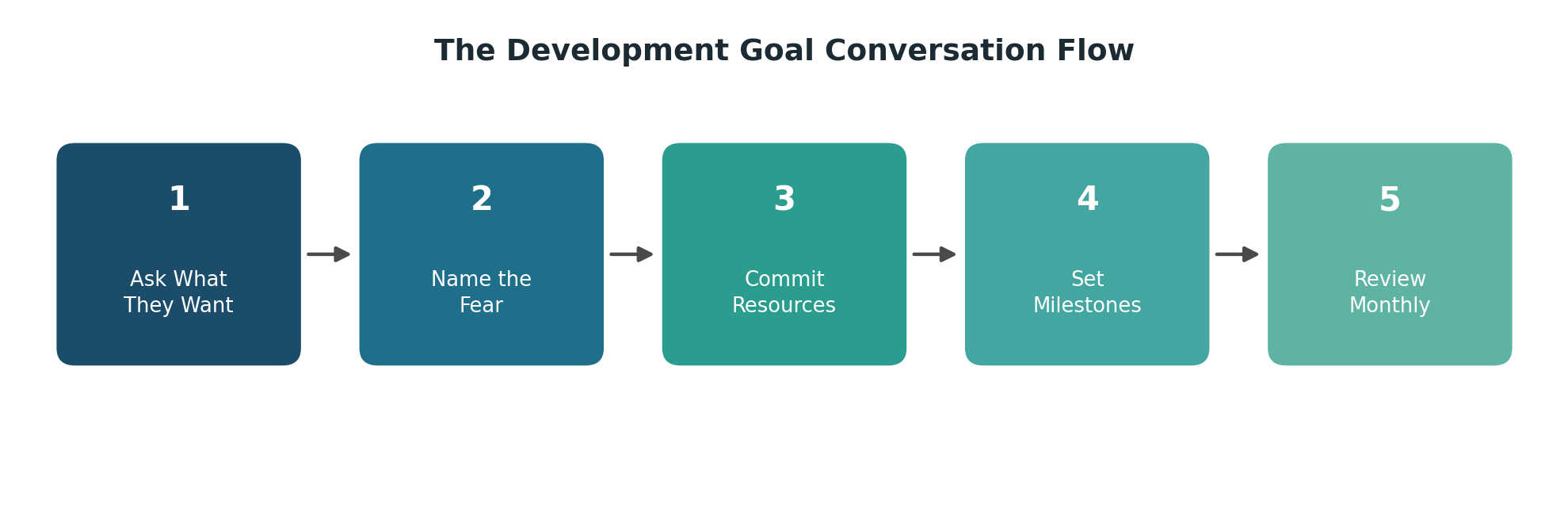
- Start with what the employee wants, not what the org chart needs: Yes, goals need to be business-relevant. But opening with organizational priorities gets you compliance. Opening with “where do you want to be in two years, and what about your current role genuinely frustrates you?” gets you honesty. You can connect to business needs afterward in the same conversation. The order matters more than most managers realize.
- Name the fear directly: If someone has defaulted to safe, vague goals before, they learned to. Ask outright: what would you want to work on if there were no risk attached to the answer? Then work backward to something appropriately scoped. The fear is usually scope creep, extra work without extra pay, or goals that become a liability in internal politics. None of those fears is unreasonable.
- Be specific about what the company is providing: A development goal without committed resources is a wish. When you agree on a goal, state explicitly what support comes with it: time, budget, access, tools, mentorship. According to the U.S. Bureau of Labor Statistics, employer-provided training is consistently among the top factors employees cite when evaluating whether a role supports their growth. “We support development” is not a commitment. A named resource is.
- Connect goals to what actually matters to the person: If someone is building skills to eventually move into a different function or a different company, that is a legitimate goal worth supporting. Employees who feel development is genuinely for them show up to it differently than employees who feel it is designed for the org chart.
What Does a Complete Employee Development Plan Include?
A single goal is not a plan. A plan gives a goal context, accountability, and a feedback rhythm. Without that structure around it, even well-written employee development goals and objectives examples don’t produce anything useful by year-end.
A usable plan has six components:
- The goal itself in SMART format, specific enough that both sides can verify it later
- The rationale: one or two sentences on why this goal matters now for this person, not just for the business
- The resources committed: specific courses, tools, budget allocation, time, or mentorship access
- Two or three milestones before the end date so drift gets caught before it becomes failure
- A clear success metric both sides agree on in advance, before the year runs out
- A feedback rhythm: monthly check-ins or quarterly at minimum; anything less is not management, it’s documentation
The follow-up rhythm is where most plans actually collapse. Not at the goal-writing stage.
For teams managing development across multiple roles or locations, tracking completion and pulling progress reports gets operationally heavy fast. Platforms like ProProfs Training Maker handle the tracking layer so when development goals include specific training, certifications, or compliance requirements, you are not managing that in a separate spreadsheet.
What Are Common Mistakes When Setting Employee Development Goals?
Most of these are structural, not motivational. And most managers I’ve seen make at least two of them without realizing it.
- Setting goals for the employee instead of with them: Top-down goal assignment signals the process is for the organization, not the person, regardless of how well the goal was designed.
- Treating everyone the same: A third-year high performer and someone in their first 90 days need completely different employee development goals and objectives. One-size-fits-all frameworks almost always produce one-size-fits-none results.
- Rewarding goal-setting instead of development: When positive reviews consistently go to people who write polished-sounding goals but never act on them, the implicit lesson is to write better-sounding goals. Teams absorb that lesson quietly and quickly.
- Setting stretch goals without providing support: Ambitious goals without time, tools, or feedback are just disappointment on a schedule. That is usually a leadership failure, not an employee motivation failure.
- Reviewing goals only at year-end: A goal set in January and revisited in December was never managed. It was documented. Monthly check-ins are better. Quarterly is the floor.
The Version That Actually Changes Something
Goal-setting season returns whether you’re ready for it or not.
The difference between employee development goals that produce something real and goals that get quietly abandoned has very little to do with how well they were written. It has to do with whether the manager had an honest conversation at the start, made a specific commitment, and showed up to follow through on it over the months that followed.
Thirty minutes of that kind of conversation at the beginning of a cycle changes the whole year. Skipping it costs the same amount of time and produces nothing worth remembering.
Frequently Asked Questions
What are employee development goals?
Employee development goals are specific, time-bound objectives guiding an individual's professional growth. Unlike performance targets, they focus on building skills and capabilities rather than measuring output. They work best when they reflect both what the employee wants and what the business genuinely needs.
What are some good examples of employee development goals?
Good examples include: completing a relevant certification by a specific date; improving public speaking by leading two team meetings per quarter; automating a recurring task to recover 20% of weekly time; and mentoring a junior colleague with structured weekly check-ins and a written development plan.
What is the difference between performance goals and development goals?
Performance goals measure what you deliver: output, revenue, quality scores. Development goals focus on how you grow your ability to deliver: skills built, behaviors changed, knowledge gained. Both belong in a complete review process, but they answer different questions.
How do you write employee development goals that are SMART?
Name a specific skill or behavior, attach a measurable deliverable, set a realistic scope given the person's actual bandwidth, connect it to their role or career path, and give it a concrete deadline. "Complete a data visualization course and present one dashboard to leadership by Q3" is SMART. "Improve data skills" is not.
How often should employee development goals be reviewed?
Monthly is better. Quarterly is the floor. A goal reviewed only at year-end was never really managed. Short review cycles catch blockers before they become reasons the goal got abandoned.
What are examples of employee development goals for managers?
Complete a foundational management course by a set date; build a succession plan for your current role; run structured retrospectives on team projects with documented findings; mentor at least one direct report with a formal development plan and regular check-ins.
What should I do if an employee has no interest in development goals?
Start by listening rather than selling. Many people have learned through experience that development goals go nowhere or simply create more work. Ask what would make their current role less frustrating. Process improvement goals and depth-building goals are a legitimate alternative to promotion-track objectives, and often more valuable.
How do employee development goals benefit the organization?
According to the U.S. Bureau of Labor Statistics, organizations that invest in structured development see measurable improvements in retention and productivity. Development goals create visibility into skill gaps, build internal capability, and reduce dependence on external hiring for roles that could have been grown from within.

Let ProProfs AI create your training course

 We'd love your feedback!
What did you like & how can we make it even better?
 Thanks for your feedback!
 Ask Your Question
Have a question? Get expert help to make your decision easier.