

Every fall, somebody on the leadership team asks the same question: “Are we covered?” Not covered like the roof over the office. Covered like the legal kind, the kind that shows up in a deposition. That’s usually when annual compliance training gets rediscovered, dusted off, and rushed into place before December 31.
I’ve built these programs from scratch. I’ve also rebuilt them after someone else’s version failed to hold up under a state audit. Annual compliance training requirements don’t change much year to year once you know your industry’s floor. What changes is whether anyone actually retains what they clicked through. So here’s the list I’d build from if I were starting today: the topics that carry real legal weight, the ones that are best-practice-wearing a mandatory costume, and what I’ve actually seen move completion rates.
This is for:
- HR generalists building next year’s training calendar from a blank spreadsheet
- L&D leads watching completion rates flatline every December
- Compliance managers who need the legal floor, not a wish list
- Operations leads rolling one program out across multiple states or sites
What Counts as Annual Compliance Training, Exactly?
That definition holds up fine on paper. In practice, “annual” turns out to be doing a lot of quiet lying, and untangling that is most of what makes annual compliance training requirements hard to plan around.
The Word “Annual” Doesn’t Mean What Most Training Calendars Assume
Here’s the thing nobody explains clearly enough. Some annual compliance training requirements really do mean every 365 days, no grace period, no credit for tenure. OSHA’s Bloodborne Pathogens Standard is explicit about this: training is required at initial assignment and then at least annually thereafter, and OSHA has said in writing that experienced employees don’t get an exemption just because they’ve heard it all before.
Other rules use the word “periodic” and let you argue about what that means until an auditor argues back. The HIPAA Security Rule requires covered entities to implement a security awareness and training program for the whole workforce, including management, but the regulation itself never says the word “annual.” Industry practice treats yearly as the floor anyway, because nobody wants to be the test case for a looser interpretation.
And then there’s harassment prevention training, where “annual” varies by state in a way that trips up almost every multi-state employer I’ve worked with. New York requires it every single year for everyone. California requires it every two years. Miss that distinction and you’ve either over-trained half your company or left the other half exposed.
| State | Who Must Comply | Frequency |
|---|---|---|
| California | Employers with 5+ employees | Every 2 years |
| New York | All employers, regardless of size | Every year |
| Illinois | All employers | Every year |
| Connecticut | Employers with 3+ employees | Within 6 months of hire, refreshers periodically |
| Delaware | Employers with 50+ employees | Every 2 years |
| Maine | Employers with 15+ employees | Within 1 year of hire, no fixed refresher cycle |
Build your calendar off the strictest state you operate in, not the average. That’s not me being cautious. That’s just how multi-state compliance actually works.
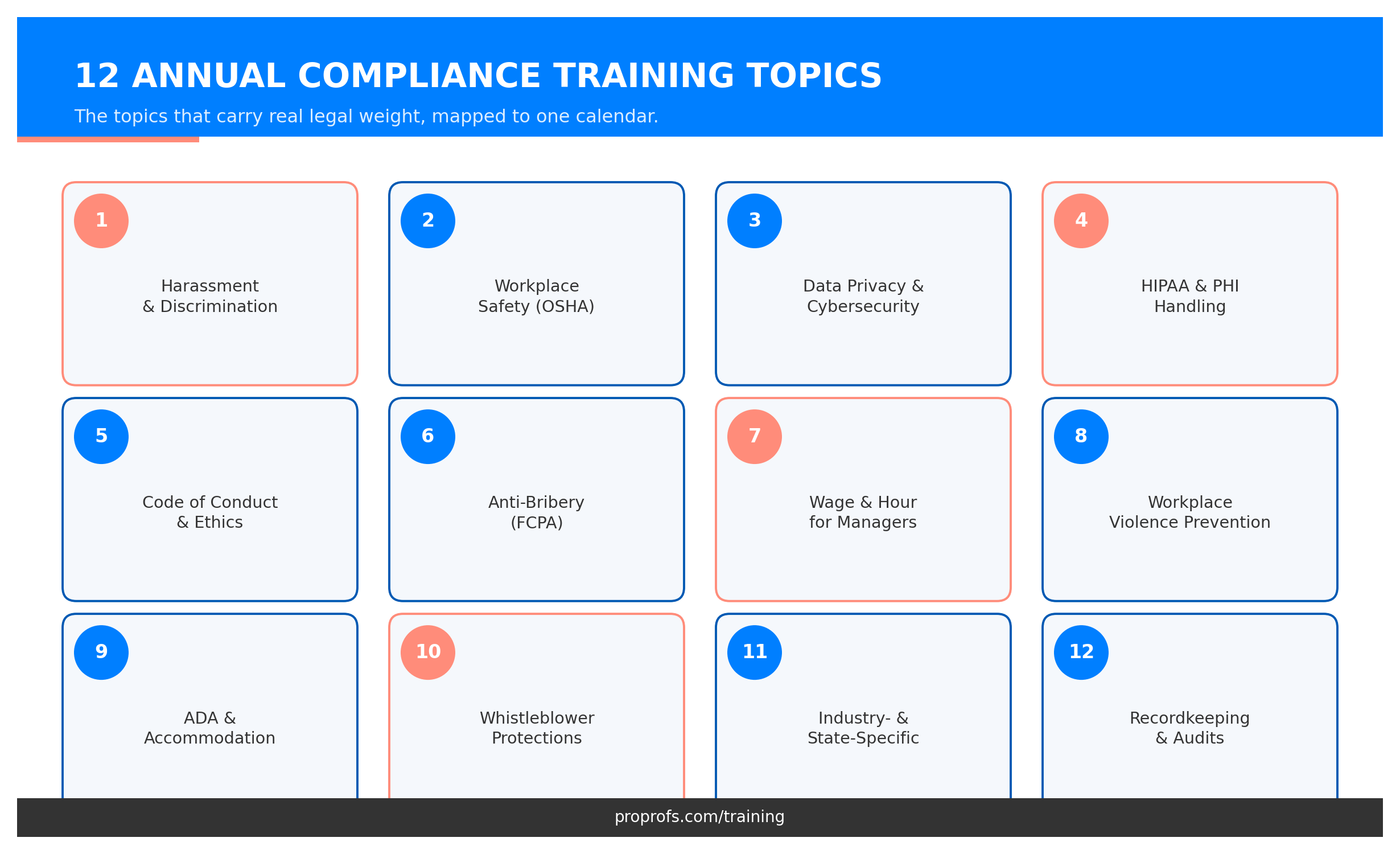
The 12 Topics I’d Put on Every Compliance Calendar
None of these are ranked by importance, because importance depends entirely on your industry. A hospital and a manufacturing plant should not have the same annual compliance training program, even though both of them absolutely need one, and one difference often comes down to whether annual HIPAA compliance training even belongs on the list.
| Topic | Who Needs It? | Required For |
|---|---|---|
| Harassment & Discrimination | All employees | Nearly every organization |
| OSHA Safety | Employees exposed to workplace hazards | Manufacturing, construction, warehousing, healthcare, etc. |
| Cybersecurity | All employees | All organizations |
| HIPAA | Anyone handling PHI/ePHI | Healthcare, insurers, benefits teams |
| Code of Conduct | All employees | All organizations |
| Anti-Bribery (FCPA) | Finance, procurement, sales, executives | Companies with international business |
| Wage & Hour | Managers & supervisors | Organizations with hourly/non-exempt employees |
| Workplace Violence | All employees | Most organizations (some states require it) |
| ADA Accommodation | Managers & HR | All employers |
| Whistleblower Protection | All employees & managers | Most organizations |
| Industry-Specific Requirements | Regulated roles | DOT, healthcare, caregiving, unions, etc. |
| Recordkeeping | HR, Compliance, L&D | Every organization |
1. Workplace Harassment and Discrimination Prevention
This is the one most people already have, and it’s also the one most likely to be done wrong. Federal law doesn’t mandate it outright, but the Supreme Court’s Faragher and Ellerth decisions mean an employer’s best legal defense against a hostile-work-environment claim depends on showing it exercised reasonable care to prevent and correct harassing behavior, which courts read as meaning real, documented training. Skip it, and you haven’t just skipped a nice-to-have. You’ve given away your own defense.
Best practice: don’t just hit the state minimum. Cover all protected characteristics, not only sex, and build in a bystander-intervention component even where it isn’t required. It’s cheap insurance.
2. Workplace Safety (OSHA-Mandated Topics)
If your industry touches physical hazards, chemicals, or equipment, some slice of your annual compliance training is not optional and never has been. OSHA’s own Top 10 Most Frequently Cited Standards for fiscal year 2025 includes Fall Protection Training as a standalone entry, separate from the general fall protection requirement it’s paired with. Training failures aren’t a footnote in OSHA enforcement. They’re their own category of violation.
Best practice: match the training to the actual hazard profile of the role, not a generic safety deck. A warehouse forklift operator and an office employee do not need the same 45 minutes.
3. Data Privacy and Cybersecurity Awareness
Phishing simulations, password hygiene, and the growing “shadow AI” problem, employees pasting client data into a public chatbot because it was faster than asking IT, all belong here now. This one barely existed as a standalone compliance topic a decade ago. It’s arguably the fastest-growing one today.
What actually works: run this more than once a year, even if the formal record only requires an annual sign-off. Threats change monthly. Your training shouldn’t be frozen in the year you wrote it.
It’s also why so many employees wonder is cyber security hard to keep up with – the field simply moves faster than most training calendars do.
4. HIPAA and Protected Health Information Handling
If your organization touches protected health information, in a clinical setting, a benefits department, or anywhere ePHI crosses a network, annual HIPAA compliance training isn’t a suggestion. The Security Rule’s training standard applies to management and non-clinical staff too; a benefits coordinator with network access is, on paper, exactly as much of a risk surface as a nurse. Most organizations quietly narrow HIPAA training to clinical staff and never notice the gap until an audit does.
Best practice: don’t let “annual HIPAA compliance training” mean one static module. Add quarterly security reminders on top of the yearly curriculum. That’s not a nice touch; it’s the actual implementation specification the rule describes.
5. Code of Conduct and Business Ethics
This is the topic most likely to feel like filler, and the one most likely to actually matter when something goes wrong. A documented ethics training program is part of what regulators and courts look at when deciding whether a violation was a rogue employee or a systemic failure.
Best practice: use real, anonymized scenarios from your own industry instead of generic “would you accept this gift” slides. Specificity is what makes ethics training memorable instead of forgettable.
6. Anti-Bribery and Anti-Corruption (FCPA)
Skip this one if you have zero international exposure. Otherwise, it stays. The Foreign Corrupt Practices Act reaches further than most people assume, covering third-party intermediaries and facilitation payments that “everyone in that market just does.”
Best practice: train the people who touch vendor contracts and international sales separately from the general population. A finance controller needs depth here that a customer support rep does not.
7. Wage and Hour Basics for Managers
Not glamorous. Genuinely expensive to skip. Misclassification and off-the-clock work claims are some of the most common and most costly employment lawsuits out there, and they’re almost always a manager problem, not an HR problem, because managers are the ones approving schedules and deciding who “just finishes up an email or two” after clocking out.
The fix here is simple: this one belongs specifically in manager-track annual compliance training, not the general employee curriculum. General staff don’t make the classification decisions; managers do.
8. Workplace Violence Prevention
More states are adding requirements here every year, and even where it isn’t mandated, it’s becoming close to indefensible not to have something. This covers recognizing warning signs, de-escalation, and what to actually do in an active-threat scenario, which is a very different skill than reciting a policy.
Best practice: pair the online module with a genuine tabletop or drill component. Nobody internalizes an evacuation plan from a slide.
9. ADA and Disability Accommodation
Managers specifically need to understand the interactive process, the back-and-forth conversation required when an employee requests an accommodation, because getting this wrong is one of the more common and more avoidable sources of litigation.
Where this usually goes wrong: train managers on what NOT to say as much as what to say. “We don’t do accommodations for that” is the sentence that turns a request into a lawsuit.
10. Whistleblower Protections and Anti-Retaliation
Employees need to know how to report a concern, and managers need to understand, explicitly, that retaliation against someone who reports one is its own separate violation, often prosecuted more aggressively than the underlying issue.
Best practice: make the reporting channel genuinely anonymous and say so clearly in the training. A whistleblower policy nobody trusts is functionally the same as not having one.
11. Substance-Free Workplace and Industry- or State-Specific Mandates
This is the category that swallows every industry-specific requirement that doesn’t fit neatly elsewhere: DOT drug and alcohol rules for safety-sensitive transportation roles, state-specific caregiver certifications, or union-negotiated training obligations layered on top of standard employment law.
It’s also where compliance gets genuinely narrow. In Washington State, in-home caregivers employed through Consumer Direct of Washington complete a required 30-minute CDWA Annual Compliance Training module covering state and federal regulations specific to that role, on top of their broader continuing education requirements. Ask five HR generalists outside home care what CDWA Annual Compliance Training even covers, and four of them will guess wrong. Nobody outside that sector needs to know it exists. If you’re in it, missing it means falling out of compliance and losing your ability to work.
Best practice: audit for these narrow, sector-specific obligations separately from your general program, the same way CDWA Annual Compliance Training gets tracked separately from Washington’s broader labor code. They rarely show up on a generic “compliance topics” checklist, which is exactly why they get missed.
12. Recordkeeping and Audit-Ready Documentation
Not a training topic in the traditional sense, and I’d argue it belongs on the list anyway, because none of the previous eleven matter if you can’t prove they happened. OSHA requires bloodborne pathogens training records to be kept for three years. HIPAA documentation requirements run to six. An excellent training program with no completion trail is, legally speaking, indistinguishable from no training program at all.
My honest advice: build documentation into the training platform itself rather than tracking it in a separate spreadsheet nobody updates by March. A shared policy library, the kind ProProfs Knowledge Base is built around, keeps the source policies and the completion records pointing at the same version of the truth.
Why AI and a Younger Workforce Are Already Changing This List
By now, it’s fair to call those twelve the “OG” compliance topics. They’re not going anywhere; the law doesn’t care how old they feel.
But the room actually sitting through annual compliance training looks nothing like it did five years ago, and pretending otherwise is how a program quietly goes stale without anyone noticing.
Gen Z Has Changed the Training Audience
Start with who’s in the room.
Gen Z workers surpassed Baby Boomers in the U.S. labor force for the first time in the third quarter of 2023, and, according to the most recent Department of Labor data, they’re already close to a fifth of it. That’s not a future planning assumption. That’s this year’s training roster.
A generation that grew up skipping ads, closing pop-ups, and abandoning slow-loading pages within seconds is not going to sit patiently through a 45-minute video because HR called it mandatory. They’ll skip ahead. They’ll open a second tab. And some of them will do something I genuinely didn’t expect to be writing about two years ago.
AI Is Already Beating Passive Training
Here’s the workaround already showing up in 2026: employees point an AI agent at the training window and let it click through the whole module, including quizzes, unattended.
It’s not hypothetical. It’s happening inside compliance programs right now, and it makes every completion number I mentioned earlier a lot less trustworthy than it looks on a dashboard. A finished module is used to at least prove someone clicked through it. Now it might just prove a bot did.
AI Is Also the Fastest Way to Update Training
AI cuts the other way too, and this is the part worth taking seriously instead of getting defensive about.
Used well, it’s the fastest fix for the authoring bottleneck that’s kept compliance content stale for a decade. Platforms like ProProfs Training Maker now let you describe a topic and get a working course draft back. That matters because a three-month authoring cycle leaves a program a full regulatory update behind by the time it actually launches.
This is especially valuable when organizations need to keep up with changing annual compliance training requirements, refresh annual HIPAA compliance training, or update specialized programs such as CDWA Annual Compliance Training.
Human Review Still Matters
The catch is accuracy, and I’d trust an actual expert on this over my own optimism.
As Teresa Hirata, HR Specialist at Absorb, put it, the real risk shows up “the moment AI starts hallucinating regulatory requirements.” That’s not a reason to keep AI out of your compliance program. It’s a reason to keep a human checking its work, especially on anything that’s going to sit in front of an auditor someday.
None of this replaces the twelve topics above. It just changes who’s sitting through them, and how much you can actually trust the checkmark that says they did.
Why Completion Rates Are the Real Compliance Risk
Here’s what I keep noticing, and it’s the part that doesn’t fit neatly into a topics list. Nobody fails an audit because they picked the wrong 12 topics. They fail because half the company never finished module nine, and nobody noticed until the state came asking. A completion problem is a compliance gap wearing an engagement costume.
The instinct is to make the training longer and stricter to close that gap. That’s usually a mistake. A 60-minute video that employees game their way through, using a second screen, skipping ahead, and reading a transcript, produces a worse record than a focused 15-minute module people actually pay attention to.
What Actually Gets People to Finish
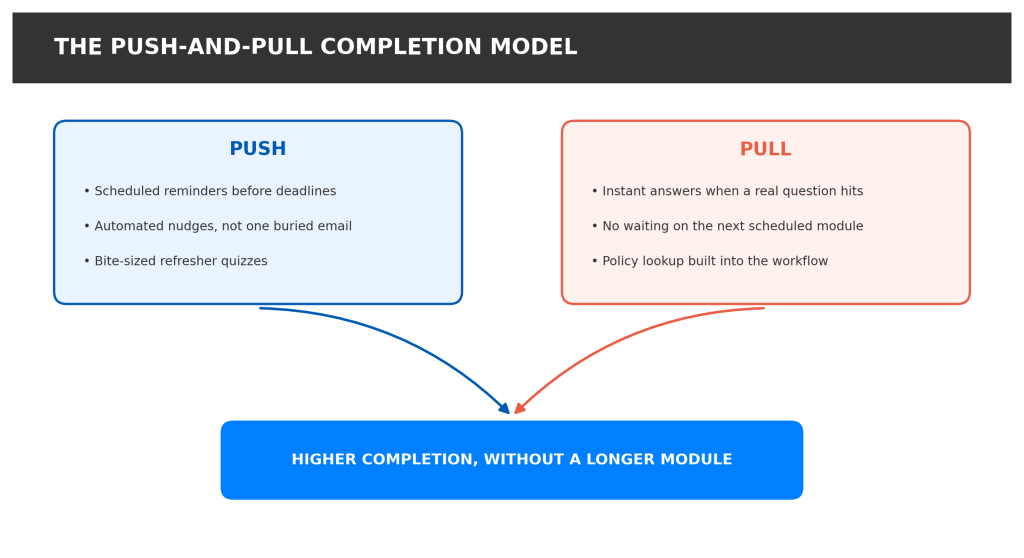
I’ve had better luck with a pull-and-push combination than with either alone. Push means scheduled nudges: automated reminders before a deadline, not a single email that gets buried. Pull means giving people a place to get an instant answer when a real policy question comes up mid-task, instead of forcing them to wait for the next scheduled module to stumble across the answer.
There’s also a blunter lever, and it works precisely because it’s blunt: tie system access to completion. Restrict a login, a badge, or a shared drive until the training is done, and completion rates move in a way that a polite reminder email never will. It’s not subtle. It’s also honest about what “mandatory” is supposed to mean.
Platforms like ProProfs Training Maker build this kind of tracking and reminder automation directly into the course, so the completion trail exists automatically instead of living in someone’s personal spreadsheet.
Making the Legal Minimum Feel Less like a Punishment
None of this requires reinventing the training. It requires trimming it.
Focus on the One Thing Employees Need to Remember
Build one-pagers or short videos around the “enduring understanding,” the one thing an employee actually needs to carry away, instead of a 45-minute march through every edge case a lawyer could imagine.
Save the edge cases for role-specific modules that only the people who need them ever see.
Let Employees Test Out of What They Already Know
Test-out options matter more than most programs give them credit for.
An employee who’s already demonstrably competent shouldn’t have to sit through content they could pass cold. A short pre-assessment that lets people skip ahead respects their time, and it’s honestly a better proof of competence than seat time ever was.
That’s a small lift for any program that already has quizzes built into it, and a real gain in both engagement and documentation.
Use Gamification Carefully
Gamification helps, too, but only the kind that’s tied to something real.
Badges for finishing a module nobody would otherwise finish are fine. Leaderboards for compliance training are usually not, mostly because compliance topics like harassment prevention shouldn’t feel like a competition.
Know the difference.
Aim for Behavior Change, Not Just Completion
Organizations don’t just want a box checked.
As Katherine Nukk-Freeman, Co-Founder and President of SHIFT HR Compliance Training, puts it, the goal is “training that doesn’t just check a box but truly shifts behavior and culture.”
That’s the direction the whole category is moving, and for good reason.
Coverage Isn’t a Feeling. It’s a Completion Report.
Somebody is going to ask “are we covered?” again next fall, and the honest answer isn’t a gut feeling about how thorough the training looked. It’s a completion report, a documented record, and a topic list that actually matches the risks your organization carries.
Start with the topics that are legally non-negotiable for your industry, since annual compliance training requirements rarely leave room to negotiate on those. Layer in the best-practice additions that make the mandatory stuff land. Then fix the completion problem before you fix the content, because a beautifully designed module nobody finishes protects exactly nobody. That’s the version of “covered” that actually holds up when someone asks the question for real.
Frequently Asked Questions
How often is annual compliance training legally required?
It depends entirely on the topic and jurisdiction. OSHA's bloodborne pathogens standard requires refreshers every 12 months with no exceptions. Harassment training frequency ranges from every year (New York, Illinois) to every two years (California, Delaware). There's no single universal cadence.
What topics are mandatory for annual compliance training?
Annual compliance training requirements depend on industry, state, and workforce. Workplace safety (if hazards exist), harassment prevention (in mandate states), and HIPAA (for entities handling PHI) are the most commonly required. Everything else is best practice layered on top of a legal floor.
Is annual HIPAA compliance training required for all employees?
Yes, for any workforce member with access to systems connected to electronic protected health information, not just clinical staff. Annual HIPAA compliance training under the Security Rule explicitly includes management and applies more broadly than most organizations initially assume.
What is CDWA Annual Compliance Training?
CDWA Annual Compliance Training is a required 30-minute module for in-home caregivers employed through Consumer Direct of Washington, covering state and federal caregiving regulations. It's a sector-specific example of how narrow annual compliance training requirements can get outside general HR and L&D contexts.
Can annual compliance training be completed online?
In most states, yes, provided it includes interactive elements like quizzes, scenarios, or a way to ask questions. A handful of state harassment laws specifically require the ability to submit a question and receive an answer within a set window, so passive video alone may not qualify.
What happens if an employee doesn't complete required compliance training?
Consequences vary by policy, but incomplete training weakens an employer's legal defenses in a lawsuit and can trigger findings during a regulatory audit. Many organizations now restrict system access until training is completed, treating it as a hard requirement rather than a suggestion.
Do remote employees need the same compliance training as in-office staff?
Yes, and often more. Harassment and data privacy mandates typically apply based on where the employee physically works, not where headquarters sits, which means a distributed workforce can trigger several states' requirements at once.
How long should annual compliance training actually take?
Shorter than most legacy programs assume. Focused 10 to 20 minute modules generally outperform 45 to 60 minute sessions on both completion and retention, with longer content reserved for role-specific or high-risk topics only.
What's the difference between mandatory compliance training and best-practice training?
Mandatory training is legally required and its absence creates direct liability. Best-practice training, like extended ethics scenarios or civility training, isn't legally required in most places but strengthens your defense and your culture. Most strong programs include both.
Can employees use AI to complete compliance training for them?
Some try, using AI agents to click through modules and quizzes unattended. It defeats the purpose of the training and weakens your legal record, since a completed module no longer proves anyone actually learned the material. Interactive, scenario-based assessments are harder for a bot to fake convincingly.

Let ProProfs AI create your training course

 We'd love your feedback!
What did you like & how can we make it even better?
 Thanks for your feedback!
 Ask Your Question
Have a question? Get expert help to make your decision easier.