

Corporate training is supposed to improve performance. But if you’ve ever sat through a mandatory session with outdated slides, you already know the gap between what training promises and what it delivers. The issue isn’t that learning doesn’t work. It’s that corporate training for employees is often built in ways that don’t match real work or real learners.
Only 31% of U.S. employees were engaged at work in 2024, according to Gallup. Yet ATD reports that companies with strong corporate training and development programs generate 218% higher income per employee. The opportunity is clear, but execution often falls short.
This guide explains the corporate training meaning, the types of corporate training that matter most, and what effective training looks like in practice.
What Is Corporate Training, Really?
Corporate training is the structured process of helping employees build the skills, knowledge, and role-readiness they need to do their jobs well and grow within an organization. The corporate training meaning is pretty straightforward: you prepare your people for what their work actually demands.
In my experience, the best corporate training for employees isn’t a one-time event. It’s an ongoing investment that delivers real business outcomes, better customer experiences, stronger retention, and higher-quality work.
And employees feel that difference too. LinkedIn’s 2023 Workplace Learning Report found that 94% of workers say they’d stay longer at a company if it invested in their development.
There are two fundamentally different ways companies approach training, and the gap between them explains most of the frustration you’ll find on employee surveys.
| Compliance-Only Training | Growth-Driven Training |
|---|---|
| Focused on covering liability | Focused on building capability |
| Happens once or annually | Continuous and role-specific |
| Measures completions | Measures behavior change and outcomes |
| Generic, one-size-fits-all | Personalized by role and department |
| Employees endure it | Employees value it |
The question worth asking isn’t ‘are we doing training?’ It’s ‘which column does our training actually live in?’
Types of Corporate Training Used by Modern Organizations
Understanding the different types of corporate training helps organizations design programs that serve specific business needs rather than forcing all learning into a single model. Each type plays a distinct role within broader corporate training and development efforts.
1. Onboarding Training
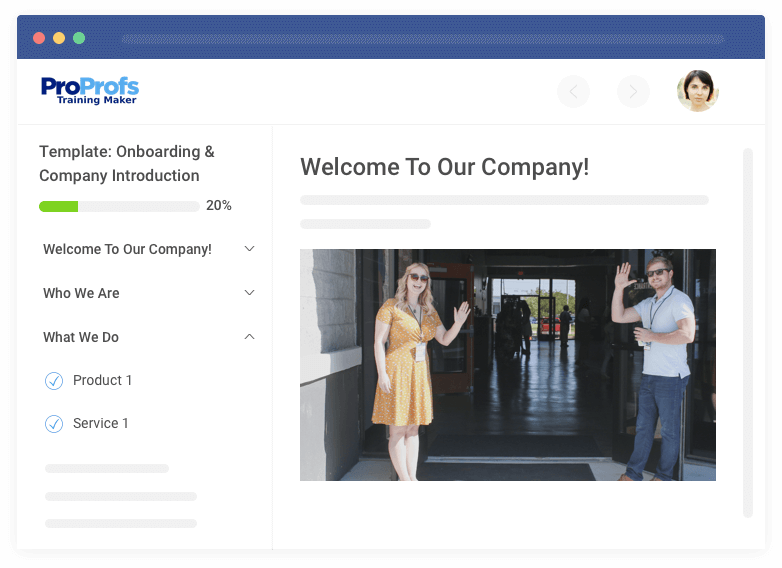
Onboarding training helps new employees understand their role, company culture, tools, and workflows before they’re expected to perform. When it’s designed well, the productivity impact is significant. Research consistently shows that structured onboarding accelerates new-hire time-to-productivity and that 1 in 3 new hires start looking for another job soon after joining, specifically due to poor onboarding experiences.
2. Compliance Training
Compliance training covers legal, regulatory, and policy requirements, workplace safety, anti-harassment protocols, data privacy regulations, and industry-specific mandates. One-third of compliance leaders report their programs take employees five or more hours to complete, and many are under pressure to shorten training time without reducing coverage. The challenge is that this category is often where training design is weakest, leading to low engagement and poor retention.
3. Skills Development Training
This kind of training covers the technical and functional skills employees need to do their specific jobs. According to a 2024 Gartner study, 62% of HR leaders believe the gap between present and future skills poses a significant risk to their business. This is where corporate training for employees should allocate a significant share of time and budget, because it directly improves day-to-day performance.
4. Leadership Training
Almost 60% of first-time managers never receive any formal management training. That’s a major gap, because leadership quality has a direct impact on team performance, engagement, and retention. Investing in management training is one of the clearest ways corporate training can influence business outcomes.
5. Sales and Product Training
Sales teams need to understand what they’re selling, how to position it, and how to handle objections. Product training ensures they’re always up to date on features, pricing, and competitive comparisons. In fast-moving product environments, this category of training often has the highest direct revenue impact.
6. Partner, Contractor, and Franchise Training
Not all training happens inside your four walls. External training for partners, contractors, or franchise operators is one of the more challenging areas in corporate training and development because you need to deliver consistent knowledge to people who don’t report to you without exposing your internal systems. A pharmaceutical distributor, for example, must ensure its network of independent sales reps can pass regulatory knowledge assessments, on its schedule, not theirs.
What Modern Corporate Training and Development Actually Looks Like
Modern corporate training works when it’s designed around how people actually learn and work, not how training has traditionally been delivered. The most effective approaches directly address the pain points of older models while supporting real skill development and behavior change.
1. Microlearning
Microlearning breaks training into short, focused modules that cover one task, decision, or concept at a time. Instead of overwhelming employees with broad overviews, each module targets a single objective, making it easier to understand, retain, and apply.
Because microlearning modules are brief, they fit naturally into the workday. Employees can complete them in small pockets of time, apply what they’ve learned immediately, and return for additional learning when needed, without disrupting their workflow.
2. Asynchronous and Mobile-Friendly Delivery
Asynchronous training removes the pressure of real-time participation. Employees can engage with content when they’re ready to focus, pause when needed, and revisit complex material without holding others back. This flexibility is especially valuable for distributed teams, variable schedules, and global organizations.
Mobile-friendly design extends this flexibility further. When training is optimized for smaller screens, employees can learn wherever they are. The key is designing for mobile intentionally, with concise content, clear navigation, and interactions suited to quick, focused use.
3. Multimodal Content
People absorb information in different ways. Offering content in multiple formats, such as video, written guides, scenarios, or visuals, allows employees to choose what works best for them in the moment.
Multimodal design also improves accessibility. Captions, transcripts, and clear visuals ensure training can be used by employees with different needs while improving clarity for everyone.
4. Introvert-Friendly Design
Not all learners thrive in high-interaction environments. Modern training design provides options that don’t rely on spontaneous speaking or public performance. Written participation, optional discussions, and time to process information privately make learning more inclusive.
Removing random call-outs and forced role-play reduces anxiety and helps employees focus on the content itself. Interaction still exists, but it happens in ways that feel intentional and productive rather than performative.
5. Learning in the Flow of Work
The most effective learning often happens while work is being done. Performance support resources provide guidance at the moment of need, rather than relying on employees to remember information from earlier training.
Quick reference guides, searchable resources, and contextual help reduce dependence on memory and support accurate execution. Over time, repeated use builds real understanding tied directly to work, rather than abstract knowledge that fades quickly.
What Employees Say Corporate Training Is Lacking
You can read all the research on adult learning theory you want. But if you’ve spent any time listening to employees talk about corporate training, the real data is harder to ignore. Only 12% of learners say their training is always relevant to their job roles, according to a 2024 survey. That single number explains more about where training programs fail than most L&D post-mortems do.
1. Training Feels Boring and Outdated
Slide-heavy sessions, long videos with no interaction, and content that hasn’t been reviewed in years. Keeping learners engaged remains one of the biggest challenges in corporate training. When content feels outdated or disconnected from real work, it quickly erodes trust in the entire program.
2. It’s Not Relevant to Their Actual Work
The most common internal complaint isn’t about the format. It’s about relevance. Employees almost always ask the same question: “How does this help me do my job better?” If training can’t answer that in the first few minutes, you’ve already lost the room.
3. Forced Participation Creates Discomfort
This one is particularly acute for introverted employees. Mandatory roleplay, being randomly called on in front of a group, and forced icebreakers aren’t engagement strategies. For many people, they’re anxiety triggers. The result is that participation becomes about survival rather than learning. You end up measuring the wrong thing and calling it engagement.
4. No Gamification or Feedback Loops
Training programs that incorporate gamification see a 60% increase in learner engagement. When there’s no sense of progress, no reward for effort, and no visible milestone to reach, most learners drift. Gamification isn’t about adding frivolous points to a module. It’s about giving people a feedback loop that says: ‘You’re moving forward. What you’re doing is working.’
5. Training Becomes Pure Box-Ticking
This is one of the most common and most expensive failures. Completion does not equal learning. An employee can complete a 45-minute compliance module in 12 minutes, mark it as done, and retain nothing. The real problem is that training often checks the box without building understanding. When the only thing being tracked is whether someone finished, that’s exactly what the system ends up optimizing for.
Strategies to Improve Corporate Training Programs
Before you jump to tools or platforms, the strategy has to be right. The organizations seeing the strongest training ROI share a few common practices. Here are the approaches that actually move the needle.
| Strategy | Why It Works |
|---|---|
| Use microlearning instead of long workshops | Most workers want training that fits into their schedule; short modules fit real work patterns |
| Make training role-based, not universal | 77% of employees say personalized training increases their engagement and retention |
| Refresh content on a regular cycle | Outdated content is the leading driver of low engagement and damaged program credibility |
| Add engagement mechanics (quizzes, scenarios) | Gamification can produce a meaningful lift in learner engagement, making training more interactive and increasing participation compared to passive formats |
| Track impact beyond completion rates | Connects training to real business outcomes, not just administrative checkboxes |
| Design for psychological safety | Improves participation quality, especially for introverts who disengage from performative formats |
| Align training to KPIs and OKRs | Gives learning a clear business purpose and makes the ROI conversation straightforward |
An LMS fits naturally into this framework as the infrastructure layer, the place where all of this gets organized, delivered, and tracked. But the tool only works when the strategy is already sound. A well-designed course delivered through a clunky system still beats a slick platform delivering irrelevant content.
How to Set Up Corporate Training for Employees: A Step-by-Step Guide
Setting up corporate training for employees that actually works requires more than uploading a few PDFs and calling it an LMS. Here’s how to build a program that holds up.
Step 1: Identify Training Needs
Start with real data. Skills gap analyses, performance reviews, exit interview themes, and manager observations are all valid sources. According to SHRM, 53% of HR managers say their workforce currently faces a skills gap, and 51% say training is their primary strategy for closing it. The goal is to connect training to specific capability gaps tied to business goals, not to build content because it seems like a good idea.
Step 2: Build Training by Role or Department
Sales training is not support training. Leadership development is not onboarding. Segment your programs by each group’s actual needs, and resist the temptation to build a single master course that covers everything. One-size-fits-all simply doesn’t serve anyone well.
Step 3: Create and Organize Training Content
This is where most L&D teams hit a wall. Content creation is time-consuming, requires instructional design expertise, and tends to become inconsistent when multiple people contribute. Centralizing content in a single platform solves the fragmentation problem. Many organizations use a Learning Management System here to ensure all materials, versions, and updates live in one place rather than scattered across email threads and SharePoint folders.
Step 4: Make Course Creation Faster With AI and Templates
Modern expectations in corporate training have shifted significantly. L&D teams are expected to build, update, and iterate faster than traditional authoring tools allow. AI-powered course creation tools can dramatically cut production time, particularly for first drafts, while prebuilt training module libraries let you launch topic areas without starting from scratch. Platforms like ProProfs Training Maker offer AI-powered course creation, a ready-to-use template library, and built-in quizzes that help teams ship training faster without sacrificing quality.
Step 5: Deliver Training That Employees Will Actually Complete
Delivery design matters as much as content design. The elements that consistently drive completion and engagement are:
- Self-paced access so learners can move at their own speed
- Mobile-friendly formats let employees learn on their own schedule
- Gamified quizzes and scenario-based challenges to maintain momentum
- Certificates of completion to give learners a visible sense of achievement
- Optional live sessions rather than mandatory group experiences
Step 6: Track Progress and Improve Continuously
This is where the investment either pays off or quietly dies. You need visibility into completion rates by department and role, assessment scores and learning gaps, compliance training status for audit-ready proof, and trend data over time to show whether training is actually improving performance. Reporting dashboards in a modern LMS make this manageable without requiring a dedicated analytics team.
Key Features to Look for in a Corporate Training Platform
When evaluating tools to support your corporate training and development program, the feature list matters less than fit. But there are a few capabilities that set genuinely useful platforms apart from those that create more administrative work than they solve.
- AI-powered course creation that reduces authoring time without requiring technical expertise
- Quiz and assessment tools with automatic grading and performance tracking
- A prebuilt content library with ready-to-use training modules across common training categories
- Learner-friendly design that works on mobile and requires no implementation consultant to navigate
- Role-based access controls so the right content reaches the right people, without exposing internal systems
- Compliance tracking and audit-ready reports that remove manual effort from regulatory deadline management
- Integrations with your existing HR, payroll, and communication tools, so training data stays connected to your core systems instead of being stored separately
Why ProProfs Training Maker Is Worth Considering
I want to keep this simple. Most L&D teams aren’t struggling because they lack ideas. They’re struggling because corporate training becomes hard to run once it scales, too many learners, too many deadlines, too much content, and not enough time.
ProProfs Training Maker helps address many of the operational frictions that arise in real training environments.
When Training Is Manual and Fragmented
If your program lives across email attachments, slide decks, shared drives, and live sessions, consistency becomes almost impossible. ProProfs gives training a central place to live, so courses, assignments, updates, and tracking aren’t spread across five different tools.
When Compliance Deadlines Are a Recurring Scramble
Recurring deadlines, audit pressure, and manual follow-ups are where compliance training usually breaks down. ProProfs makes it easier to enroll learners automatically, track completions, and pull reports without rebuilding the process every cycle.
When Course Creation Takes Too Long
Most corporate training and development teams are small, but the content demand is endless. ProProfs reduces the workload with an AI course builder, ready-to-use modules, and support for importing existing PDFs, videos, presentations, and SCORM files instead of starting from scratch.
Watch: How to create course with ProProfs AI in minutes
When Engagement Is Low and Completion Rates Tell You Nothing
A completed module doesn’t always equal learning. ProProfs includes quizzes, scenarios, certificates, and simple gamification tools that make training more interactive without requiring deep instructional design work.
When You Need to Train Teams You Don’t Directly Manage
Partner training, contractor onboarding, and franchise compliance often get messy fast. ProProfs supports separate learner portals and role-based access, so external teams can be trained without being mixed into internal systems.
At its core, ProProfs Training Maker is useful because it keeps corporate training operational. It helps teams spend less time managing logistics and more time improving what employees actually learn and apply.
From Forced Training to Useful Learning
Corporate training itself is not the problem; poor design and outdated delivery methods are. When done right, training respects employee time, accommodates different personalities and learning preferences, and connects directly to real work challenges. The distinction between effective and ineffective training lies not in budget size or technology sophistication but in thoughtful design that starts with learner needs and business outcomes.
The goal is not more training. The goal is better decisions, fewer mistakes, and confident employees who can perform their roles effectively without unnecessary anxiety or wasted time.
Frequently Asked Questions

How often should corporate training for employees be updated?
Compliance content should be reviewed annually or whenever regulations change. Skills and product training should be updated whenever workflows, tools, or offerings shift. Outdated content quickly reduces engagement and weakens trust in the overall training program.
What is the most important type of corporate training for new hires?
Onboarding training is the highest-priority investment for new hires because it directly affects time-to-productivity and early retention. A structured onboarding program helps employees ramp up faster and perform more confidently in their first months.
How do you measure the ROI of corporate training?
Measuring ROI means looking beyond completion rates. Focus on behavioral change and business outcomes, such as performance improvements, reduced compliance incidents, faster time-to-competency, and retention trends. Training should be tied to clear KPIs from the design stage.
What makes corporate training engaging for employees?
Relevance is the biggest driver of engagement. When employees see how training connects directly to their job, participation improves. Short modules, self-paced formats, scenario-based learning, and personalized content all increase retention and practical application.
Can small and mid-sized businesses benefit from a corporate training program?
Yes. Structured corporate training reduces onboarding inconsistency, strengthens compliance processes, and builds internal capability. For growing businesses, it creates stability and reduces the cost and disruption of constant rehiring.
What is microlearning, and why does it matter in corporate training?
Microlearning delivers training in short, focused modules rather than long sessions. It fits more naturally into the workday and improves retention by concentrating on one clear objective at a time. It is especially effective in modern corporate training and development environments.
How do you handle compliance training without disengaging employees?
Separate the legal requirement from the delivery method. Instead of static content, use short scenarios, practical examples, and knowledge checks. When employees understand the real-world impact of policies, compliance training becomes more meaningful.
What is the role of an LMS in corporate training?
A Learning Management System centralizes the creation, delivery, and tracking of corporate training. It replaces manual tracking, email-based distribution, and sign-in sheets with a single system that provides visibility into progress and performance.
How does corporate training differ for remote or hybrid teams?
Remote and hybrid teams require training designed for asynchronous access and mobile compatibility. Self-paced modules, clear learning paths, and structured tracking become essential when in-person sessions are limited or unavailable.

Let ProProfs AI create your training course

 We'd love your feedback!
What did you like & how can we make it even better?
 Thanks for your feedback!
 Ask Your Question
Have a question? Get expert help to make your decision easier.