
I’ve lost count of how many BambooHR admins I’ve talked to who hit the same wall. BambooHR handles the boring stuff well, records, PTO, and onboarding paperwork, and most people don’t think about it much, which is the highest compliment you can give HR software.
Then someone hires four people in one month, and the training “system” turns out to be a shared doc nobody opened. That’s usually how this goes. You don’t notice the gap in BambooHR’s training tab until volume forces you to.
That’s the moment people start looking for a BambooHR LMS. Not because BambooHR is bad. Because it’s being asked to do a job it was never built for.
Your situation might look different. Maybe you’re at fifty people already, and this problem snuck up slowly. Maybe compliance is the fire, not onboarding. Either way, here’s what I’ve actually found, not the vendor-brochure version.
What a BambooHR LMS Actually Is (And What It Isn’t)
People search this term expecting a product. There isn’t one. There’s a category of solutions, and BambooHR itself isn’t really one of them.
I think that sentence alone would save people a lot of frustration if they read it before shopping around. BambooHR’s Training tab, plus its EasyLlama compliance courses, handles basic assignment and tracking of employee training in BambooHR fine. It does not do custom course creation, learning paths, or anything resembling a real curriculum. That’s not a knock. It’s just not what the product is for. If you’re picturing full BambooHR training management living inside that same tab, that’s the expectation to reset first.
Why Teams End Up Needing a BambooHR LMS in the First Place
Most content on this topic splits BambooHR employee training into tidy categories, functional, emotional, social, like there’s a clean line between wanting proof of completion and wanting to feel less anxious about an audit. In my experience those overlap more than people admit. Here’s how I’d actually break it down.
The Real Job Is Proof, Not Just Training
What people actually want is boring and specific: new hires trained without someone remembering to trigger it manually, a report that doesn’t require three follow-up emails to compile, and the ability to stop wondering whether training happened or just got assigned. Most of what gets filed under BambooHR employee training really comes down to that last part: proof.
Why This Feels Personal for Whoever Owns Compliance
Nobody puts this in the marketing copy, but half the anxiety here isn’t about the employees at all. It’s about the HR person’s own exposure if something goes wrong. That’s a different problem than “we need an LMS,” even though it gets solved the same way. I’ve sat across from HR leads who could recite every compliance requirement from memory and still couldn’t produce a clean completion report in under ten minutes. That gap is the real job.
The Contexts Where This Gets Urgent Fast
- Hiring in bursts, where BambooHR onboarding training becomes the bottleneck instead of paperwork
- Operating in a regulated industry where “we meant to train them” isn’t a defense
- Running multiple locations where training consistency quietly falls apart by site
- Approaching a size where one missed audit turns into a real financial exposure, not just an inconvenience
Where BambooHR’s Native Training Management Actually Falls Short
BambooHR’s compliance setup is tiered, and honestly, tiered better than I expected the first time I looked at it.
| Plan | Courses Included | Best Fit |
|---|---|---|
| Core | 1 course (Harassment Prevention) | Very small teams, minimum legal coverage |
| Pro | 15 curated courses | Growing teams needing broader compliance basics |
| Elite | 300+ courses, 10 languages | Teams treating this as a full compliance program |
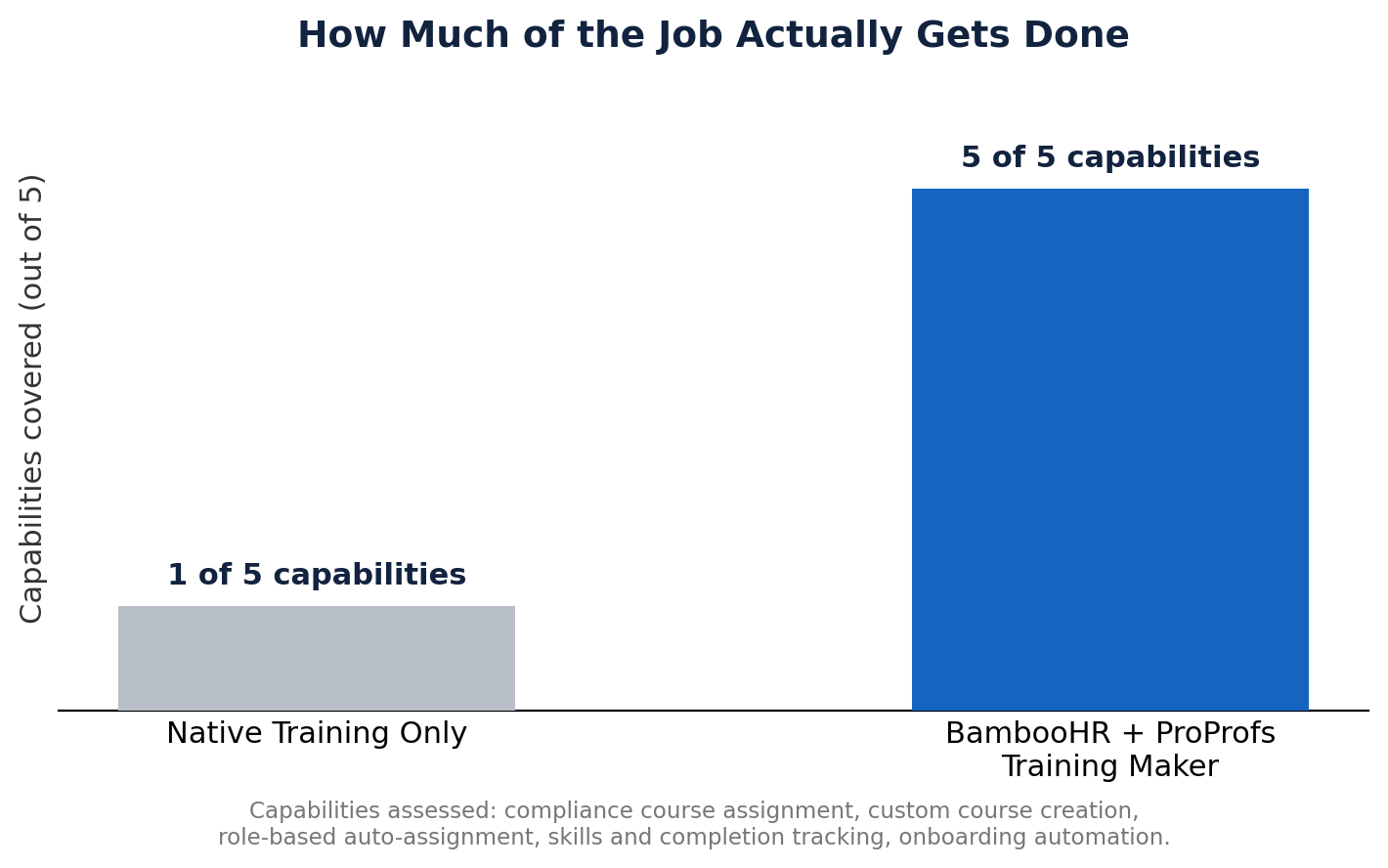
Native compliance handles assignment. Everything past that, custom content, role-based automation, skills tracking, comes from the connected LMS layer.
For a ten-person company, Elite might genuinely be enough. I’d almost tell smaller teams to stop reading here and just turn that on. Past a certain size, though, it stops working.
1. No native course authoring, so you can’t build role-specific or product-specific training from scratch.
2. No SCORM or xAPI support, so content you’ve already built elsewhere doesn’t transfer over.
3. No gamification, branching scenarios, or skills tracking. If skills verification matters more than course completion, that’s usually a Quiz Maker problem, not an LMS one.
4. No dedicated training management dashboard, just assignment and completion status, nothing deeper.
I think people overweight the feature list here and underweight the actual question, which is simpler: do you need to teach your own material, or just prove people sat through someone else’s. Those are very different problems with very different price tags. Native compliance covers the minimum. It’s not the same as full employee training in BambooHR, and pretending otherwise is where most of the frustration starts.
Why I Wouldn’t Abandon BambooHR for a Bigger Workforce Platform
Every few months someone tries to sell me on ripping out BambooHR for one of the all-in-one workforce platforms. Payroll, benefits, performance, training, all in one system.
I keep saying no, and I’ll probably keep saying no.
The bigger the platform, the more it wants to own every workflow its own way, including the HR admin that already works fine.
- You inherit workflows you didn’t ask for, on top of the one gap you actually had
- Migrating clean HR data becomes its own project, separate from the training problem you started with
- You lose the exact simplicity that made BambooHR worth choosing
BambooHR’s whole value, to me, is that it stays out of the way. Add a dedicated tool for the one gap you actually have. Don’t rebuild the entire stack because one function is missing. That’s usually a mistake, and I’ve watched a few companies make it and regret the switching cost a year later.
If BambooHR onboarding training is your only real gap, fix that gap. You don’t need a new HR system to do it.
The Best Ways to Add a BambooHR LMS, Ranked by What I’d Try First
I’m ranking these because I think most people evaluate every option at once instead of in order. Here’s the order I’d actually use.
1. Turn On Native Compliance Training First
If compliance is the fire, start with the native tier that matches your plan. It’s already paid for. Turn it on before you evaluate anything else. This step alone resolves a surprising share of the panic I see.
2. Connect a Dedicated LMS for BambooHR Employee Training
If you need more, role-based paths, actual content, skills tracking, this is where a real BambooHR LMS integration earns its cost. TalentLMS is the one I hear about most, and for good reason. Employee data syncs from BambooHR into TalentLMS automatically, and completed courses show back up on the employee’s BambooHR profile. Clean, in theory.
In practice, there’s a landmine here nobody warns you about clearly enough. The sync between the two systems matches course and category names exactly, and it’s case-sensitive. Rename a course in BambooHR after you’ve connected everything, and the sync can quietly break with no error telling you why. Lock your naming convention before you connect anything. Not after.
Worth mentioning here, because it’s the most direct fit for the onboarding piece specifically: ProProfs Training Maker’s BambooHR integration is built around exactly this gap. It connects without code, auto-assigns courses by job title, department, or location the moment someone’s hired, and syncs progress back into BambooHR automatically, with a manual sync available whenever you don’t want to wait. That’s the difference between remembering to trigger BambooHR onboarding training and it just running itself.
Streamline your HR processes with BambooHR
Get pricing, explore features, and see how BambooHR can simplify onboarding, employee records, and performance management.
| Path | Best For | Setup Effort | Watch Out For |
|---|---|---|---|
| Native Compliance Training | Pure compliance, small teams | Minutes, already in your plan | Caps out fast past basic courses |
| TalentLMS (Marketplace) | Role-based training at scale | Moderate, one-time sync setup | Case-sensitive name matching breaks silently |
| ProProfs Training Maker | Onboarding automation, custom courses | Low, no-code setup | Confirm offboarding access behavior for your plan |
| Zapier / API | Non-standard, multi-entity setups | High, ongoing maintenance | Fragile if internal ownership changes |
Which path fits your situation, roughly in the order I’d evaluate them.
If you’re also weighing this against other tools broadly, here’s how the alternatives stack up. And if the real gap is building the training content itself, not just assigning it, that’s what an AI-assisted course builder is actually for.
3. Reserve Zapier or the API for Non-Standard Setups
Zapier and the raw API exist for the weird cases, multiple entities, homegrown systems, non-standard fields. Most companies don’t need this route. If you think you do, you’re probably right, but check twice.
What Mistakes Do Most Teams Make Connecting an LMS to BambooHR?
Here’s the assumption that gets people every time: once employee training in BambooHR is connected to an outside tool, they treat the two systems as one thing. They’re not. Three mistakes show up constantly.
1. Assuming the sync is instant. Most integrations run on a schedule, daily is common, with manual sync as a backup. I’ve watched people convince themselves something’s broken because a new hire didn’t show up in the LMS within five minutes. It’s not broken. It’s just waiting for the next cycle.
2. Assuming offboarding automatically cuts access. Removing someone from BambooHR does not automatically kill their LMS access in every integration. Sometimes that has to be done manually on the LMS side. If your compliance story depends on access ending the moment someone’s terminated, don’t assume it. Check it. I’ve seen this go wrong, and it’s not a fun conversation to have after the fact.
3. Assuming a synced integration means two-way visibility. Some setups only push data one direction. Completion data doesn’t always flow back cleanly, especially in older or looser API connections. If you can’t see finished courses inside BambooHR itself, you’re still doing manual reconciliation, you’ve just moved where it happens.
How Much Legal Risk You’re Carrying If Employee Training in BambooHR Slips
I’ll be honest, this section bores me to write and I still think it’s the most important one.
- California: broad requirement, training required every two years
- New York: annual training, required for all employers regardless of size
- Illinois: annual training required for all employers
- Connecticut, Delaware, and Maine: broad mandates with size-based thresholds
Even outside those states, the EEOC treats documented training as part of an employer’s reasonable-care defense, a standard that traces back to the Faragher and Ellerth Supreme Court decisions.
BambooHR’s own Chief Product Officer said it plainly when the compliance partnership launched: “the stakes for compliance have never been higher,” five-person shop or not. I think most owners underestimate this until the first time someone actually asks for the paperwork.
A BambooHR LMS setup that can’t produce a clean report on demand isn’t a minor inconvenience. It’s the first thing an auditor asks for. For a closer look at which states require what, we’ve broken it down separately.
What I’d Actually Do First With BambooHR Training Management
Treat this as a BambooHR training management decision, not a tooling hunt.
1. Audit what you’re legally required to deliver against what you’re actually delivering. That gap, not a feature chart, decides your next move.
2. Turn on native compliance training first if you haven’t. It’s fast and it’s already there.
3. Connect a dedicated LMS only once you need more than compliance, role-based paths, actual content, skills tracking.
4. Don’t build custom Zapier flows before confirming the standard integration genuinely can’t do the job.
5. Don’t rename your BambooHR trainings after you’ve gone live. This is the mistake I’d bet money on you making otherwise.
How to Tell If Your BambooHR LMS Setup Is Actually Working
Not by whether the sync ran. By whether anything changed.
- Completion rate, not assignment rate, obviously, but people still track the wrong one
- Time from hire date to first completed course, which tells you how real your BambooHR onboarding training actually is versus how it looks on paper
- Audit turnaround time, the number I’d watch most closely, because it’s the one that shows up when you least want it to
- Manager follow-up volume, if managers are still manually chasing people three months in, the automation isn’t doing its job
Track those four numbers for a quarter and you’ll know more about your BambooHR training management setup than any vendor demo will tell you.
The Real Fix for a BambooHR LMS Isn’t a Bigger System
You didn’t pick BambooHR because you wanted the biggest platform on the market. You picked it because it stayed out of your way. Adding training doesn’t have to change that.
The companies that get this right don’t rebuild their HR stack. They keep BambooHR doing what it’s good at and add exactly one focused layer for training, native compliance for the basics, a connected LMS for everything past that. I don’t think there’s a version of this where one tool does BambooHR employee training, HR admin, and everything else equally well. I’ve stopped looking for that tool, and I’d suggest you do too.
Start with the audit. Fix the biggest exposure first. Add the rest when you actually need it, not before. That’s really what determines whether employee training in BambooHR works long term or just looks good on paper.
Frequently Asked Questions
Does BambooHR have a built-in LMS?
Not really. The native Training tab covers assignment and EasyLlama compliance courses, tiered by plan. For anything closer to a full BambooHR LMS, custom courses, learning paths, most people end up connecting something through the Marketplace for real BambooHR employee training instead.
How do I add employee training to BambooHR?
Start with native compliance training if that's your immediate need. Past that, connect a dedicated LMS to expand employee training in BambooHR beyond compliance, TalentLMS or ProProfs Training Maker are the two I hear about most, through BambooHR's Marketplace.
Does BambooHR's integration with TalentLMS sync automatically?
Yes, usually daily, with manual sync available. Just watch the naming. The match between BambooHR and TalentLMS course names is case-sensitive, and renaming something after you've connected the two is the most common cause of a broken sync.
Is native compliance training enough on its own?
For a small team, often yes. Past a certain size, or once you need role-specific content and skills tracking, it stops being enough. That's when a connected LMS becomes the more complete BambooHR LMS setup, not before.
What happens to LMS access when someone's terminated in BambooHR?
Depends on the tool. Some revoke access automatically. Others need a manual archive step on the LMS side. If your compliance posture depends on immediate access removal, don't assume, confirm it for whatever you're using.
Can I assign BambooHR onboarding training automatically by role?
Yes, through a connected LMS. TalentLMS and ProProfs both let you auto-assign by job title, department, or location using BambooHR's fields, so new hires get the right training without someone remembering to set it up manually each time.

Let ProProfs AI create your training course

 We'd love your feedback!
What did you like & how can we make it even better?
 Thanks for your feedback!
 Ask Your Question
Have a question? Get expert help to make your decision easier.