
Ask ten L&D leaders why their corporate upskilling program underperformed, and nine will point to the content. The tenth, usually the one who’s been doing this longest, will say the content was fine. The problem showed up nine months later, in an exit interview. I trust the tenth answer more every year.
That’s the pattern worth understanding before you build or fix a corporate upskilling program: training can work exactly as intended and still cost you the person who took it, because getting better at a job and getting paid more for it are two separate decisions most companies never link. If your team is remote, stretched thin, and one mandatory course away from tuning out completely, you don’t need more content. You need a system that catches the real gap before it becomes an exit interview.
This is for:
- L&D managers building a program from scratch, not just refreshing one
- HR leaders trying to prove training actually changes performance, not just completion rates
- Talent development leads managing distributed or hybrid teams across time zones
- Anyone who inherited a “training strategy” that turned out to be a course library nobody opens
What Does Corporate Upskilling Actually Mean in 2026?
Everyone in this conversation already knows the broad strokes of corporate upskilling. What trips people up is a smaller, more specific distinction, one that quietly changes budget and timeline the moment you name it out loud.
That distinction matters more than it sounds. A support rep learning to use an AI ticketing assistant is upskilling. That same rep being trained into a data analyst role is reskilling, and it needs a different budget, timeline, and manager conversation entirely. Conflating the two is how programs overpromise without anyone deciding to lie.
Why Do Most Corporate Upskilling Programs Quietly Fail?
Three reasons keep coming up, and two of them have nothing to do with content.
1. Role creep without a pay conversation. When corporate upskilling programs work exactly as designed, the employee gets better at more things while their title and pay stay put. A marketing coordinator picks up automation skills because the team needs them. A support agent starts doing basic data work because nobody else can. The company calls this growth. The employee eventually calls it, recognizing what they’re worth elsewhere.
2. Generic content built for no one specifically. A one-size-fits-all course library feels efficient to build and useless to sit through, because nobody’s actual gap gets closed by a module written for everyone. A real training matrix, mapping specific roles to specific skill requirements, fixes this before a single course gets built.
3. Training is treated as homework, not work. Most training still happens bolted onto an already full week. A program that looks complete on a dashboard can accomplish very little on a Tuesday afternoon if nobody has protected the time to actually sit with it.
The retention math backs up reason one:
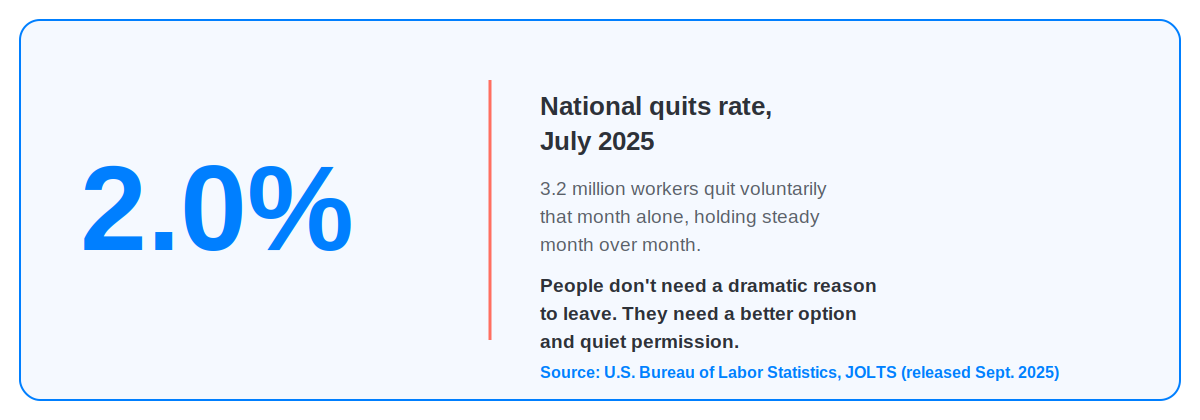
People don’t need a dramatic reason to leave. Handing someone new skills without adjusting what they’re paid to use them just gives them one more reason to go looking. If you only fix one of these three, fix the first one. It’s the one nobody budgets for, and it’s the one that costs you the employee.
What Does a Skills-Gap System Look Like Instead of a Course Catalog?
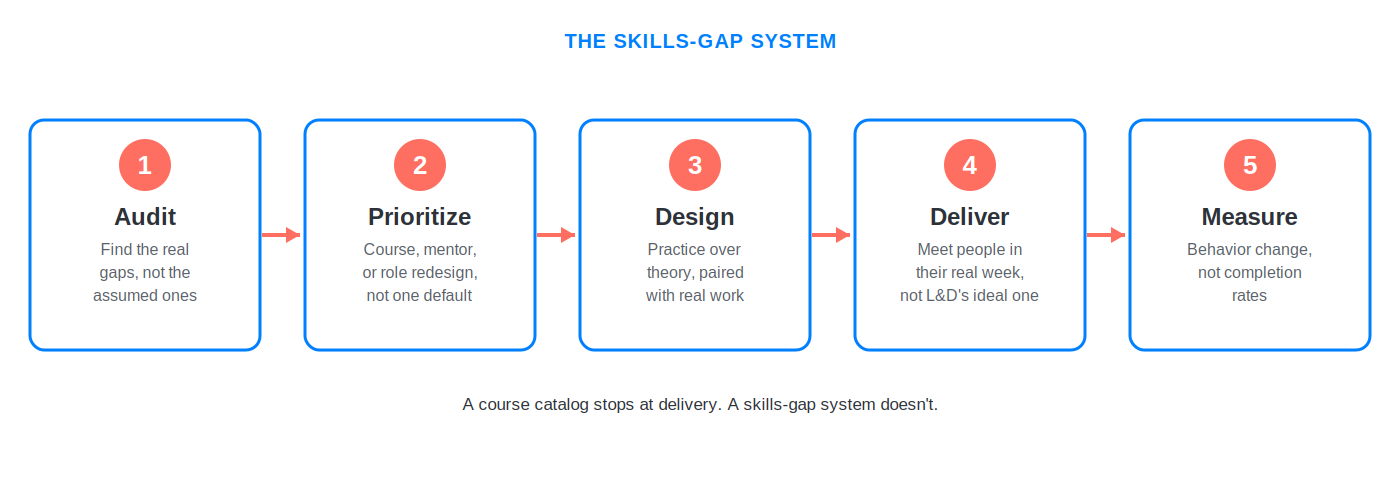
Josh Bersin, CEO of the Josh Bersin Company, put it more bluntly than most vendors would like: “Our skills challenge at work is not one of learning or training.” He’s right, and it changes what a corporate upskilling program should even be optimizing for. Here’s what a skills-gap system looks like end-to-end, instead of a shelf of courses nobody asked for:
- Audit. Find out where the gaps actually are, not where the org chart assumes they are. An employee training matrix that maps roles to required skills does this in a single view, rather than by guesswork.
- Prioritize. Not every gap deserves a course. Some deserve a mentor, a shadowing rotation, or an honest conversation about whether the role itself needs restructuring.
- Design. Bias toward practice over theory, and pair any course with a real project or a mentor check-in, rather than leaving the skill purely inside a module. Building the actual course is the easy part once the gap and the format are both clear. Soft skills deserve real weight here, too, since judgment and communication are proving more durable than any single tool skill as the tools themselves keep changing.
- Deliver. Meet people where their week already happens, not where L&D wishes it happened.
- Measure. Track behavior change, not completion rates. More on why that distinction matters further down.
The full flow looks like this:
None of this requires exotic technology. It requires someone to own the system end-to-end, rather than just a course catalog. Platforms like ProProfs Training Maker exist precisely because most teams don’t have the bandwidth to build a skills-tracking system from scratch.
Train Distributed Teams Without Building Every Course From Scratch
How Do You Run Cost-Effective Corporate Upskilling for Remote Teams?
Remote and hybrid teams break the assumptions built into most training calendars. There’s no shared lunchroom conversation to reinforce a concept, no manager glancing over their shoulder to catch confusion early, and time zones make “everyone at 2pm Thursday” a fantasy for many companies. If you’re looking for cost-effective corporate upskilling solutions for remote teams, none of the fixes below require a bigger budget, just a different one:
- Protect two to four hours a week, built into the calendar the same way a standing meeting is. It outperforms a single mandatory training day that gets rescheduled twice and resented once.
- Default to microlearning. Short modules built into a real workflow, rather than a single long session, are the only format that reliably survives contact with a distributed team’s actual calendar.
- Automate the follow-through. Deadline reminders, auto-enrollment, and progress nudges matter more for remote teams because there’s no hallway conversation to catch someone who’s fallen behind. Automating this layer turns “someone should check on that” into something that actually happens, quietly, in the background, without anyone chasing anyone down over Slack.
- Stop building every course from scratch. A distributed team still needs the same compliance and skills content delivered consistently across locations. A prebuilt course library covers the recurring categories, things like harassment prevention, safety, and leadership basics, so your actual budget goes toward the specific gaps a template can’t fix.
None of these is exotic. They’re just the difference between a training calendar built for an office that assumes everyone’s in it, and one built for the team you actually have.
Turn Any Skill Gap Into a Course in Minutes
The 3 AI Trends in Corporate Learning and Development That Actually Matter in 2026
Every conversation about AI in corporate learning and development upskilling trends 2026 seems to collapse into two camps: people who think AI replaces L&D entirely, and people using it as a slide in the all-hands deck without changing a single workflow. Neither camp is looking at what’s actually proving useful. Three trends are:
- AI-assisted course drafting. Tools that turn a topic into a working course outline, quizzes and structure included, matter less for the raw speed and more for what they free up. Subject matter experts spend their time correcting a draft instead of writing one from a blank page, which is a better use of an expert’s hour.
- Personalized, adaptive learning paths. What a learner sees adjusts based on what they’ve already demonstrated, rather than every employee getting the same module regardless of where they actually stand.
- Human verification is built in as a formal step, not an afterthought. The teams getting this right treat AI-generated content the way you’d treat a smart, fast, occasionally overconfident new hire: useful, but not left alone with anything that matters until someone with actual expertise has checked it. Skipping this step is how a confidently wrong module ships with the same tone as an accurate one.
That’s the real story behind AI in corporate learning and development upskilling trends for 2026: less magic, more infrastructure, and a verification habit that didn’t used to be necessary.
What Should You Actually Do First?
If you can only do one thing this quarter, run the skills audit before you touch a course catalog. Everything else is guesswork without it, and I’ve watched teams spend six figures on content before they knew which gaps actually mattered.
A few things worth sorting by priority instead of tackling all at once:
- Do first: the skills audit and a scheduled compensation review tied to whatever the audit says matters most.
- Can wait: a full LMS migration, a shiny mobile app, and gamification badges. They photograph well in a board deck and solve problems you probably don’t have yet.
- Watch for the trap: mistaking “we bought a platform” for “we fixed the gap.” The platform is infrastructure. The audit and the compensation conversation are the actual program.
Decide now, before training ships, what happens when someone gets meaningfully better at their job. If the honest answer is “nothing changes,” you have a retention problem waiting, not a training success story.
How Do You Know If Your Upskilling Program Is Actually Working?
Completion rates tell you who clicked through, not who can do the job differently. If your only success metric is “X% finished the course,” you’re measuring compliance, not capability, and those are not the same thing, no matter how the dashboard labels it.
Better signals to track instead:
- Pre and post skill checks that show actual movement, not just a certificate
- Manager-reported behavior change at 30 and 60 days out, not just at the finish line
- Whether people can apply the skill under a realistic scenario instead of a multiple-choice recall question
- Analytics that surface a skill gap before it becomes a performance problem, rather than after
Track this quarterly, not annually. A yearly review catches problems long after they’ve already cost you the employee who got frustrated and left, or the customer who got the wrong answer from someone marked “trained” six months ago.
The Upskilling Program Nobody Has to Pretend to Like
None of this requires a bigger budget than you already have. It requires being honest about which gaps are real, which content is theater, and what happens to a person’s paycheck after they get good at something new. Corporate upskilling was never really a content problem. It’s a decision about whether your company grows the people already inside it, or waits to hire the version of them that already exists somewhere else, at a higher salary, at a company that figured this out first.
Start with the audit. Protect the actual hours. Fix the compensation conversation before someone else fixes it for you. Everything else is detail work, and detail work gets a lot easier once the real problem is the one you’re actually solving.
Frequently Asked Questions
What is the difference between corporate upskilling and reskilling?
Upskilling builds on an employee's current role as it evolves, like teaching a support rep to use new tools. Reskilling prepares someone for a different role entirely. Most corporate upskilling programs need to name which one they're actually doing, because the budget and timeline differ.
How much should a company spend on corporate upskilling programs?
There's no universal number. Large companies often allocate seven figures annually while smaller companies spend far less in absolute terms. What matters more than the total is whether the spend follows a skills audit or a generic course catalog. Misallocated spend is more common than under-spending.
What are cost-effective corporate upskilling solutions for remote teams?
The most cost-effective approach is short, frequent learning built into protected work hours rather than after-hours homework, paired with a prebuilt course library for recurring topics like compliance and safety. That combination avoids building every course from scratch while still fitting a distributed team's real schedule.
Why do corporate upskilling programs fail?
Most fail for three reasons: role creep that outpaces pay, generic content that doesn't match a specific role's actual gap, and a training win that never translates into a title or pay conversation. Employees who get measurably better without recognition tend to use that improvement to leave rather than stay.
How do you measure whether an upskilling program is working?
Skip completion rates as your primary signal. Use pre and post skill assessments, manager-reported behavior change at 30 and 60 days, and scenario-based testing instead of recall questions. Review these numbers quarterly, since a yearly check catches problems well after they've already cost you people.
What AI trends in corporate learning and development should you actually watch in 2026?
The three worth watching are AI-assisted course drafting, personalized learning paths that adapt to what someone's already demonstrated, and human verification built in as a standard step. AI-generated content nobody checks is the trend to avoid, since unchecked errors can ship with the same confident tone as accurate information.
Should upskilling happen during work hours or after hours?
During work hours, protected and scheduled like a standing meeting. Training that happens after hours competes with rest and family time, gets skipped under any pressure, and quietly signals that the company doesn't consider the skill important enough to fund with paid time.
What is role creep in corporate upskilling, and how do you avoid it?
Role creep happens when upskilling adds real responsibility without adjusting title or pay. Avoid it by pairing every corporate upskilling program with a scheduled compensation review, so skill growth and career growth move together instead of one quietly outpacing the other.

Let ProProfs AI create your training course

 We'd love your feedback!
What did you like & how can we make it even better?
 Thanks for your feedback!
 Ask Your Question
Have a question? Get expert help to make your decision easier.