My short answer to anyone searching for Arlo training alternatives is to check the category before the price. Arlo is a training management system built to sell seats, take payments, run schedules, and send reminders for providers who run public and blended courses.
Plenty of people shopping around are really looking for a place to deliver courses, track completion, and issue certificates, and a TMS charges you for the wrong half of that job. The rest want the same box office at a smaller bill.
The ten below cover both groups, and I say which is which.
Top 10 Arlo Training Alternatives Compared
A training business runs two jobs at once: selling seats and teaching people. Most replacements only cover one of them, which is why the best Arlo training alternatives for a provider with a packed classroom calendar look nothing like the best pick for one whose courses are mostly online.
Here is the fast version: Capterra ratings, current pricing, and the two columns that map to the loudest complaints, how fees are structured, and whether you can sell courses online.
| Tool | Best For | Capterra | Pricing | Fee Structure | Sells Courses Online |
|---|---|---|---|---|---|
| ProProfs Training Maker | Course creation for employee training & compliance | 4.8 | Free (10 learners); paid from $1.99/learner/mo | Per learner; no per-registration fees | Yes: ProProfs Store or your site via Stripe |
| TalentLMS | Simple setup, active-user pricing | 4.7 | Free plan; $149–$579/mo | By monthly active users | Yes |
| LearnWorlds | Branded storefront, interactive video | 4.7 | $24–$249/mo (annual) | Monthly plan; $5/enrollment on Starter | Yes: built-in storefront |
| Thinkific | Structured courses under your brand | 4.4 | $40–$164/mo (annual) | Monthly plan; 0% transaction fees | Yes: storefront and checkout |
| Kajabi | Selling with marketing tools built in | 4.3 | $143–$499/mo (annual) | Monthly plan; funnels and email included | Yes: storefront, checkout, funnels |
| LearnUpon | Training several audiences from one account | 4.7 | Custom quote | Custom quote | Yes: e-commerce available |
| Absorb LMS | Large compliance-driven programs | 4.5 | Custom quote | Custom quote; add-ons | Confirm scope with vendor |
| Docebo | Enterprise reporting, extended training | 4.4 | Custom quote (~$25K+/yr) | Annual custom contract | Confirm scope with vendor |
| Moodle | Cost control, open-source flexibility | 4.3 | Free (self-hosted); hosting varies | Free software; hosting costs | Via plugins |
| Teachable | Simple branded course business, native app | 4.3 | $29–$189/mo (annual) | Monthly plan; 7.5% fee on Starter | Yes: storefront and checkout |
1. ProProfs Training Maker – Best for Easy Course Creation for Employee Training, Compliance & Skill Assessment
ProProfs Training Maker suits a provider whose courses are mostly online, or whose classroom sessions need an online backbone. Arlo prices on admin licenses plus registrations, so every sale nudges the bill, which I would test against a per-learner plan first.
You can sell courses through ProProfs Store or your own website with Stripe, add coupons, and let buyers in automatically once payment clears. The AI course creator turns your slides, documents, or recordings into a structured course with chapters and quizzes, ready to brand with your own logo and colors.

Let ProProfs AI create your training course
Separately, 500+ expert-built courses can sit beside your own. Reports and certificates show who passed, courses run in 70+ languages, and gamification lifts completion.
It will not schedule venues, instructors, or session capacity, so classroom-heavy businesses still need a TMS or calendar beside it. Among Arlo training alternatives, it is the one I would test first for online courses.
Pros:
- Let’s you sell courses through ProProfs Store or your own website with Stripe, with coupons and 15 currencies to choose from
- Turns your existing slides, documents, and recordings into complete courses with the AI course creator
- Gives you 500+ expert-built courses to assign alongside your own material
- Tracks offline and instructor-led activity in a central training record, so classroom attendance sits beside online results
- Issues completion certificates and learner reports automatically, so clients get proof without a spreadsheet
Cons:
- No downloadable or on-premise version, since the platform is cloud-only
- No dark mode yet for learners studying in low light
Pricing: Free for up to 10 learners; paid plans start at $1.99 per learner per month.
2. TalentLMS – Best for Simple Setup and Active-User Pricing
TalentLMS answers the usability complaint directly: it is an LMS that new admins can run without weeks of self-study. Pricing is published and based on how many people log in each month, so a seasonal provider is not paying for last quarter’s learners, and there is no per-registration meter running under every sale.
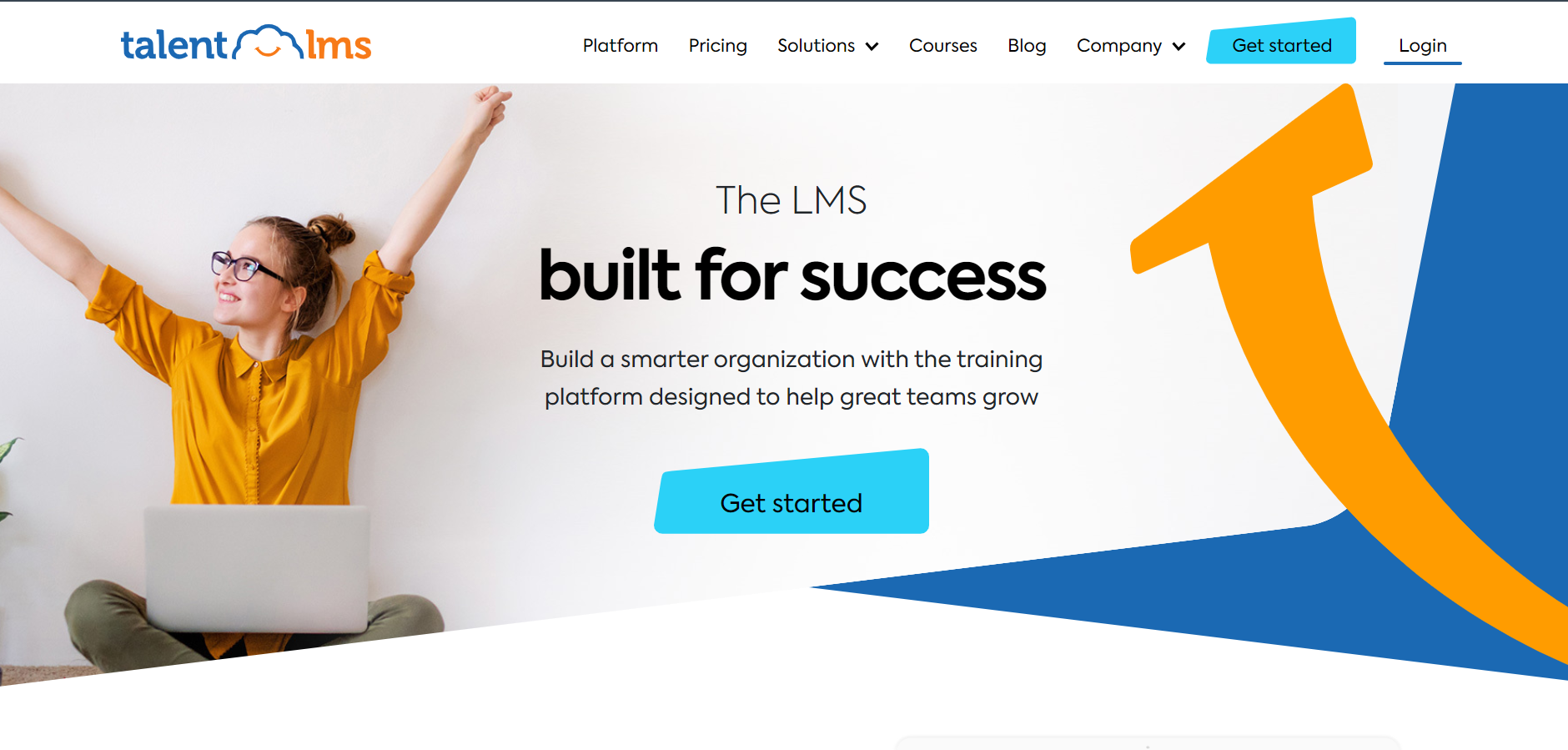
You can sell courses online, run instructor-led sessions alongside self-paced content, and issue certificates, with reporting on who finished. The optional TalentLibrary add-on brings 1,000+ ready-made courses and 30+ integrations, including Zapier, for easier connections to the CRM or payment tools you already use.
It is not a full training management system. Venue booking, resource planning, and heavy scheduling are thinner than with a dedicated TMS, so I would pick it for a provider that delivers mostly online, with some live sessions, and wants a predictable bill as volume grows.
Pros:
- Pricing based on monthly active users, with no sales call required
- Genuine free plan for testing with a real course
- Courses, instructor-led sessions, and certificates in one place
- Optional TalentLibrary add-on with 1,000+ ready-made courses
- 30+ integrations including Zoom and Zapier
Cons:
- Scheduling and venue management are lighter than at a dedicated TMS
- The ready-made library is a paid add-on
Pricing: Free plan available; Core starts at $149 per month for up to 100 users, scaling to $579 per month for 1,000 users.
3. LearnWorlds – Best for a Branded Storefront and Interactive Video
LearnWorlds goes after the storefront complaint: sites built on a rigid template tend to look alike, and it offers a branded school with a real checkout, so your courses do not read as a clone of every other provider’s page. Interactive video with embedded questions adds engagement that a plain registration page never will.
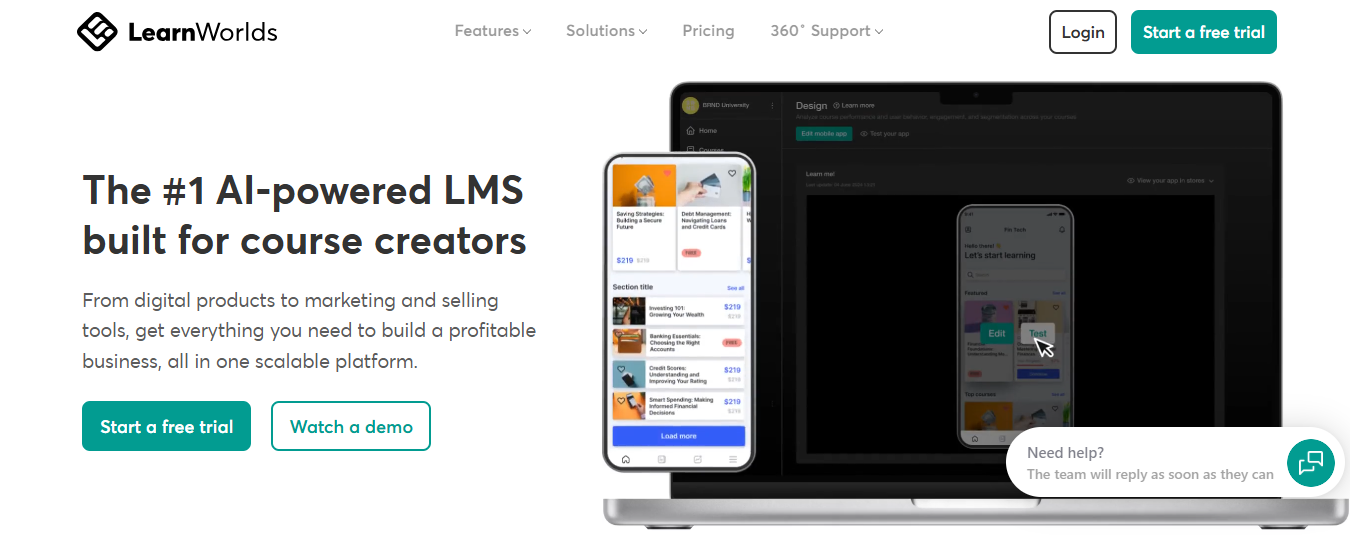
Live classes connect through Zoom and Webex, which suits providers who mix recorded content with scheduled sessions. The Starter plan carries a flat $5 fee per enrollment, which is worth modeling against your volume, though the fee disappears on Pro Trainer and above and the monthly plans stay easy to read.
It is a course platform first, so it will not manage venues or in-person capacity. I would choose it for a provider shifting toward online delivery who cares about how the course catalog looks and sells, and who wants video to do some of the teaching.
Pros:
- Built-in storefront and checkout, with a branded course player
- Interactive video with embedded quizzes and clickable moments
- Fee drops to 0% on Pro Trainer and above
- Live classes through Zoom and Webex integrations
- Assessment options beyond basic quizzes
Cons:
- Starter plan charges a flat $5 fee per enrollment
- No venue, room, or in-person capacity management
Pricing: Starter starts at $24 per month on annual billing with a $5 enrollment fee, scaling to $249 per month for Learning Center with no fee.
4. Thinkific – Best for Structured Courses Sold Under Your Brand
Thinkific is the plain, dependable way to publish and sell structured courses without a revenue cut. Transaction fees stay at 0% on paid plans, so what you charge is what you keep apart from card processing, which answers the sting of layered usage fees on a classic TMS.
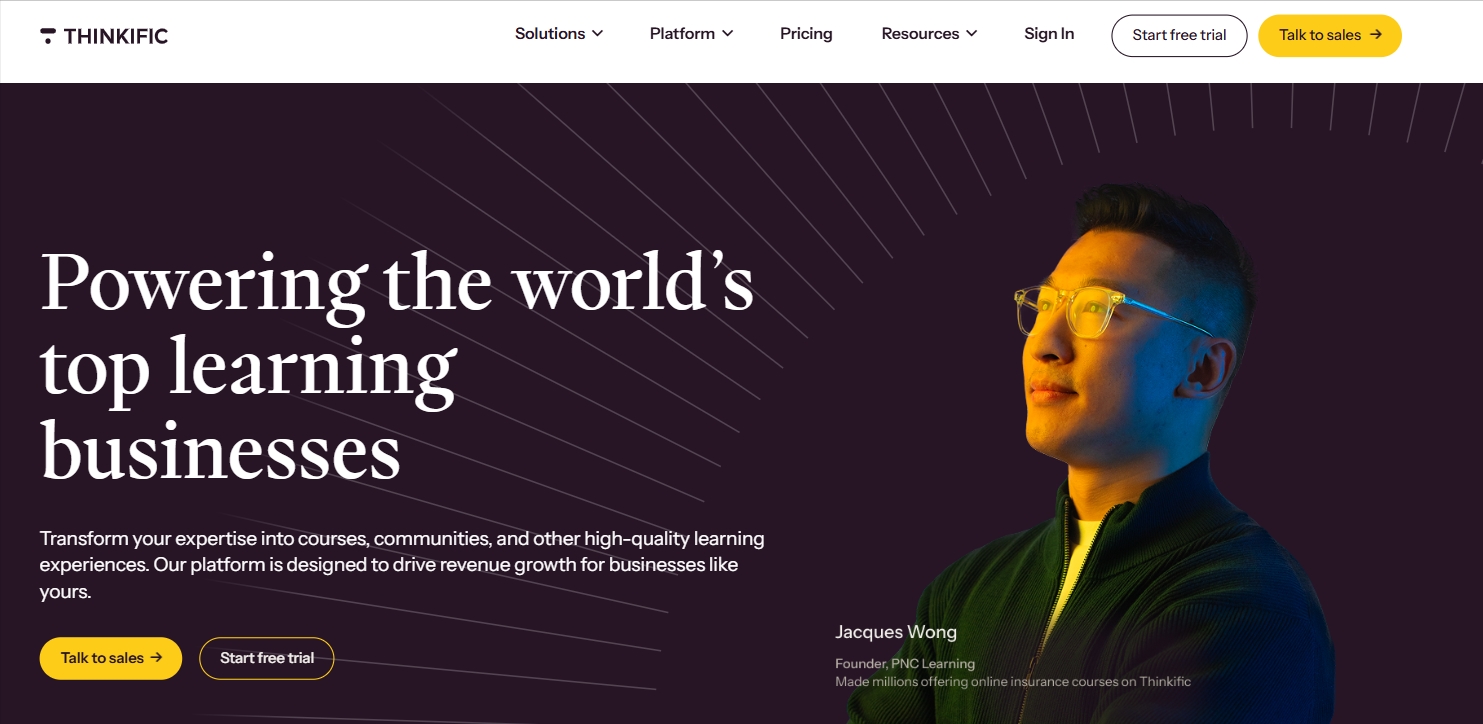
Graded assignments, quizzes, and learning paths give you more than a recording behind a paywall, and the builder is approachable for a small team that does not have a developer. The 2026 price increase and the end of the free plan are real costs, and a branded mobile app is not included below the enterprise tier.
It will not handle venue booking or instructor scheduling, so I would choose it for a provider whose catalog is mostly online and whose real pain is a heavy, expensive system. If you run many live classes a week, keep a scheduling tool beside it.
Pros:
- 0% platform transaction fees on every paid plan
- Storefront and checkout for selling courses directly
- Graded assignments and quizzes that add accountability
- Structured learning paths for sequenced programs
- Approachable builder for non-technical teams
Cons:
- No permanent free plan, only a 14-day trial
- Branded mobile app is not included below the enterprise tier
Pricing: Basic starts at $40 per month on annual billing, scaling to $164 per month for Grow.
5. Kajabi – Best for Selling With Marketing Tools Built In
Kajabi suits the provider whose growth problem is filling seats, not running them. Landing pages, email, funnels, and checkout sit in the same platform as the course, so you are not stitching a registration tool to a separate marketing stack, which is the integration friction many providers describe with a TMS.
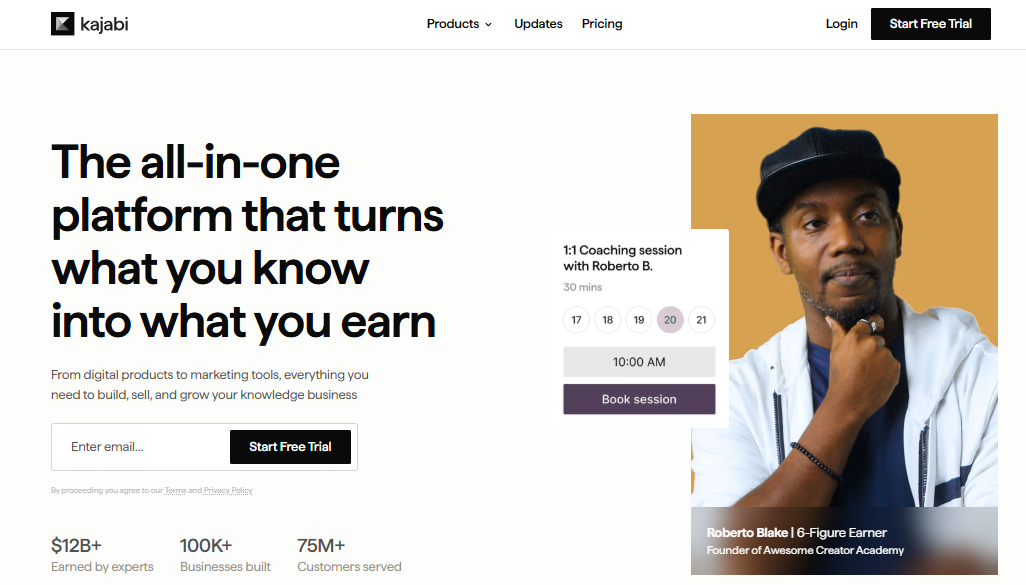
That convenience carries a price. Plans run well above most course platforms, and a team that only needs delivery and certificates will be paying for marketing it never touches, which is worth checking against a realistic year of enrollments. It is built around online sales rather than classroom operations, so scheduling, venues, and instructor management are outside its scope.
I would pick it for a provider selling online programs to the public who wants one system for the funnel and the course. For corporate clients and compliance training, a platform with deeper reporting and certification tracking will fit better.
Pros:
- Landing pages, email, and funnels alongside the course
- Checkout and payments built into the platform
- Single system for marketing and delivery
- Strong fit for selling to the public
- Fewer separate tools to connect
Cons:
- Higher monthly cost than most course platforms
- No venue, scheduling, or instructor management
Pricing: Plans range from $143 to $499 per month on annual billing.
6. LearnUpon – Best for Training Several Audiences From One Account
LearnUpon is built for the provider who trains employees, customers, and partners and does not want them to see each other’s material. Separate branded portals let each audience get its own content, branding, and permissions from a single account, which answers the complaint about cookie-cutter sites and limited customization.

Automation takes care of enrollment and reminder busywork, multilingual support suits distributed audiences, and users consistently point to responsive customer support. Integrations include HR and CRM tools such as BambooHR and Salesforce. Customization and advanced analytics lag pricier enterprise tools, and pricing is a custom quote rather than a published rate.
I would choose it for a mid-sized provider with corporate clients that each need their own space. It is not a scheduling engine, so classroom bookings still need a separate tool. Check how its e-commerce and reporting handle client-specific invoicing before you commit.
Pros:
- Separate branded portals for employees, customers, and partners
- Strong, consistently praised customer support
- Automation for enrollment and reminder workflows
- Multilingual support suited to distributed audiences
- HR and CRM integrations including BambooHR and Salesforce
Cons:
- Pricing is not published and requires contacting sales
- Customization and analytics depth lag top-tier enterprise platforms
Pricing: Custom quote only; contact the vendor for pricing based on user count and portal needs.
7. Absorb LMS – Best for Large Compliance-Driven Programs
Absorb is the step up for a provider whose clients are large and whose work is driven by compliance. Automated enrollment rules and bulk operations take the click-heavy admin out of assigning courses at volume, and the learner interface is polished enough that adoption rarely needs a campaign of its own.
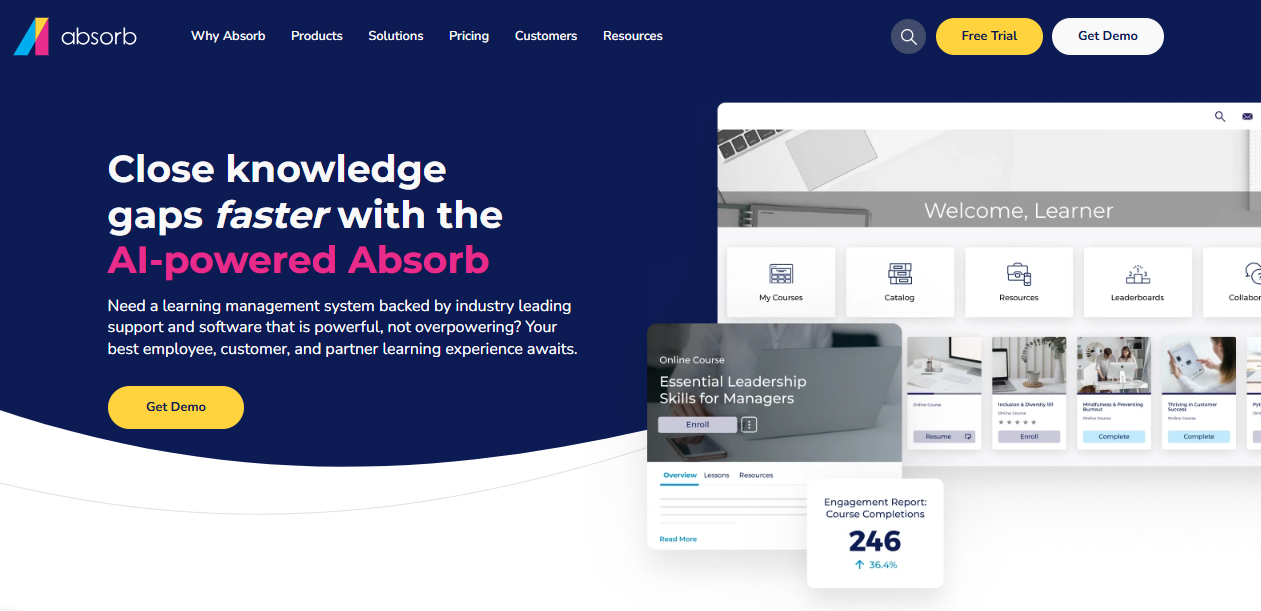
Absorb Intelligence recommends courses and flags learners who are falling behind, which gives managers something to act on before a deadline. Reporting leans toward audit needs. Pricing is not published, and social learning, authoring, and advanced analytics sit behind add-ons, so scope the real cost before you compare it with Arlo’s licenses and fees.
It is built for mid-size to large organizations, so a small provider will find it more than it needs. I would pick it when your clients demand strong compliance records and you can budget for a quote-based contract and a pilot with real client data.
Pros:
- Automated enrollment rules and bulk operations
- AI-powered course recommendations and at-risk learner flagging
- Modern learner interface that drives adoption
- Strong customer support consistently praised
- Scales from mid-size to large deployments
Cons:
- Pricing is not published and requires a custom quote
- Add-on model means the base price rarely reflects final cost
Pricing: Custom quote only; contact the vendor for pricing based on active learner count.
8. Docebo – Best for Enterprise Reporting and Extended Training
Docebo is the heavyweight option for a provider that has grown into an enterprise learning business. It is an AI-powered platform serving employees, partners, and customers, and its Shape tool turns existing documentation into course drafts, which helps when content creation is the bottleneck for a growing catalog.
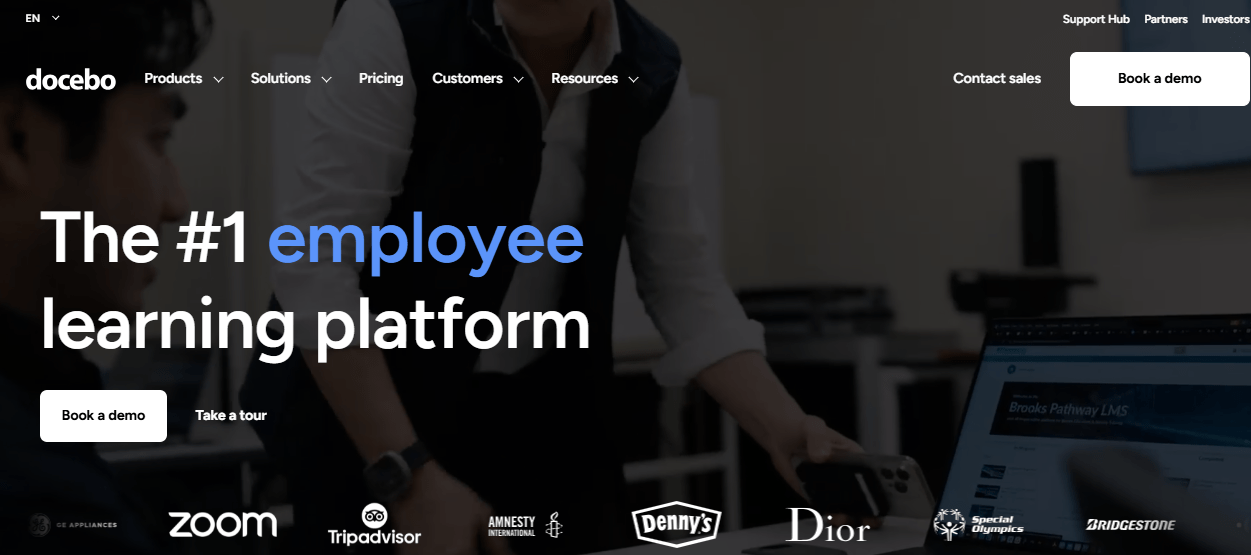
Reporting goes well beyond what users call limited at a TMS, and flexible learning paths let you build programs around roles and progress. The cost is real. Pricing is quote-only, commonly reported around $25,000 a year before add-ons, and configuration takes dedicated admin effort that a small team may not have spare.
For a large provider with a team to run it, the price makes sense. For a small training business, it is more platform than the problem requires, so ask for a pilot scoped to one client, and for references from a provider of your size, before signing anything multi-year.
Pros:
- Deep, customizable reporting beyond completion rates
- AI-powered content creation (Shape) that speeds up course drafting
- Strong multi-audience support for employees, partners, and customers
- Flexible learning paths built around roles and progress
- Active roadmap with frequent AI feature releases
Cons:
- Pricing is quote-based and expensive at scale
- Steep admin learning curve during initial configuration
Pricing: Custom quote only; total cost of ownership commonly starts around $25,000 per year before add-ons.
9. Moodle – Best for Cost Control With Open-Source Flexibility
Moodle attacks the cost complaint at the root: the software itself is free, so there is no admin license and no per-registration meter. A large plugin ecosystem covers payments, enrollment, and reporting, and you control the data and the design, which answers the limited-customization frustration directly.
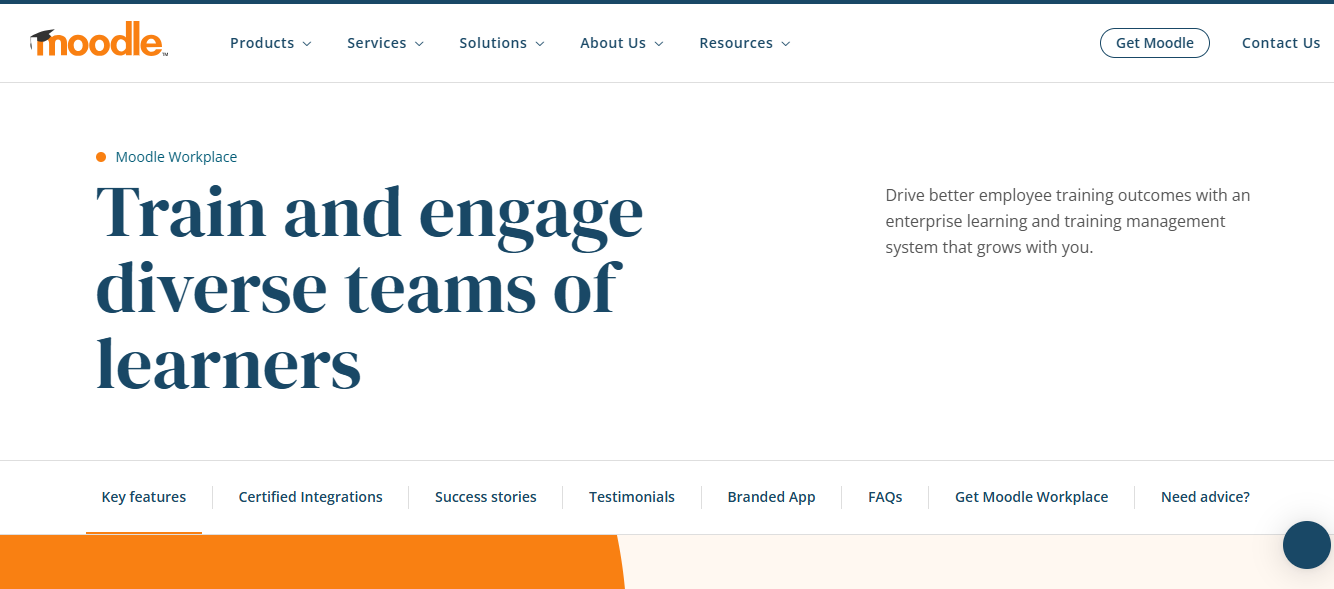
The price you pay is effort. Self-hosting needs real technical staff and ongoing maintenance, reviewers consistently note the interface feels dated next to commercial platforms, and plugins vary in quality. Hosted plans through partners exist if you would rather not run servers, though costs then depend on the provider.
I would choose it for a training provider with technical people in-house who want total control over the storefront and are comfortable assembling the pieces. If you want something running this week without a developer, a commercial platform will save you time, and hosting, backups, and upgrades should be budgeted as real costs, not afterthoughts.
Pros:
- Free, open-source software with no per-seat or per-registration fees
- Large plugin ecosystem for payments, enrollment, and reporting
- Full control over design, data, and hosting
- Strong track record in education and government
- Large community providing support and development
Cons:
- Self-hosting requires technical staff and ongoing maintenance
- Interface feels dated compared with commercial platforms
Pricing: Free and open-source to self-host; hosted plans through Moodle partners vary by provider.
10. Teachable – Best for a Simple Branded Course Business With a Native App
Teachable is the low-fuss option for a provider whose catalog is a handful of well-built courses. You publish under your own brand, set the price, and keep the customer relationship, and a native iOS and Android app comes with every paid plan, so learners open an actual app instead of a browser tab.
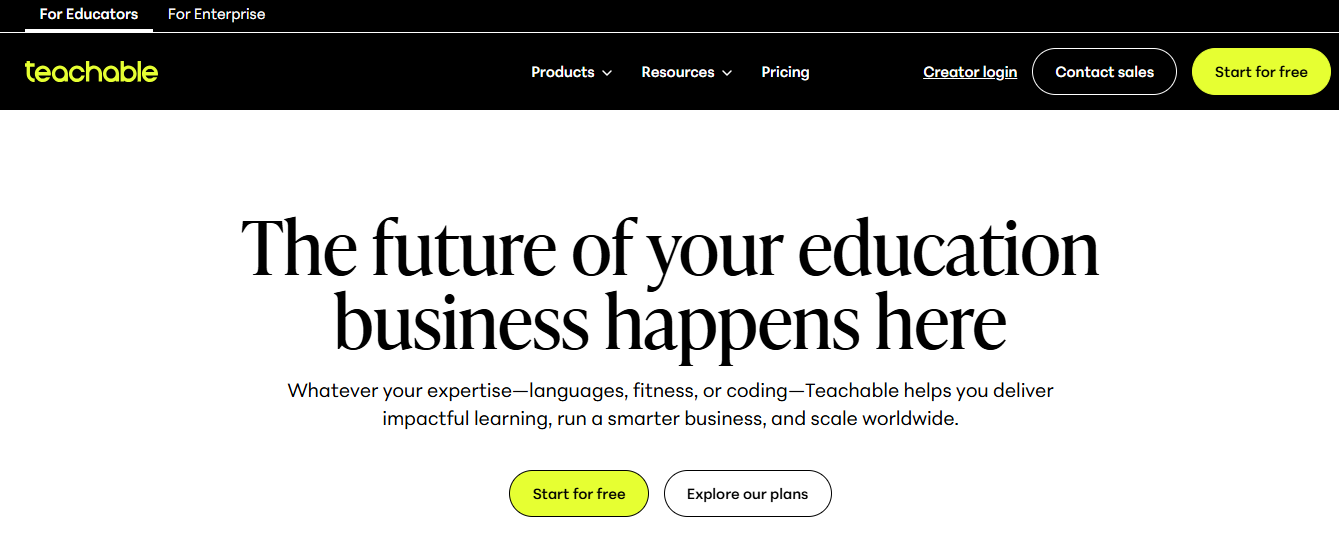
The cost shows up in the fee structure. The entry Starter plan takes 7.5% of each sale on top of card processing, which falls away from the Builder plan up, and there is no permanent free plan, only a trial. Reporting and classroom tools are lighter than at a TMS or enterprise LMS.
I would choose it for a small provider who wants to move courses online quickly and sell them without a long setup. It will not run venues or complex scheduling, so keep a calendar tool beside it for any live classes.
Pros:
- Publish and price courses under your own brand
- Native iOS and Android app included on every paid plan
- 0% transaction fees from the Builder plan up
- Built-in affiliate tools to drive sales
- Course completion certificates on higher tiers
Cons:
- 7.5% transaction fee on the entry Starter plan
- Lighter reporting and no venue or scheduling tools
Pricing: Starter starts at $29 per month on annual billing with a 7.5% fee, scaling to $189 per month for Growth with 0% fees.
My Top Picks Among the Arlo Training Alternatives
If you read nothing else, start here. Among all the Arlo training alternatives above, these three cover the three jobs people actually switch for: selling and delivering online courses cheaply, keeping a simple bill that tracks usage, and training several client audiences. Whether you searched for Arlo training competitors or Arlo training software alternatives, one of them fits.
1. ProProfs Training Maker
My pick if your courses are mostly online and the per-registration meter is what hurts. Pricing follows learners on per-learner plans; you can sell through the ProProfs Store or your own site, and certificates and reports come with the course. Keep a calendar tool beside it for venue-based classes.
2. TalentLMS
My pick if usability and a predictable bill matter most. Active-user pricing means seasonal learners do not cost you; a free plan makes a pilot low-risk, and instructor-led sessions sit alongside online courses. It is lighter than a dedicated TMS on venue booking, so check how much scheduling you really need.
3. LearnUpon
My pick if you train several client audiences and each needs its own space. Branded portals keep customers, partners, and employees separate, automation handles reminders, and support is consistently praised. Pricing is a custom quote, so ask for first-year costs before you compare it with Arlo.
How I Evaluated These Arlo Training Alternatives
I did not rank these ten alternatives to Arlo training on feature lists alone. Here is what shaped the order:
- User reviews and ratings from Capterra, weighted toward platforms with a meaningful volume of recent reviews
- Fee structure and total cost, meaning admin licenses, usage or per-registration fees, add-ons, and transaction fees, since layered pricing is the loudest reason people look at Arlo training competitors
- Ease of setup and day-to-day admin, because a steep learning curve and thin onboarding are repeated complaints
- Storefront and branding flexibility, including how much your sales pages and emails can look like yours
- Online delivery depth, including eLearning authoring and SCORM support, quizzes, and certificates
- Instructor-led and blended delivery, meaning how well a platform handles live sessions, attendance, and scheduling, compared with a dedicated TMS
- Integrations and support, including CRM and payment connections, and whether support hours work for your time zone
Decide Which Half of the Business You’re Replacing
Arlo is two jobs in one product, and most replacements only cover one.
Arlo remains strong for established providers who run public and blended courses and want scheduling, registrations, payments, and CRM in one place. If venue booking and resource planning drive your week, a dedicated training management system such as Administrate or accessplanit is the like-for-like swap, and an LMS can sit beside it for the online content. If most of your courses are delivered online, one of the LMS options above will usually cost less and take less to run. Among all these Arlo training alternatives, none wins every category, so decide which half you are replacing first.
Before you migrate to any of these Arlo training software alternatives, add up licenses and per-registration fees for your last twelve months, pilot with one course, and keep your registration history until the new system reports it correctly. If you are building the online side from scratch, a clear walkthrough on how to create an online course will save a few false starts. Anyone weighing alternatives to Arlo training should ask each vendor to price a realistic year of registrations, not just the headline plan.
Frequently Asked Questions
What are the best Arlo training alternatives for online courses?
For mostly online delivery, ProProfs Training Maker, TalentLMS, LearnWorlds, and Thinkific are the strongest fits, with checkout, certificates, and predictable pricing. Pick based on whether branding, simplicity, or fees matter most, and test checkout with a real course.
Which Arlo training software alternatives avoid per-registration fees?
TalentLMS bills by monthly active users and ProProfs Training Maker by learner. Thinkific charges 0% transaction fees on paid plans, and LearnWorlds drops its enrollment fee above the Starter plan, so model your volume before choosing.
Who are the main Arlo training competitors for instructor-led scheduling?
Dedicated training management systems such as Administrate and accessplanit are the closest Arlo training competitors for scheduling and venues. Most LMS options support live sessions but handle rooms, resources, and capacity far more lightly than a TMS.
What should I look for in alternatives to Arlo training?
Compare total cost, including fees, storefront customization, instructor-led depth, integrations, and support hours for your time zone. Then pilot one course end-to-end before you move your whole catalog, and keep your registration history safe.
Is there a free Arlo training alternative?
Yes. Moodle is free to self-host, TalentLMS has a free plan, and ProProfs Training Maker is free for up to 10 learners. Free plans suit pilots; check fees, caps, and support before you scale.
Can an LMS replace Arlo's registration and scheduling?
Partly. An LMS covers online enrollment, payments, and certificates well, but venue and instructor scheduling usually need a TMS or calendar. For corporate clients, online employee training delivered through an LMS is often enough on its own.
Let ProProfs AI create your training course

 We'd love your feedback!
What did you like & how can we make it even better?
 Thanks for your feedback!
 Ask Your Question
Have a question? Get expert help to make your decision easier.