
Picture this. A high-performing account manager pastes excerpts from an internal research report into an AI writing tool to draft a client proposal. The output looks excellent. She sends it off the same day. Weeks later, the legal team flags a serious problem: the internal document contained data protected by a client’s NDA, now processed by a third-party AI platform without authorization. No malicious intent. Just a modern workflow that existing compliance training never anticipated.
This scenario is no longer hypothetical. It is playing out in workplaces across the country right now. Drawing from a survey of 1,000 full-time U.S. workers, our findings reveal a quiet crisis inside corporate compliance programs – one hiding beneath reassuring completion rates and confident self-assessments.
The data raises a question most organizations are not yet asking: when an employee says they understand their compliance obligations, do they actually know what to do when it matters?
The Workplace Compliance Gap Hiding in Plain Sight
On the surface, the numbers look fine. 51% of employees say they are ‘very familiar’ with their workplace compliance requirements. 69% call their training effective. These are the figures that make it into board presentations.
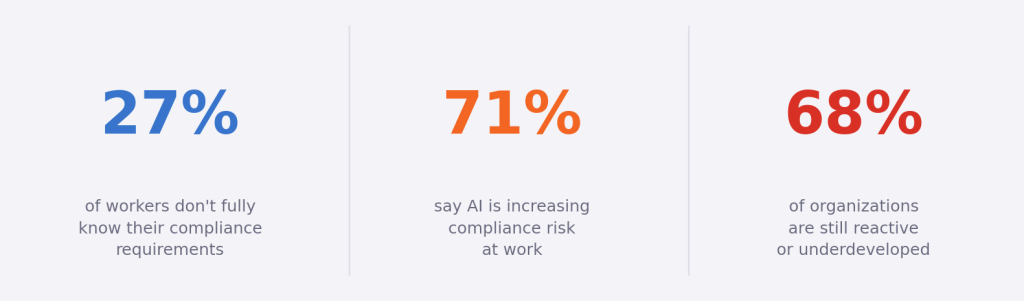
But underneath that confidence sits a significant minority that organizations consistently undercount. More than 1 in 4 workers – 27% – describe themselves as only slightly or not at all familiar with the compliance requirements in their specific role.

In a 500-person company, that translates to roughly 135 people making daily decisions without a clear picture of what workplace compliance actually requires of them. That is not a rounding error – it is a structural gap that widens every time an untrained decision gets made without consequence, and surfaces catastrophically when one finally does.
The disconnect between organizational confidence and employee clarity is where most workplace compliance failures begin. Employees are not deliberately ignoring rules. They are operating in environments where the rules were never made concrete enough to follow in the first place.
Why “Effective” Training Still Fails: The Workplace Compliance Training Gap
There is a well-worn story in workplace compliance: a new hire joins, completes onboarding modules, passes the quiz, and receives a certificate. The completion rate is logged. 6 months later, that same employee handles a sensitive situation and makes a choice that violates policy – not because they ignored training, but because the training never addressed their actual job.

Our survey puts numbers to how widespread this problem is. While 69% of respondents call their compliance training effective, that rating collapses under closer examination. 12% of workers receive no compliance training at all. Another 18% say what they do receive is not very effective or not effective at all.
When asked what would actually make workplace compliance training better, the demand for relevance dominates every other response. 63% of employees say making training more directly connected to their role would be the single most impactful change.
Nearly half want interactive compliance courses and real-life scenarios over passive formats. A third simply want modules short enough to complete without sacrificing other work.

Taken together, these responses paint a picture of a workforce that is willing to engage with compliance, but is being given content that was not designed for how they actually work. Generic modules, built to cover every role with the same material, score fine on completion dashboards. They fall apart in the real situations they were meant to prepare people for.
The Reinforcement Gap: Why Compliance Training Doesn’t Stick
Workplace compliance knowledge does not disappear overnight. It erodes gradually, through everyday decisions made by people who passed a quiz months ago and have not revisited the material since. The Ebbinghaus forgetting curve, well established in cognitive science, is not a theoretical concern in corporate compliance programs. It is a daily operational reality.
Yet nearly half of employees in our survey – 47%, combining those who receive refreshers ‘rarely’ or only ‘occasionally’ – report that their company provides no consistent reinforcement after initial compliance training. Only 42% say their organization follows up regularly.

In high-turnover industries, this compounds quickly. Every new hire resets the clock. Every missed refresher is a gap that widens quietly until something surfaces it – usually an incident, an audit, or a regulator.
By that point, the training record shows a passed quiz from months ago, and the organization is left explaining the distance between what was taught and what was actually retained.
Workplace Compliance Maturity Levels: 68% of Organizations Are Still Reactive & It’s Costing Them
Only 32% of organizations in our survey describe their workplace compliance approach as advanced – proactive, systematic, and technology-driven. The remaining 68% fall somewhere between developing and reactive, or report having no meaningful compliance infrastructure at all.

The financial consequences of that gap are well-documented. Reactive workplace compliance – the kind that responds to incidents rather than preventing them – consistently runs 2.5 to 2.7 times the cost of proactive investment, once fines, legal fees, operational disruption, and reputational damage are factored in.
Most organizations in our survey are not making that trade. They are running compliance programs that respond to problems rather than anticipate them – and paying the difference in ways that rarely show up on the same line item as training.
AI and Workplace Compliance Risk: 71% of Workers Say It’s Getting Worse
AI is not an emerging workplace compliance concern. According to our survey, it is already embedded in everyday workflows – and most employees recognize it is creating risks their organizations have not yet accounted for.
71% of workers say AI tools increase workplace compliance risk. The largest single group, 42%, call the increase significant. Only 22% believe AI adds little or no risk at all.

When asked where AI’s workplace compliance impact is most felt, data privacy and governance topped the list by a significant margin at 33%. Risk detection and audits came second at 20%, followed by personalized training and reminders at 18%.

The account manager in the opening scenario was not reckless. She was using tools available to her in the way modern professional workflows have normalized. The compliance failure was not a failure of character. It was a failure of a workplace compliance program built for a world that no longer exists.
AI is already in your employees’ workflows. The only question is whether your compliance program knows it. Updating your training to address AI-specific risks is not a future project. It is already overdue. You can easily do this by choosing an AI LMS that will make the revamping of the courses easier for you.
What Compliance Looks Like When It Works
The 32% of organizations operating at advanced compliance maturity are not running larger programs. They have changed how the programs are designed. The distinction is not one of scale – it is one of architecture.
Where most organizations treat workplace compliance as a documentation exercise – something that produces certificates and satisfies auditors – mature programs treat it as a behavioral system. Training is role-specific, not generic. Reinforcement is scheduled, not occasional. Evidence of understanding is measurable, not assumed.
The shift from reactive to proactive compliance does not require a bigger budget. It requires a different question. Rather than asking ‘did employees complete the training?’, mature organizations ask ‘can employees demonstrate what the training was meant to teach?’ Our data suggests most have not yet made that shift.
Methodology
This workplace compliance survey was conducted among 1,000 full-time U.S. workers across industries and work environments in 2026. Participants were balanced by age, gender, and employment status. All responses are self-reported.
About ProProfs Training Maker
ProProfs Training Maker helps teams move beyond checkbox compliance. Create custom courses using AI or select from 500+ expert-taught courses with automated assignment, progress tracking, and audit-ready reports.
Fair Use Statement
You are welcome to cite or republish these findings for noncommercial use with proper attribution. Please credit ProProfs Training Maker and include a link to the complete study.

Let ProProfs AI create your training course

 We'd love your feedback!
What did you like & how can we make it even better?
 Thanks for your feedback!
 Ask Your Question
Have a question? Get expert help to make your decision easier.