
I ran my first cohort on Ruzuku for two years before hitting the same wall a lot of people do: the platform teaches beautifully, but the moment I needed a real sales funnel instead of one plain checkout page, I was buying a separate landing-page tool and stitching it together with Zapier. That gap, not any single missing feature, is usually what prompts people to look for Ruzuku alternatives.
Ruzuku still does the core job well: 0% fees, built-in live sessions, and genuinely helpful support if a student gets stuck. But between the thin marketing tools, no mobile app for students, and $99 a month starting to feel steep once you are paying for three other tools on top of it, plenty of coaches decide the switch is worth the migration hassle.
Here are ten platforms that fix a specific piece of what Ruzuku leaves you to solve yourself.
Top Ruzuku Alternatives Compared
Every one of these fixes a different piece of what Ruzuku leaves for you to handle elsewhere, so the best Ruzuku alternatives for someone who needs real funnels look nothing like the best pick for someone who just wants a mobile app for students. If you have already looked at alternatives to Ruzuku before, this version reflects the current 2026 pricing.
Here is the fast version: Capterra ratings, current pricing, and two things Ruzuku genuinely lacks: built-in marketing tools and a native mobile app.
| Tool | Best For | Capterra | Pricing | Marketing Tools | Native Mobile App |
|---|---|---|---|---|---|
| ProProfs Training Maker | Course creation for employee training & compliance | 4.8 | Free (10 learners); paid from $1.99/learner/mo | Built-in store, no funnel builder | Yes — iOS & Android |
| Kajabi | Built-in marketing & sales funnels | 4.3 | $143–$499/mo (annual) | Full funnels, email, landing pages | Shared app only, no custom build |
| Thinkific | Customization & course depth | 4.4 | $40–$164/mo (annual) | Basic marketing, no native funnels | Add-on only, not included |
| LearnWorlds | Interactive video & assessments | 4.7 | $24–$249/mo (annual) | Landing pages, email on higher tiers | Add-on, ~$149/mo extra |
| Podia | Staying close to Ruzuku’s simplicity | 4.6 | $39–$75/mo (annual) | Basic email marketing built in | No native app |
| Teachable | Native app on every paid plan | 4.3 | $29–$189/mo (annual) | Affiliate tools, basic email | Yes — iOS & Android |
| Mighty Networks | Community-first coaching programs | 4.6 | $79–$354/mo | Limited, community-focused | Yes — iOS & Android |
| Circle | Discussion-led communities + courses | 4.7 | $89–$219/mo (annual) | Limited, community-focused | Enterprise tier only |
| TalentLMS | Fast setup, transparent pricing | 4.7 | Free plan; $149–$579/mo | Minimal, not creator-focused | Responsive mobile view |
| Systeme.io | Zero-fee marketing on a tight budget | 4.8 | Free; $17–$97/mo | Full funnels, email, affiliates | No native app |
1. ProProfs Training Maker – Best for Easy Course Creation for Employee Training, Compliance & Skill Assessment
A few of my coaching peers hit the same fork Ruzuku eventually forces: once corporate clients started asking for certification-style training instead of another cohort course, Ruzuku’s simple course-and-discussion setup stopped being enough.
ProProfs Training Maker is built for that shift, with its own store and checkout for selling courses publicly and for running structured training for teams.
Course creation moves fast here, too. I type a topic into the AI course creator and get a structured course back, with chapters, quizzes, and a skill assessment already in place.

Let ProProfs AI create your training course
I can also pull from 500+ expert-built, ready-to-use courses whenever I want to supplement my own content.
Audit-ready reporting, 70+ language support, and built-in gamification, badges, leaderboards, and points all come standard rather than requiring three separate plugins.
It is the better fit once training depth and compliance tracking matter more than a marketing-heavy launch funnel. If a simple cohort course is genuinely all you need, some of the lighter tools further down this list will feel closer to what Ruzuku already gave you.
Pros:
- AI course creation that turns a topic into a full, structured course in minutes
- 500+ expert-built, ready-to-use courses to supplement your own content
- Audit-ready reporting and compliance tracking built in, not a paid add-on
- 70+ language support for global or distributed teams
- Built-in gamification (badges, leaderboards, points) that lifts completion rates
Cons:
- No on-premise or self-hosted deployment option
- Light and dark mode theming is not yet available for the learner interface
Pricing: Free for up to 10 learners; paid plans start at $1.99 per learner per month.
2. Kajabi – Best for Built-In Marketing and Sales Funnels
Kajabi solves the exact gap that eventually pushes people off Ruzuku: real funnels, email sequences, and a proper storefront instead of one plain checkout page. I stopped paying for a separate landing-page tool and an email platform the week I switched, since both live inside the same subscription here.
That consolidation costs real money, though. Kajabi raised rates again in January 2026, and the Basic plan now starts at $143 a month, noticeably more than Ruzuku’s flat $99. There is no platform fee if you use Kajabi Payments directly, but routing sales through your own Stripe account brings a small surcharge back.
If tool sprawl and a thin sales page were your actual complaints about Ruzuku, Kajabi removes both at once, just at a meaningfully higher price point than what you are used to paying.
Pros:
- Full email marketing, funnels, and website builder in one subscription
- No platform transaction fee when using Kajabi Payments directly
- Sales funnels and landing pages replace the tools you were stitching together
- Cohort courses with a defined start and end date
- Strong track record processing billions in creator revenue
Cons:
- No free plan and a noticeably higher starting price than Ruzuku
- A surcharge of up to 2% applies if you skip Kajabi Payments for your own Stripe account
Pricing: Basic starts at $143 per month annually, scaling to $499 per month for Pro.
3. Thinkific – Best for Customization and Course Depth
Thinkific was the platform I trialed when Ruzuku’s fixed course layout started to feel limiting. Graded assignments, structured learning paths, and considerably deeper theming options let a course look like a real product rather than a template, which matters more once you are charging premium prices.

Transaction fees stay at 0% on every plan, matching what Ruzuku already does well, so that part of the switch costs nothing extra. The 2026 price increase took some shine off, and the free plan Thinkific used to offer is gone now, replaced by a 14-day trial. A branded mobile app is not included below the enterprise Plus tier either.
If design flexibility and course structure were the ceiling you hit on Ruzuku, Thinkific raises it considerably without adding a fee on top.
Pros:
- 0% platform transaction fees on every paid tier, same as Ruzuku
- Graded assignments and structured learning paths for real course depth
- Far more theming and branding flexibility than Ruzuku’s fixed layouts
- Automatic certificates and coupons included even on the entry plan
- Strong ease-of-use ratings from non-technical reviewers
Cons:
- No permanent free plan anymore, only a 14-day trial
- Branded mobile app is not included below the enterprise Plus tier
Pricing: Basic starts at $40 per month annually, scaling to $164 per month for Grow.
4. LearnWorlds – Best for Interactive Video and Advanced Assessments
LearnWorlds is where I send coaches whose complaints about Ruzuku are really about how basic the actual teaching tools feel. Interactive video, dropping quizzes and clickable moments directly into a lesson, goes well beyond anything Ruzuku’s simple course player attempts, and quiz depth here supports far more than multiple choice.
The Starter plan carries a flat $5 fee per enrollment rather than a percentage, worth knowing before you commit, though that disappears entirely on Pro Trainer and above. A branded mobile app exists too, but only as a $149-a-month add-on rather than something included the way Ruzuku’s browser experience already is.
If interactive content and assessment depth matter more to you than staying at Ruzuku’s flat $99, LearnWorlds is a genuine step up on the teaching side.
Pros:
- Interactive video with embedded quizzes and clickable moments
- Deeper assessment and quiz options than Ruzuku’s basic format
- Fee drops to 0% entirely on Pro Trainer and above
- Strong live class integration through Zoom and Webex
- Consistently rated 4.7 across multiple independent review platforms
Cons:
- Starter plan charges a flat $5 fee per enrollment
- Branded mobile app costs an extra $149 per month rather than being included
Pricing: Starter starts at $24 per month annually with a $5 enrollment fee, scaling to $249 per month for Learning Center with no fee.
5. Podia – Best for Staying Close to Ruzuku’s Simplicity and Price
Podia is the closest thing to a lateral move from Ruzuku that I have seen: similar simplicity, a similar teaching-first philosophy, and a starting price that undercuts Ruzuku’s flat $99 rather than adding to it. Courses, downloads, and memberships all live in one place without a steep learning curve.
The tradeoff is the fee structure. The entry Mover plan charges roughly 5% on every sale, which can outpace what you would have paid on Ruzuku’s 0% fees once revenue climbs, though the higher Shaker plan drops that back to 0%. Podia also removed its free plan in 2024, so testing the waters now means a 30-day trial instead.
If Ruzuku’s price is the actual complaint rather than its features, Podia is worth comparing closely before you assume any switch means paying more.
Pros:
- Starting price undercuts Ruzuku’s flat $99 on the entry plan
- Similar all-in-one simplicity for courses, downloads, and memberships
- 0% transaction fees once you reach the Shaker plan
- Built-in email marketing more capable than Ruzuku’s basic tools
- Strong Capterra ratings for ease of use and value for money
Cons:
- 5% transaction fee on the entry Mover plan until you upgrade
- No permanent free plan, only a 30-day trial
Pricing: Mover starts at $39 per month annually, scaling to $75 per month for Shaker with 0% fees.
6. Teachable – Best for a Native Mobile App on Every Paid Plan
Teachable fixes the one thing Ruzuku still does not offer at any price: a real native iOS and Android app for students, not a browser bookmark. That difference showed up directly in completion rates when I moved a cohort over, since students actually opened the app between sessions instead of forgetting the course existed.

The tradeoff is the fee structure. The entry Starter plan still charges 7.5% on every sale on top of card processing, noticeably more than Ruzuku’s 0%, though that disappears once you move to Builder. Built-in affiliate tools also give you a marketing lever Ruzuku does not offer natively.
If a mobile app is the single feature that would fix your Ruzuku frustration, Teachable delivers it standard, at the cost of a real transaction fee until you upgrade.
Pros:
- Native iOS and Android app included on every paid plan
- 0% transaction fees once you reach Builder and above
- Built-in affiliate marketing tools Ruzuku does not offer
- Course completion certificates available on higher tiers
- Straightforward, well-reviewed checkout experience for buyers
Cons:
- 7.5% transaction fee on the entry Starter plan, higher than Ruzuku’s 0%
- No permanent free plan, only a short trial before choosing a paid tier
Pricing: Starter starts at $29 per month annually with a 7.5% fee, scaling to $189 per month for Growth with 0% fees.
7. Mighty Networks – Best for Community-First Coaching Programs
Mighty Networks answers a complaint I hear a lot from coaches on Ruzuku: the discussion feature works, but it never quite feels like the actual product the way a dedicated community space does. Spaces here blend discussions, courses, and events in a way that keeps members returning between sessions rather than just when a new lesson drops.
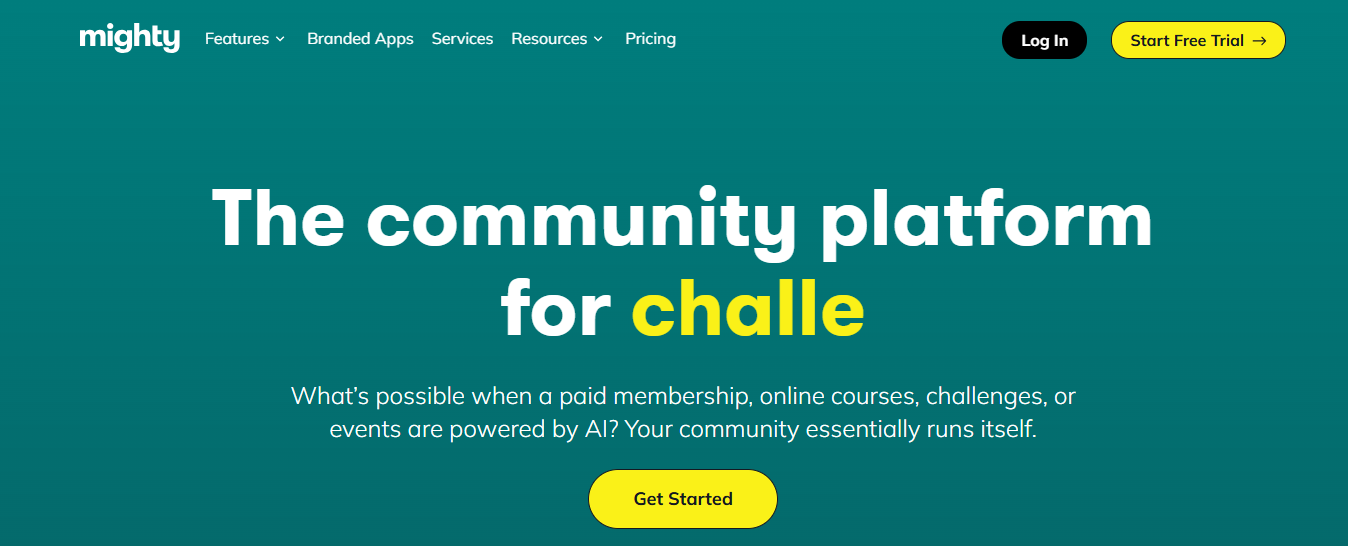
The tradeoff is that transaction fees never reach zero, not even on the priciest plan, unlike Ruzuku’s flat 0%. Launch charges 2%, and even the $354-a-month Growth plan still takes 0.5% off every sale. What you get in exchange is a native iOS and Android app included from the entry tier, something Ruzuku still lacks entirely.
Pick this over Ruzuku if the community itself is the product and the course content is what holds it together, not the other way around.
Pros:
- Native iOS and Android apps included from the entry Launch plan
- Spaces architecture blends discussions, courses, and events naturally
- Stronger social and engagement features than Ruzuku’s basic discussions
- Livestreaming built in without a separate tool
- Well-suited to coaches running an ongoing membership rather than one-off courses
Cons:
- Transaction fees never drop to 0%, unlike Ruzuku
- No plan below $79 a month, well above Ruzuku’s entry price
Pricing: Launch starts at $79 per month, scaling to $354 per month for Growth with a 0.5% fee.
8. Circle – Best for Discussion-Led Communities With Course Content
Circle flips the relationship Ruzuku assumes: instead of a course with a discussion board attached, the community is the main event and courses sit inside it. Threaded, topic-organized conversations go considerably deeper than Ruzuku’s simpler discussion feature, which matters if engagement between sessions is what actually keeps your students around.
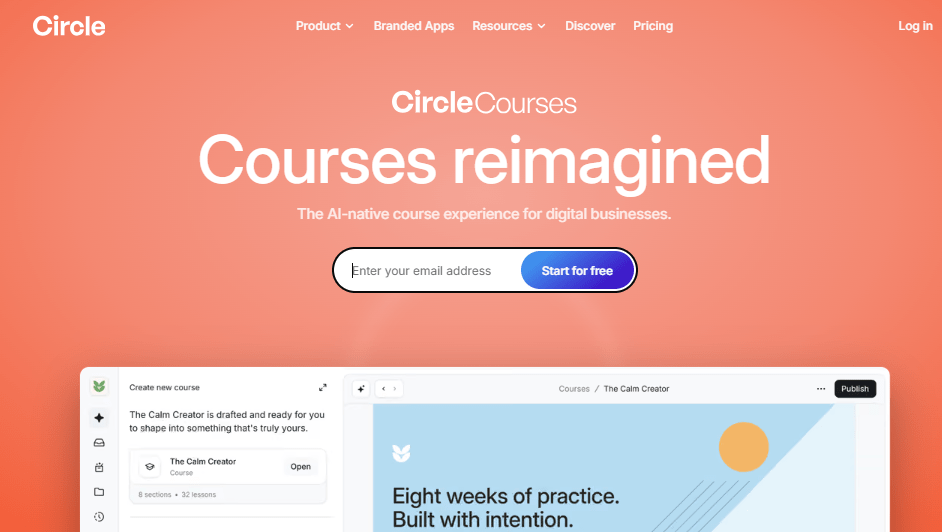
Transaction fees follow a similar shrinking pattern to Mighty Networks, 2% on the entry Professional plan down to 0.5% on the custom Enterprise tier, so they never match Ruzuku’s flat 0%. A branded mobile app is not included either unless you are on that top custom tier, which keeps the real cost higher than the sticker price suggests.
If your Ruzuku community always felt like an afterthought bolted onto the course, Circle makes it the actual foundation instead.
Pros:
- Threaded, topic-organized discussions well beyond Ruzuku’s flat feed
- Live events and courses included from the entry Professional plan
- Strong ease-of-use ratings from both admins and members
- SOC 2 Type 2 certification for security-conscious communities
- Workflow automation included even on lower tiers
Cons:
- Transaction fees never reach 0%, ranging from 2% down to 0.5%
- Branded mobile app is only available on the custom Enterprise tier
Pricing: Professional starts at $89 per month annually, scaling to $219 per month for Business.
9. TalentLMS – Best for Fast Setup and Transparent Pricing
TalentLMS solves a different problem than the marketing-heavy platforms on this list: speed and clarity. I had a course live and taking learners the same afternoon, with pricing published right on the website instead of a quote request, which is closer to Ruzuku’s straightforward approach than most alternatives manage.
It handles the fundamentals well: unlimited courses even on lower tiers, a genuine free plan, and 30-plus integrations covering tools most small training businesses already use. Where it shows seams is depth for public course selling. It leans more corporate than creator-focused, so marketing tools and storefront polish stay thinner than Ruzuku already offers.
For a team that wants training live this week without touching a marketing stack, TalentLMS gets you there fast, just with less selling polish than a course-first platform.
Pros:
- Live and taking learners within hours, pricing published upfront
- Genuine free plan available for testing before committing
- 30+ integrations including Zoom, BambooHR, and Microsoft Teams
- Unlimited courses even on lower-priced tiers
- High marks for ease of use across admins and learners
Cons:
- Leans corporate training rather than public course sales and marketing
- Thinner storefront and marketing tools than Ruzuku already provides
Pricing: Free plan available; Core starts at $149 per month for up to 100 users, scaling to $579 per month for 1,000 users.
10. Systeme.io – Best for Zero-Fee Marketing on a Tight Budget
Systeme.io is what I point newer coaches toward when Ruzuku’s $99 a month feels steep before they have proven the course sells at all. The free plan is genuinely usable, not a crippled trial, with 2,000 contacts, three sales funnels, and 0% transaction fees permanently, no credit card required to start.
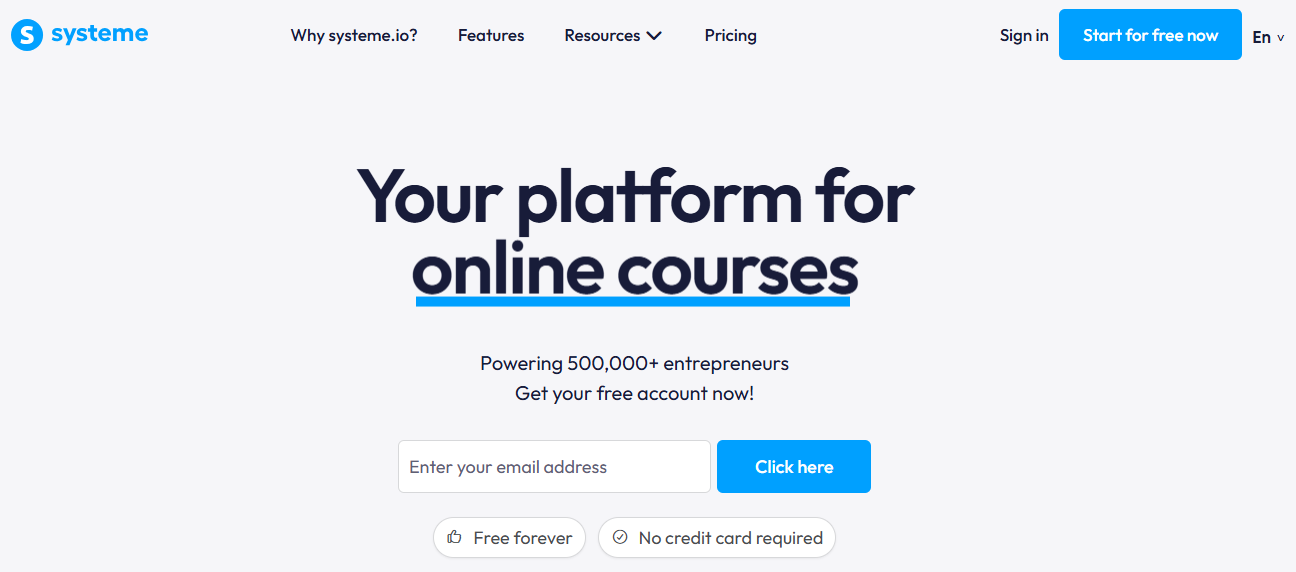
It will not match Ruzuku’s teaching polish or live session tools. Course structure stays basic, and there is no dedicated mobile app. What you are trading course-building depth for is an entire marketing stack, funnels, email automation, affiliate management, bundled into one of the cheapest subscriptions in this category.
If your Ruzuku frustration is really about needing marketing tools you cannot yet afford elsewhere, Systeme.io solves that specific problem and costs less than Ruzuku while doing it.
Pros:
- 0% transaction fees on every plan, including the permanent free tier
- Free plan supports real sales activity, not just a demo account
- Built-in sales funnels and email marketing without extra tools
- Costs less than Ruzuku’s flat $99 starting price at every tier
- Consistently high ratings for ease of use from non-technical founders
Cons:
- No native mobile app for students or admins
- Course-building and live-session tools are more basic than Ruzuku’s
Pricing: Free plan available; Startup starts at $17 per month, scaling to $97 per month for Unlimited.
My Top 3 Picks Among the Ruzuku Alternatives
If you read nothing else, start here. Among all the Ruzuku alternatives above, these three cover the three real reasons people actually leave Ruzuku: missing marketing tools, training depth, and tight budgets.
1. ProProfs Training Maker
My pick if what you actually need is training depth and compliance tracking rather than another cohort launch. It handles easy course creation for employee training, certification, and skill assessment, with its own store for selling courses publicly, too, not just running internal programs. Reporting, gamification, and 70+ language support come standard, and pricing stays transparent as you grow past a single course.
2. Kajabi
My pick if the marketing gap, no real funnels, no email sequences, no proper storefront, is the actual reason you are searching for Ruzuku alternatives. Everything you were stitching together with a landing-page tool and an email platform now lives inside a single subscription here. It costs meaningfully more than Ruzuku’s flat $99, but for a launch-heavy business, the consolidation usually pays for itself.
3. Systeme.io
My pick if budget is the real constraint and Ruzuku’s $99 already feels like a stretch. The free plan supports genuine sales activity rather than serving as a demo; the 0% fee never becomes a surprise later; and you get a full funnel and email stack that Ruzuku does not offer at all. It will not match Ruzuku on teaching polish, but for testing whether a course sells in the first place, that tradeoff is usually worth it.
How I Evaluated These Ruzuku Alternatives
I did not rank these ten alternatives to Ruzuku based solely on feature checklists. Here is what actually shaped it:
- User reviews and ratings from Capterra, weighted more heavily where a platform has a meaningful volume of recent reviews rather than a handful of vendor-solicited ones
- Marketing and sales capability, since thin funnels and email tools are the single biggest complaint driving people toward Ruzuku competitors
- Native mobile app availability, given how often Ruzuku’s browser-only experience comes up as a reason to switch
- Total cost of ownership, including any external tools you would need to replace what Ruzuku already bundles in
- Course and content depth, from simple digital downloads through graded assessments and structured learning paths
- Fee structure, since Ruzuku’s 0% is a real baseline some alternatives beat, and others do not
- Real-world fit, matching each platform to the specific reason you would actually leave Ruzuku, rather than treating best as one-size-fits-all
Which Ruzuku Alternative Actually Fixes Your Specific Problem
There is no single best Ruzuku alternative because there is no single reason people leave Ruzuku. If the missing marketing tools are the wall you hit, Kajabi or Systeme.io solves that from opposite ends of the price range, one an all-in-one suite, one a lean budget stack. If training depth and compliance tracking are what you actually need, ProProfs Training Maker fits a use case Ruzuku was never built for. If a mobile app or a deeper community is the dealbreaker, Teachable, Mighty Networks, and Circle each address it differently.
Before you commit to any Ruzuku alternative on this list, ask yourself how much built-in marketing you actually need, how important a native app is to your students, and what your true 12-month cost looks like once external tools are counted. Anyone comparing alternatives to Ruzuku should also check that content and student lists migrate cleanly; discussions and progress data typically do not, so plan around that rather than assuming a clean cutover.
Frequently Asked Questions
What are the best Ruzuku alternatives for course creators?
ProProfs Training Maker, Thinkific, and Kajabi stand out for different reasons. ProProfs fits certification-style training with built-in reporting and no per-sale fees, Thinkific offers deeper course customization, and Kajabi replaces the entire marketing stack. Ruzuku leaves you to build yourself.
Is there a free alternative to Ruzuku?
Yes. Systeme.io offers a genuinely usable free plan with 2,000 contacts and 0% transaction fees, and ProProfs Training Maker is free for up to 10 learners, both without the flat $99 monthly commitment Ruzuku requires from day one.
What are the main Ruzuku competitors for community-based coaching?
Mighty Networks and Circle are the closest Ruzuku competitors for community-first coaches. Both blend discussions, courses, and live events into one space, though neither drops transaction fees to zero, as Ruzuku's flat pricing does at every tier.
What should I look for in alternatives to Ruzuku?
Match the fix to your actual gap: marketing and funnels, mobile access, course depth, or community integration. When comparing Ruzuku alternatives, the total cost of ownership matters more than the sticker price, since Ruzuku's simplicity often hides tools you will need to buy elsewhere.
Is there a Ruzuku alternative built specifically for training rather than course sales?
Yes. ProProfs Training Maker is built for employee training, compliance, and skill assessment, with course depth well beyond Ruzuku's simple format, while still supporting public course sales through its own store and checkout.
Which Ruzuku alternative is cheapest for someone just starting out?
Systeme.io undercuts Ruzuku's $99 starting price with a genuine free plan and 0% fees. Podia's entry plan is also cheaper than Ruzuku, though its 5% transaction fee can outpace Ruzuku's 0% once sales grow.
Let ProProfs AI create your training course

 We'd love your feedback!
What did you like & how can we make it even better?
 Thanks for your feedback!
 Ask Your Question
Have a question? Get expert help to make your decision easier.