
Every few weeks, a new number shows up in my feed telling me skills now expire in 2.5 years, or 3, or 5, depending on who is selling the report. I’ve stopped taking those headlines at face value, though the problem underneath them is real.
The Skills Expiry Crisis has better U.S. data behind it than it did a year ago. McKinsey Global Institute’s September 2026 workforce study and the Bureau of Labor Statistics’ 2025-35 projections now give us a detailed map of where the churn lands. But that map is built from forecasts, surveys, and one famous figure that nobody has ever measured directly. This piece sorts out which is which, so that when you cite a number, you know exactly what it stands on.
Figures are current as of November 12, 2026. Every source is linked in the text and listed at the end.
Who Is This Research For?
- HR and talent leaders at U.S. employers who are sizing a workforce reskilling budget
- L&D and training managers deciding which roles need new learning paths first
- Workforce development and policy analysts at workforce boards, community colleges, and think tanks
- Journalists and researchers who cite skills statistics and want to check where each figure comes from
- Operations leaders in office administration, retail, and logistics, where the McKinsey and BLS projections concentrate the most displacement
What Is the Skills Expiry Crisis?
That last distinction matters more than the term itself. McKinsey’s September 2026 report makes the same point in its own words: the next decade’s challenge is “mobility, not scarcity”. Its base estimate has automation cutting labor demand by roughly 36 million jobs by 2035 while other forces create demand for roughly 41 million, a net gain of about 5 million. Plenty of work, in other words. The question is whether the people losing one kind of work can reach the other kind.
Skills expire for more than one reason, and the economics literature keeps the reasons apart. A 2002 review by Andries de Grip and Jasper van Loo lists atrophy from disuse, wear, technological and organizational change, shifts in the structure of employment, and organizational forgetting as separate causes. Public debate tends to fold them all into a single alarming number, which is part of why the headline figures disagree with each other.
Two other terms come up constantly in this field, so here is how McKinsey’s glossary defines them. Reskilling is acquiring the skills to move into a different occupation, or to do substantially different work within the current one. Upskilling is developing more advanced skills to progress within an occupation or move into another. I treat the first as a career-path problem and the second as a course problem, and mixing them up is an easy way to buy the wrong fix for your workforce reskilling plan.
How Fast Is the Skills Expiry Crisis Moving?
Every major source points the same way, but each one measures something different, so the figures should be read side by side and never averaged.
| Source | What it measures | Headline figure | Scope and method |
|---|---|---|---|
| World Economic Forum, Future of Jobs 2025 | Share of existing skill sets expected to be transformed or outdated, 2025 to 2030 | 39% (44% in the 2023 edition) | Global employer survey: 1,000+ employers, 14 million workers, 55 economies |
| LinkedIn, Work Change Report | Share of skills used in most jobs expected to change by 2030 | 70% | LinkedIn Economic Graph, global, with AI as the catalyst |
| McKinsey Global Institute, Workforce in Motion | Share of U.S. workers whose task mix may need more than 15% reallocation by 2035 | More than 70% | U.S. model built on BLS and Lightcast data, base-case assumptions |
| Fuel50, State of Skills-Based Work 2026 | HR leaders who say critical skills in their industry expire within three years | 53% (15% say under one year) | Vendor survey of 272 HR professionals, North America and Europe |
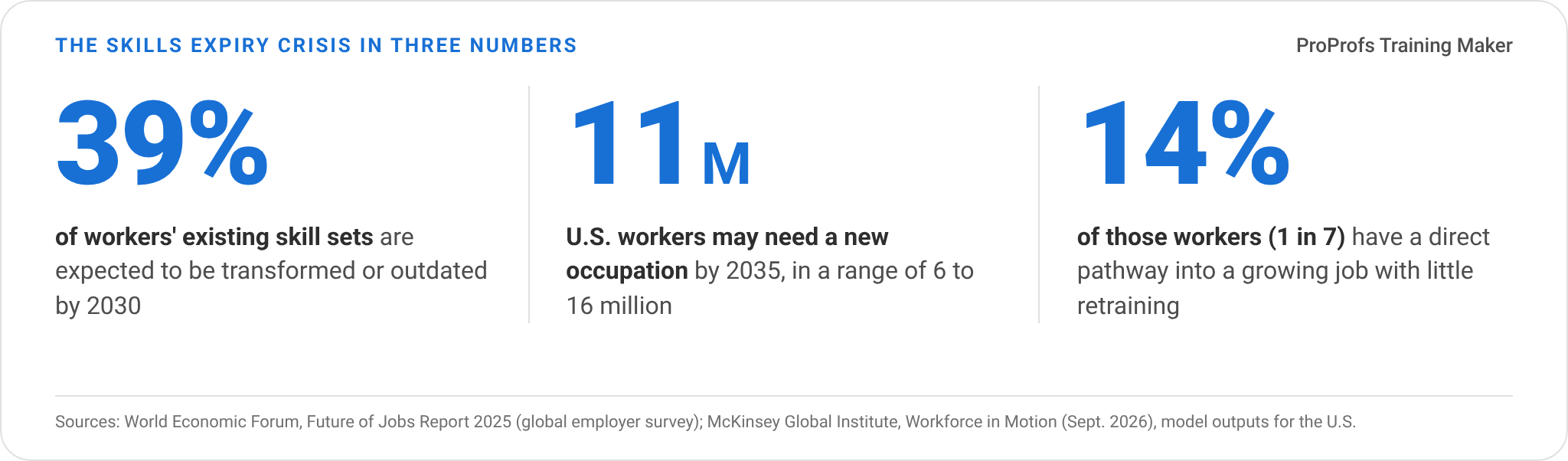
The WEF figure gets misquoted more than any other. The report says workers can expect 39% of their existing skill sets to be transformed or outdated over the five years to 2030. It does not say 39% will be obsolete. A skill that is transformed (a marketer still writes, but now edits machine drafts) has changed shape, not vanished. WEF also notes the figure fell from 44% in the 2023 edition, and suggests the drop could reflect more workers completing training: 50% in 2025 versus 41% in 2023. If you cite the number, cite that context with it.
The LinkedIn figure is a projection layered on a trend. LinkedIn’s own executives say the skills needed for the average job have already shifted about 25% over the last several years, and expect that to reach 70% by 2030. As LinkedIn’s Blake Lawit put it in an April 2026 interview, “even if you’re not changing jobs, your job’s changing on you.”
McKinsey’s U.S. analysis puts texture on that idea. It estimates that about 25% of the workforce could see more than 30% of their task time reallocated by 2035, and another 47% could see between 15% and 30% reallocated. Crucially, it finds this reinvention happens whether an occupation’s headcount grows, shrinks, or holds steady. That is why upskilling workforce programs matter even in roles that look safe on a job-loss chart.
Where Does the Skills Half-Life Number Come From?
The figure you see most often, that skills now carry a half-life of about five years, or two and a half for technical skills, is a rule of thumb with a long and loosely sourced history. I’d use it to compare skills with each other, not as a measured constant.
The idea of a “half-life of knowledge” dates to 1962, when economist Fritz Machlup used it to describe how long it takes for half the knowledge in a field to be superseded. IEEE Spectrum’s history of the idea traces how engineering estimates then drifted: a 1966 paper by Thomas Jones assumed a ten-year half-life, Intel’s then-president Craig Barrett said in 1996 that an engineer’s was only a few years, and by 2002 the National Academy of Engineering’s president was citing a range of roughly two and a half to seven years. Notice what happened. The unit slid between “knowledge in a domain”, “an engineer”, and “skills”, and the number kept shrinking as it was repeated.
IBM is the source most often credited for the current version. Its page on skills transformation presents the five-year and 2.5-year figures as what research suggests, then sorts skills into perishable (half-life under 2.5 years), semi-durable (2.5 to 7.5 years), and durable (over 7.5 years). That taxonomy is useful. It is a classification, though, and not a measurement.
The closest thing I found to a direct measurement is older and smaller. In 2002, researchers Allen and van der Velden asked Dutch tertiary graduates to assess their own skills. On average, almost a third of the skills obtained in tertiary education were obsolete seven years later, and obsolescence tracked rapid change in the work domain. It is self-assessed, Dutch, and two decades old. My own back-of-envelope reading, forcing a one-third loss over seven years into the half-life frame, lands near twelve years, which sits far from five. The two framings are not strictly comparable, and that is exactly the point: nobody has agreed on what is being measured.
What survives scrutiny is the direction. Skills tied to a specific tool or framework decay faster than skills tied to judgment, and the evidence for that is stronger than the evidence for any single half-life figure. The next sections build on that.
Which U.S. Workers Absorb the Impact First?
Office and administrative workers, retail and sales workers, and transportation and logistics workers, in that order, by share of workers who may need to change occupations. Two different approaches reach that answer, although McKinsey’s is built partly on BLS data, so they are related rather than fully independent.
McKinsey’s September 2026 study estimates that roughly 11 million U.S. workers (a range of 6 to 16 million, about 7% of current employees) may need to move into entirely new occupations by 2035. That works out to about 770,000 occupational-group switches per year, roughly 3.6 times the 215,000 non-pandemic average. The U.S. managed a similar pace during 2019 to 2022. The difference is duration: a two- to three-year shock is a different animal from a decade-long one.
More than 75% of the workers who may need to transition sit in just three of McKinsey’s 22 occupational groups: office and administrative support, retail and sales, and transportation and logistics. About a third come from five occupations: customer service representatives, retail sales associates, office assistants, cashiers, and warehouse workers.
The BLS 2025-35 projections, released August 27, 2026, line up with that picture:
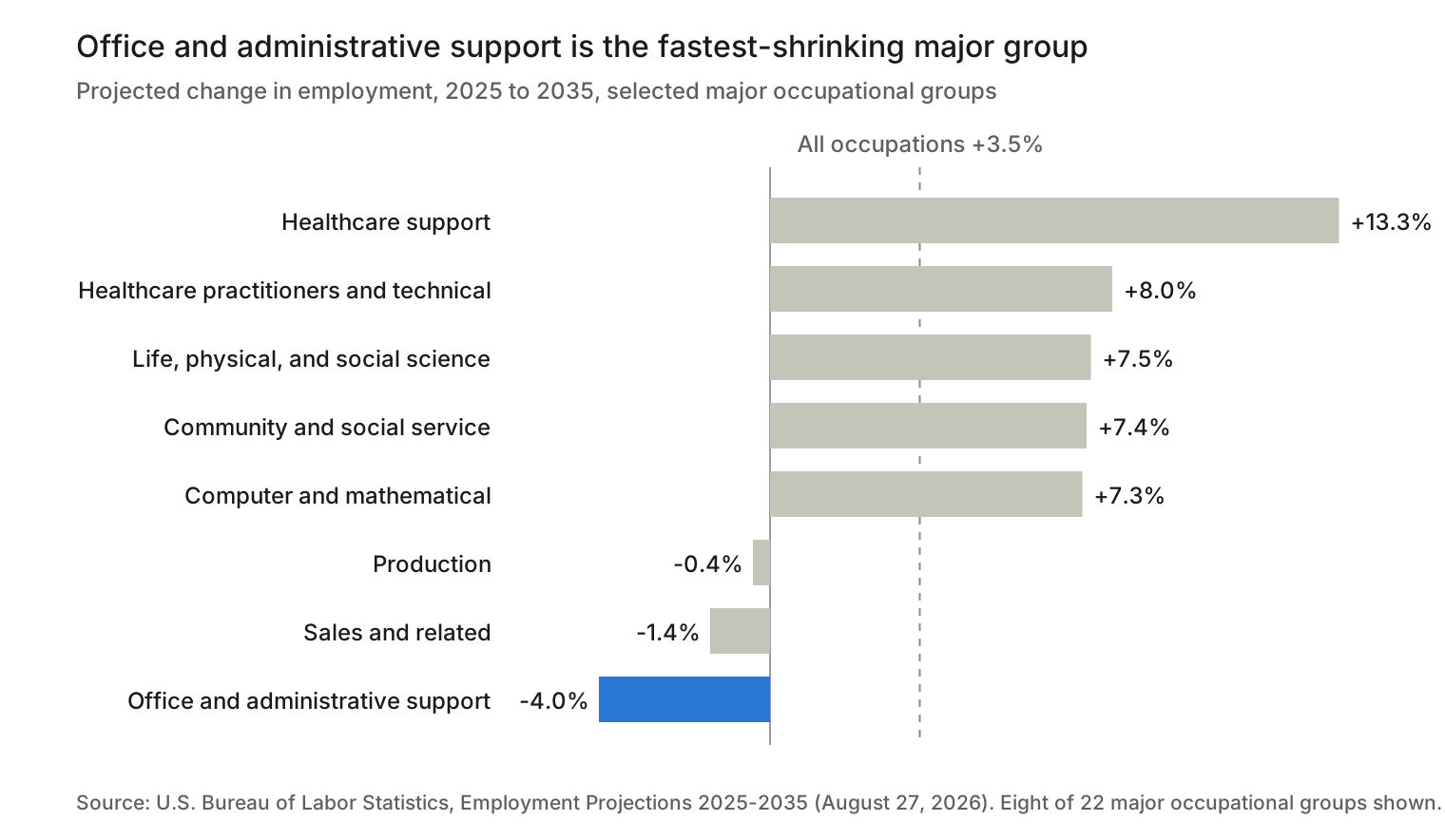
U.S. Bureau of Labor Statistics, Employment Projections 2025-2035 (August 27, 2026). Eight of 22 major occupational groups shown.
Office and administrative support is also projected to shed 752,100 jobs, the most of any group, even as total employment grows.
The burden is not spread evenly across the workforce. In McKinsey’s model, lower-wage workers are 7.6 times as likely as higher-wage workers to need a wholly new occupation. Workers without a bachelor’s degree are about 1.8 times as likely as degree holders, and women and younger workers each about 1.6 times as likely as men and prime-age workers. McKinsey attributes these gaps to who is employed in the affected occupations, not to anything about the workers themselves.
Two transitions from the report show how different “a new job” can be. A dishwasher moving into home health aide work shares only about 20% of the required skills, and McKinsey classes that path as unpaved. An office assistant moving into project management shares about 58%, which sounds comfortable until you read that many would also need a bachelor’s degree and a professional certification.
Why Is Mobility, Not Job Scarcity, the Real Constraint?
Because nearly every displaced worker has some route to a growing job, but only about one in seven has an easy one. McKinsey grades each possible move on four conditions: whether the destination occupation is growing, how many of its required skills the worker already holds, whether pay is preserved, and how long any legally required credential takes to earn.
On that grading, 14% of transitions are direct, 41% are winding, and 45% are unpaved. A direct path means strong skill overlap, no pay loss, and under six months of training. A winding path means moderate overlap, limited pay loss, and under two years of training. Everything else is unpaved.
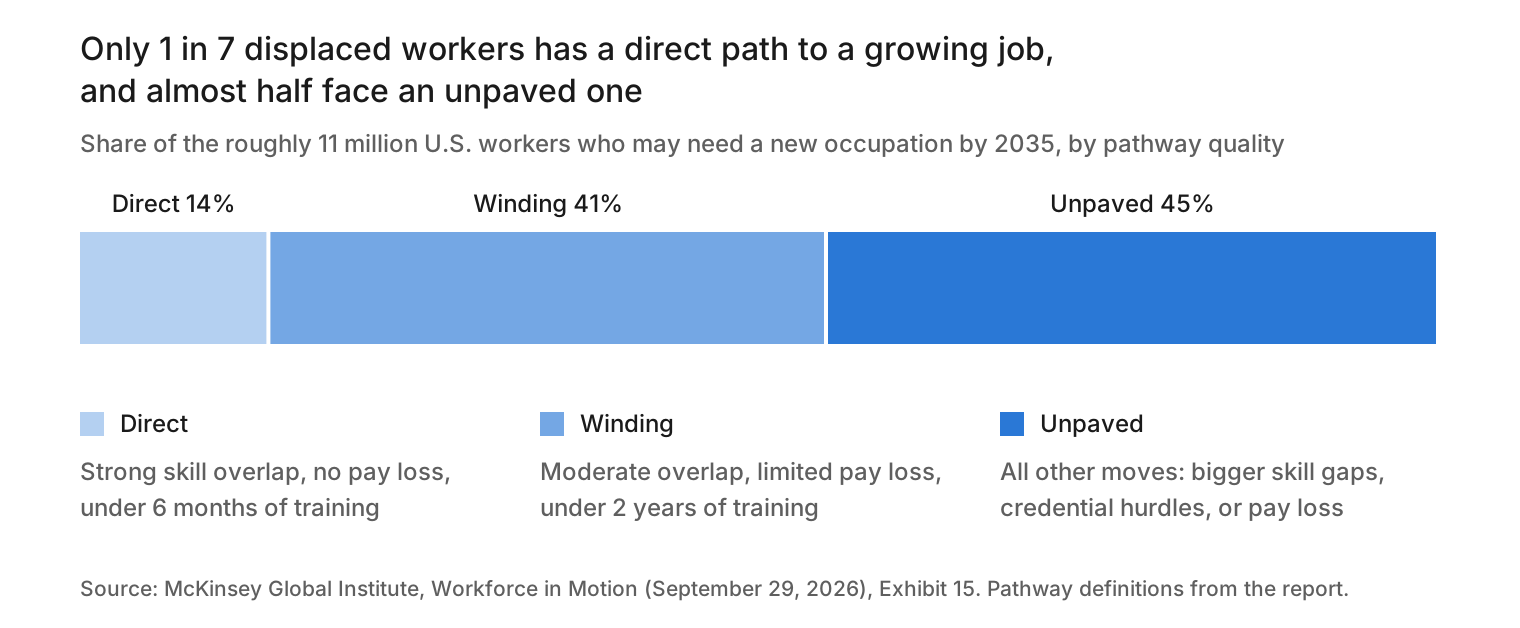
McKinsey Global Institute, Workforce in Motion (September 29, 2026), Exhibit 15. Pathway definitions from the report.
The barriers are specific, and several are set by employers rather than by nature:
- Credentials: roughly 85% of growing jobs require a credential or certification. About 38% of growing employment has one required by law, and the remainder is employer preference, which companies can change without waiting for regulators.
- Skill load: postings for growing occupations list 68 distinct skills on average, against 47 for declining ones, and 84% of growing occupations require postsecondary education versus 45% of declining ones.
- Geography: 76% of the growing jobs that require a credential cannot be done remotely, so a move often means a physical relocation.
- Income: only about 10% of workers in the lowest wage quintile (under $38,000 a year) have a direct pathway, compared with almost 40% in the top quintile.
There is good news inside the same data. McKinsey finds that only about 3% of transitioning workers, roughly 305,000 of the 11 million, would follow a pathway that requires a pay cut. Most moves preserve or improve earnings, as long as the worker can clear the skill and credential hurdles.
That last condition is where I’d focus. A credential requirement that no law demands is a policy choice, and an employer made it. McKinsey’s own glossary draws this line, noting that employer-preferred requirements can be changed by companies while legally required ones typically need policy or regulatory action. Some of the Skills Expiry Crisis, in other words, sits in job postings, and an HR team can edit those.
Which Skills Hold Their Value When Others Expire?
The ones that help a worker learn the next thing. That claim rests on two separate bodies of evidence, one academic and one from job postings.
The academic evidence comes from Tobias Schultheiss and Uschi Backes-Gellner, who analyzed Swiss job advertisements from 1950 to 2019 with machine-learning-categorized skill requirements. Their paper, published in Industrial Relations in 2023, finds that lifelong learning plays different roles depending on the occupation. In “harder” occupations full of fast-depreciating hard skills, training works mainly as a hedge against unemployment rather than a boost to wages. In “softer” occupations built on more stable soft-skill foundations, training mainly drives upward mobility and larger wage gains. The data are Swiss and measure skills employers ask for, not skills workers hold, so I’d treat the pattern as strong and the exact magnitudes as untested for the U.S.
The posting evidence comes from McKinsey. Between 2022 and 2026, measured by how many U.S. occupations list each skill, demand for AI fluency rose far faster than demand for the skills that help people keep learning. McKinsey calls these “empowering” skills, and warns of a trap: if demand for the underlying learning skills lags demand for AI fluency itself, employers could build a workforce that can use today’s tools but is no better prepared for whatever replaces them.
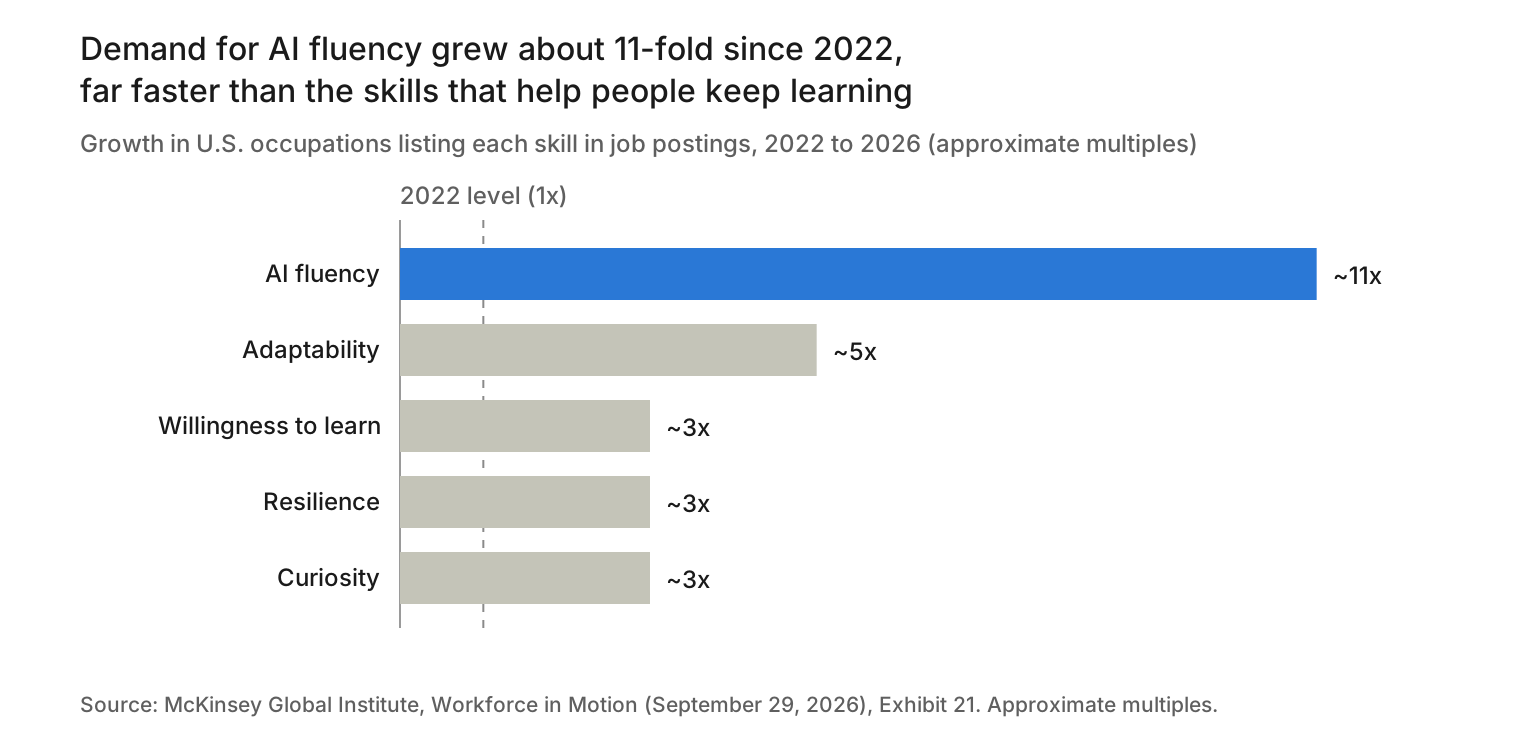
McKinsey Global Institute, Workforce in Motion (September 29, 2026), Exhibit 21. Approximate multiples; measured by the number of U.S. occupations listing each skill.
Two cautions keep this from turning into a slogan about soft skills. First, the Schultheiss finding means technical upskilling workforce programs are not optional in hard-skill roles, because there they are the unemployment hedge. Second, McKinsey itself says it is more debated whether skills like curiosity can be deliberately taught, noting that direct evidence for curiosity is limited because it has been studied less, not because it is known to be fixed. Evidence for resilience-related skills is stronger, with moderate gains from workplace programs and wide variation by intervention type.
Is Workforce Reskilling Keeping Pace With the Change?
Not on the evidence available. Every source I found that asks about training lands on the same shape: demand for new skills is rising faster than employee reskilling programs are reaching people. Most of these are surveys of perception, so the table shows each one’s limits next to its finding.
| Source | Finding | When | Caveat |
|---|---|---|---|
| IBM Institute for Business Value | Average time to close a skills gap through training rose from 3 days (2014) to 36 days (2018) | 2019 report | Executive survey; now dated |
| World Economic Forum | Of every 100 workers, 59 need training by 2030; about 11 of those are unlikely to get it | 2025 | Global employer survey |
| Indeed and YouGov | 32% of surveyed workers got proper AI training from their employer; 19% of job seekers feel fluent in AI | July 2026 | Survey of 1,000+ workers and hirers |
| The Conference Board | 55% of workers regularly use AI; 33% took employer-provided AI training in the past six months | 2026 | Global survey of nearly 1,300 workers plus 35 leader interviews |
| Fuel50 | 90% of organizations use skills data in HR decisions, yet 75% still default to external hiring | 2026 | Vendor survey of 272 HR professionals |
| Pearson | $1.1 trillion in annual U.S. earnings lost to inefficient career transitions and learning gaps (5% of GDP) | Jan 2025 | Estimate from a learning company; broader than skill expiry alone |
The Fuel50 row is the one I’d read twice. Organizations are collecting skills data, and then hiring from outside anyway: Fuel50 reports that 38% fill fewer than one in four roles internally. Data without redeployment is inventory, not strategy.
The Pearson figure deserves care when you cite it. It measures earnings lost to inefficient career transitions and learning gaps, which is a wider net than skill expiry. It is also an estimate from a company that sells learning products. It works as an order-of-magnitude signal, not a precise cost of expired skills.
The IBM number is the oldest, and it still earns its place because it describes a mechanism: the time to close a gap grew more than tenfold in four years. Whatever the right figure is today, the direction explains why the courses you commissioned last year may already be late.
What Can We Say With Confidence About the Skills Expiry Crisis?
The direction is well supported. The size is not. Here is how I’d grade the claims people cite most, based on what kind of evidence sits behind each.
| Claim | Evidence behind it | My confidence | Why |
|---|---|---|---|
| Tool-specific skills lose value faster than judgment-based skills | Swiss job-ad analysis (Schultheiss and Backes-Gellner), plus employer surveys | Moderate to high | Direction is consistent across sources; magnitudes are not |
| Most U.S. workers will see their tasks reallocated by 2035 | McKinsey model, LinkedIn projection, WEF employer survey | Moderate | These are projections and expectations, not observed change |
| U.S. employment shifts away from office, retail, and production work | BLS projections and McKinsey, which draws on BLS data | Moderate | Related methods, so agreement is weaker evidence than it looks |
| Employee reskilling is not keeping pace | Several surveys, some from vendors | Moderate | Convergent, but largely self-reported |
| Skills have a half-life of 5 years (2.5 for technical) | Repeated rule of thumb | Low | No agreed unit or direct measurement |
| Skill gaps cost the U.S. $1.1 trillion a year | Pearson estimate | Low to moderate | Covers more than skill expiry |
Three limits are worth stating plainly, because they come from the sources themselves.
First, McKinsey says its figures are model outputs under a base set of assumptions, not measurements of observed change. Its range for workers needing a new occupation runs from 6 million to 16 million, and it notes that software developer postings fell from a 2022 peak but have risen about 15% since early 2025, with gaps now in senior and AI-oriented roles. Automation and new demand can hit the same occupation at the same time.
Second, BLS builds its projections on the assumption that technological progress continues in line with historical experience, and says its methods are unlikely to give reasonable results if technology advances much faster than it has before. It also notes that technology has historically changed occupations gradually rather than suddenly. If you believe AI breaks that pattern, the BLS numbers understate the change. If you don’t, the more dramatic forecasts overstate it.
Third, LinkedIn’s own data complicate the AI-causes-everything story. In April 2026, LinkedIn’s Blake Lawit said the company’s data show hiring down about 20% since 2022, but that it had not yet seen evidence AI was responsible, pointing instead toward interest rates, while not ruling out future effects.
None of this makes the Skills Expiry Crisis imaginary. It makes it a risk to be managed with evidence, which is a stronger position than a panic built on a single half-life figure.
What Should Employers Do First About Workforce Reskilling?
Start with the barriers you control, then build the paths. The evidence above does not tell any single employer what to buy, so what follows is my reading of it, anchored where possible to what the McKinsey authors themselves recommend.
If You Can Only Do One Thing Today
Open the job postings for your three highest-volume roles and strike every degree or credential requirement that no law, license, or contract demands. McKinsey’s authors list this among the steps employers can take, alongside screening for demonstrated skills rather than titles and tracking redeployment and internal fill rates. It costs nothing, takes an afternoon, and removes a barrier that sits between your own people and your own open roles.
What Comes Next
Pick the two or three roles in your company that sit in the declining groups (customer service, office administration, retail sales, warehouse work) and name two adjacent destination roles for each. Then write down the skill gap between them in plain language. This is the pathway thinking McKinsey describes, applied to your headcount. It also gives employee reskilling a destination, which a course catalog alone never does.
Once the paths exist, you need a way to assign learning by role and see who has finished what. Platforms like ProProfs Training Maker include built-in features for role-based learning paths, automatic enrollment, and completion reporting, which is the tracking layer an internal redeployment program runs on.
What Can Wait
A perfect skills taxonomy. Fuel50’s 2026 data show 90% of organizations already use skills data in HR decisions while 75% still default to external hiring, which suggests the bottleneck is redeployment, not data. Spend the effort on moving people, then refine the taxonomy with what you learn.
The Trap
Measuring activity instead of outcomes. Course completions and training hours are easy to report and say little about whether a person can now do different work. Fuel50’s 2026 report makes a similar argument, that most skills investments produce activity without outcomes. The numbers worth tracking are the ones McKinsey names: how many roles you fill internally, and how many people actually change roles.
For upskilling workforce programs inside roles that are not shrinking, remember the McKinsey finding that most occupations will be reinvented regardless of headcount. A role that looks safe on a job-loss chart can still hand its holder a very different task mix by 2035.
What Can Workers Do While Employers Catch Up?
Move toward adjacent skills, check credentials before courses, and make what you can already do visible. Many workers are not waiting: in the Indeed and YouGov survey, about 70% said they had begun experimenting with AI tools on the job, even though only 32% reported proper employer training.
The McKinsey data suggest that most successful moves are adjacent ones. Skills overlap most within an occupational group and in nearby occupation families, so the practical question is which neighboring role shares the most of your current skill set, not which hot field you could theoretically enter. Before you invest in a course, look at what the target role requires on paper. Credentials are one of the largest barriers, and a worker with adjacent skills is often blocked by a license or degree rather than by an inability to do the work.
It also helps to make skills visible. McKinsey notes that workers who have a needed skill can still look less qualified on applications, and that employers can reduce this with structured interviews and practical assessments. If your employer offers those, treat them as a chance to demonstrate skills your résumé does not capture. And in roles heavy with tool-specific skills, keep learning on a steady schedule, because that is where the research says training works as protection against unemployment.
So What Is the Honest Version of the Skills Expiry Crisis?
There is no single magic number. There is a direction that every credible source agrees on, a handful of well-sourced U.S. estimates, and one bottleneck that keeps turning up: people cannot reach the work that is growing. McKinsey’s phrase for it is mobility, not scarcity.
Part of that bottleneck is built by employers, which makes part of it fixable by employers. So I’d retire the question of how fast skills expire, since nobody can answer it with precision, and ask one you can measure yourself: how long does it take someone in your company to get from a shrinking role to a growing one, and what is standing in the way? Track that number. It will tell you more about whether your workforce reskilling is working than any half-life ever will.
Sources and Citations
- McKinsey Global Institute, Workforce in Motion: Skills and Pathways to Future Jobs in the United States, September 29, 2026.
- U.S. Bureau of Labor Statistics, Employment Projections, 2025-2035 (news release), August 27, 2026.
- World Economic Forum, The Future of Jobs Report 2025, January 7, 2025.
- LinkedIn, Work Change Report: AI Is Coming to Work, 2025.
- TechCrunch, LinkedIn data shows AI isn’t to blame for hiring decline… yet, April 15, 2026.
- Fuel50, The State of Skills-Based Work 2026.
- IBM Training, Skills Transformation for the 2021 Workplace.
- IBM Institute for Business Value, The Enterprise Guide to Closing the Skills Gap, 2019.
- IEEE Spectrum, article on engineering careers and the half-life of knowledge.
- Allen, J., and van der Velden, R. (2002). When do skills become obsolete, and when does it matter? In The Economics of Skills Obsolescence, Emerald.
- de Grip, A., and van Loo, J. (2002). The economics of skills obsolescence: a review. In The Economics of Skills Obsolescence, Emerald.
- Schultheiss, T., and Backes-Gellner, U. (2023). Different degrees of skill obsolescence across hard and soft skills and the role of lifelong learning for labor market outcomes. Industrial Relations, 62(3), 257-287. IZA Discussion Paper 15688.
- Pearson, $1.1 Trillion at Stake: Pearson Report Urges Action, Solutions for Skills Gap, January 2025.
- Staffing Industry Analysts, Lack of AI training contributing to talent shortage (Indeed and YouGov survey), July 28, 2026.
- WorldatWork, WorkSpan Daily news bytes for July 31, 2026 (The Conference Board survey).
- Forbes, America’s Next Workforce Challenge: Building Pathways To Better Jobs, September 29, 2026.
Frequently Asked Questions
What Is the Skills Expiry Crisis?
The Skills Expiry Crisis is the gap between how fast the tasks inside jobs change and how fast workers and employers can rebuild the skills those tasks need. It is a speed mismatch, not simply job loss. McKinsey's 2026 U.S. analysis frames the next decade as a challenge of mobility rather than scarcity.
How Long Do Skills Last Before They Become Obsolete?
No single measured figure exists. A widely repeated rule of thumb gives skills a half-life of about five years, or 2.5 for technical skills, but it is not a direct measurement. The World Economic Forum expects 39% of workers' existing skill sets to be transformed or outdated between 2025 and 2030.
How Many U.S. Workers Will Need to Change Occupations Because of AI?
McKinsey estimates about 11 million U.S. workers, roughly 7% of current employees, may need to move into entirely new occupations by 2035, within a range of 6 to 16 million. That is a model output under base-case assumptions, not an observed count. About 770,000 occupational-group switches per year would be needed, roughly 3.6 times the non-pandemic historical average.
What Is the Difference Between Upskilling and Reskilling?
Upskilling develops more advanced skills to progress within an occupation or move into another. Reskilling means acquiring the skills for a different occupation, or for substantially different work within the current one. These are McKinsey's glossary definitions, and they matter because the first usually calls for courses while the second calls for a career path.
Which U.S. Jobs Are Most Affected by Changing Skills?
Office and administrative support, retail and sales, and transportation and logistics. BLS projects office and administrative support to decline 4.0% from 2025 to 2035, shedding 752,100 jobs, the most of any major group. McKinsey adds that most occupations, including growing ones, will see their task mix reallocated.
Does the WEF Say 39% of Skills Will Be Obsolete by 2030?
No. The Future of Jobs Report 2025 says workers can expect 39% of their existing skill sets to be transformed or to become outdated over 2025 to 2030, on average across a global employer survey. Transformed skills have changed shape; they have not necessarily disappeared. The comparable figure in the 2023 edition was 44%.
Will AI Create More Jobs Than It Eliminates in the U.S.?
McKinsey's base case has automation reducing labor demand by the equivalent of about 36 million jobs by 2035 while other forces create demand for about 41 million, a net gain near 5 million. BLS separately projects total U.S. employment to grow by 5.9 million, or 3.5%, from 2025 to 2035. Both are projections, and BLS assumes technological progress in line with historical patterns.
Which Skills Stay Valuable as Technology Changes?
Skills that help people keep learning appear to hold value best. McKinsey finds demand for AI fluency up about 11-fold since 2022, adaptability about fivefold, and curiosity, resilience, and willingness to learn about threefold. Academic work by Schultheiss and Backes-Gellner adds that hard-skill-heavy occupations depreciate faster, which is why training there acts mainly as protection against unemployment.
How Can Companies Measure Employee Reskilling?
Track outcomes rather than activity. The measures McKinsey's authors point to are redeployment and internal fill rates, meaning how many people actually move into new roles and how many open roles are filled from inside. Course completions and training hours show effort, but not whether anyone can now do different work.

Let ProProfs AI create your training course

 We'd love your feedback!
What did you like & how can we make it even better?
 Thanks for your feedback!
 Ask Your Question
Have a question? Get expert help to make your decision easier.