
I have sat in enough onboarding retrospectives to know the drill. Someone pulls up a slide with the Gallup “12%” stat, everyone nods gravely, and then the meeting ends with the same paperwork-first process it started with.
So this time I went looking for employee onboarding statistics that were actually published in 2025, from researchers who ran a real survey instead of recycling one from 2019.
What I found still isn’t flattering, but at least it’s current and points to something more specific than “onboarding is bad.” These employee onboarding statistics pinpoint exactly where the process breaks down, and the new employee onboarding statistics below are more specific than the recycled ones still floating around most decks.
Who this is for:
- HR managers building a business case for a real onboarding budget
- L&D leads trying to figure out which metric actually predicts retention
- People ops folks tired of citing the same six-year-old statistic in every deck
What Do Onboarding Metrics Actually Measure?
Most employee onboarding statistics get quoted as a single, vague number, which is part of why they’re so easy to ignore. Onboarding metrics actually track what happens to a new hire between their offer letter and the point they’re contributing at full capacity. They are not the same as satisfaction scores, though people conflate the two constantly.
In practice, there are five things worth tracking separately: whether people finish the program, whether their performance is actually being monitored against a plan, whether onboarding quality predicts who stays, how long it takes someone to become worth what you’re paying them, and whether anyone ever asked the new hire what they thought of the whole thing. Most companies measure one of these. Maybe two.
How Many New Hires Actually Finish Onboarding, and Are They Happy About It?
Start with completion, because it’s the easiest number to fake yourself into feeling good about. A new hire showing up to a welcome session is not the same as a new hire finishing a program that actually prepared them.
The most current data on this comes from a 2025 benchmarking study by BambooHR and TalentLMS, based on a survey of 1,156 US employees hired in the prior 12 months. A few things stood out:
- 73% of employees report being satisfied with their onboarding experience overall
- Satisfaction splits by delivery format: hybrid onboarding scores highest at 75%, in-person comes in at 73%, and fully remote trails at 71%
- 68% say they walked away feeling prepared for success, and 75% say onboarding helped them understand how their specific role ladders up to company goals
- 52% say their onboarding was dominated by administrative tasks rather than actual job training
That last one is the tell. Companies that think they’re running a “structured” onboarding program are often just running a well-organized paperwork gauntlet. Structure and substance are not the same thing, and the data is blunt about which one most companies are actually delivering. A completion rate should mean “finished and verified,” not “sat through it.” A short, scored checkpoint at the end of each onboarding module turns “completed” from an assumption into an actual data point.
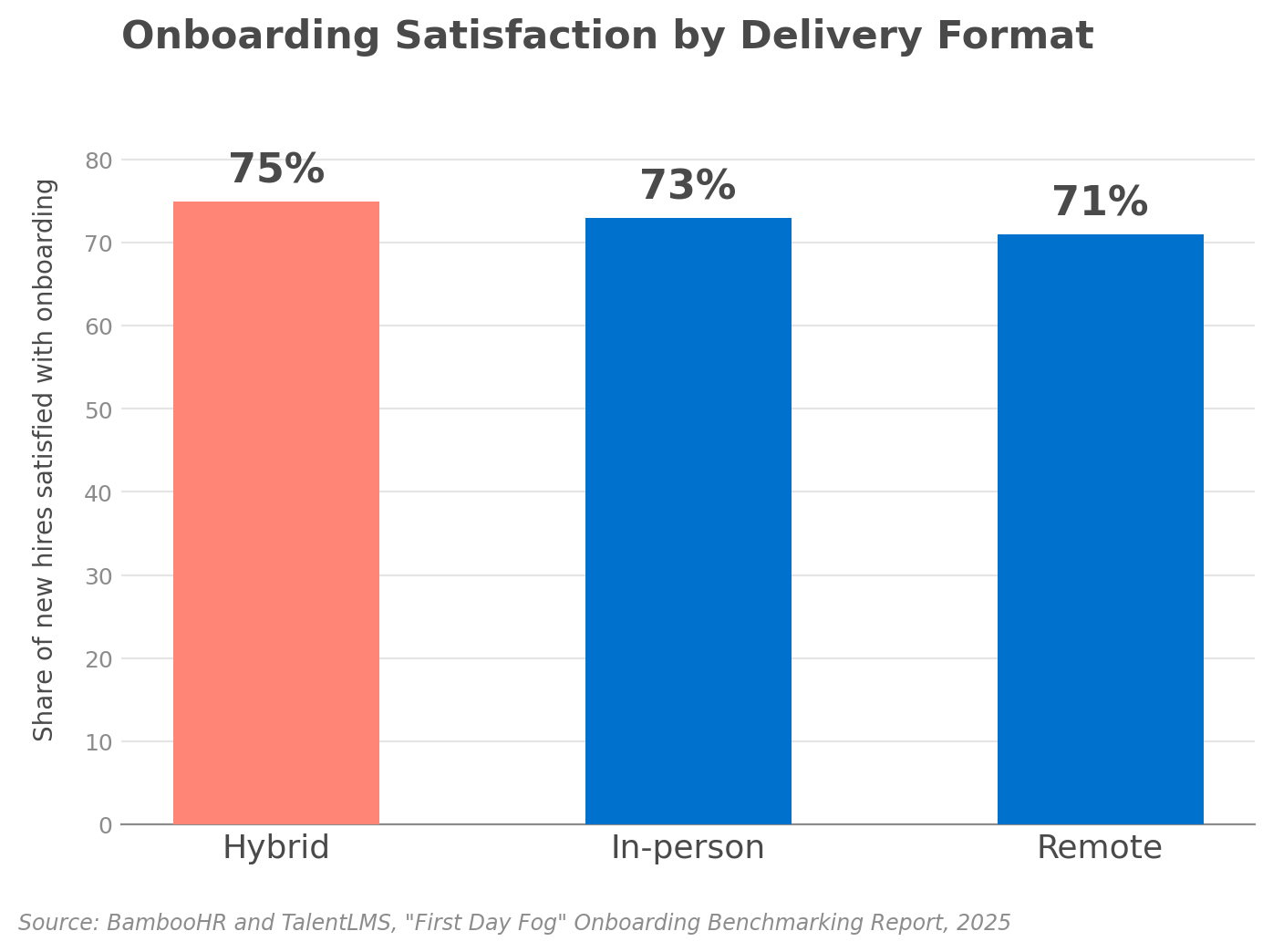
Hybrid onboarding beat both in-person and fully remote formats on satisfaction in 2025.
Nearly 4 in 10 new hires (39%) said they had second thoughts about taking the job at all during onboarding, a number that jumps to 49% among Gen Z hires specifically. If you’re building new employee onboarding statistics into a board deck, that generational split deserves its own slide. Whatever you’re doing for onboarding completion right now, it is not landing evenly across a multigenerational workforce, and treating it like it is will cost you your youngest hires first.
Is Anyone Actually Tracking New Hire Performance?
This is where most onboarding programs quietly give up, and where the employee onboarding statistics get genuinely uncomfortable. Everyone loves a 30-60-90 day plan template. Almost nobody enforces one.
According to Enboarder’s 2025 “Winning the First 90 Days” HR Leader Survey:
- 44.8% of organizations provide only general guidelines for a 30-60-90 day plan, leaving the actual execution to individual manager discretion
- 28.8% of HR leaders have personally seen a hiring manager give a new hire zero guidance or training
- Only 36% of HR leaders describe the handoff between recruiting, HR, and the hiring manager as “seamless”; nearly half call it merely “adequate, with occasional gaps”
- Providing “clear role expectations” was rated the single most important factor in new hire success, by a wide margin over anything else surveyed
Here’s the part that should bother you more than it probably does: a 30-60-90 plan that exists as a PDF template is not the same as a performance tracking system. If nobody is checking whether a new hire actually hit their day-30 milestone, you don’t have a tracked program. You have a document.
This is exactly the gap a tool is built to close, not a spreadsheet. Platforms like ProProfs Training Maker let you attach graded knowledge checks and skill assessments directly to each stage of a new hire’s learning path, so “completed the module” and “can actually do the thing” stop being the same checkbox. If part of your performance tracking problem is that nobody can quickly verify whether a new hire retained compliance or product training, that verification step, not another platform, is usually the missing piece.
Does Onboarding Quality Really Change Who Stays?
Yes, and the 2025 data is more specific about why than the usual “structured onboarding improves retention” line you’ve heard forty times.
From the same Enboarder 2025 survey:
- 20.5% of HR leaders report that up to half of their new hires leave within the first 90 days; 60.8% say this 90-day turnover has gotten worse over the past year
- The top three reasons new hires give for leaving in that window: misalignment between job expectations and reality (30.3%), lack of connection to team or culture (19.5%), and a poor onboarding experience specifically (17.4%)
- 86% of new hires decide how long they intend to stay with a company within their first six months on the job
- HR directors and managers typically estimate the cost of a failed new hire at up to $25,000; CHROs and chief people officers put it closer to $50,000
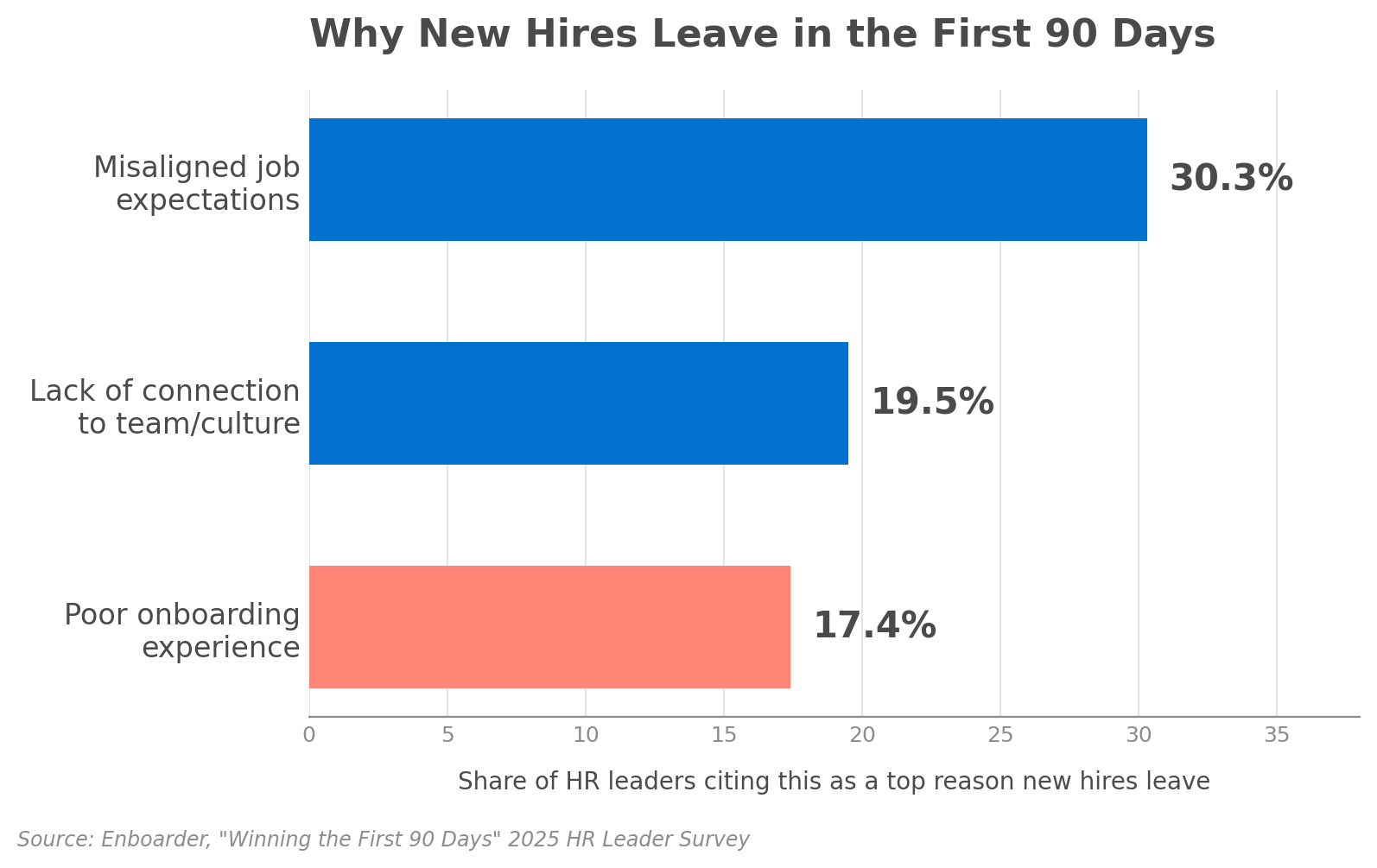
Expectation-setting during hiring, not the onboarding program itself, is the single biggest driver of early exits.
Notice that “poor onboarding experience” is the third reason, not the first. Most retention conversations treat onboarding as the whole story. It isn’t. Expectation-setting during recruiting is doing more damage than the onboarding program itself in nearly a third of cases. Fix your job postings and your recruiter’s pitch before you touch your welcome packet.
How Long Before a New Hire Is Actually Worth What You’re Paying Them?
Time-to-value is one of the most practical employee onboarding statistics because it measures how quickly new hires start contributing.
The 2025 BambooHR and TalentLMS report found that 73% of employees who experienced hybrid onboarding said it helped them contribute faster, compared with 69% for in-person and 61% for fully remote onboarding.
At the same time, Enboarder’s 2025 survey found that 46.4% of HR leaders spend at least one full week on HR administration before a new employee even begins meaningful work.
Put together, these new employee onboarding statistics show that productivity depends on more than training. Administrative delays before Day One and the onboarding format after Day One both affect how quickly someone reaches full productivity.
Are You Actually Asking New Hires What They Think?
Feedback is one of the easiest metrics to collect, yet many companies never ask new hires about their onboarding experience.
According to BambooHR and TalentLMS (2025), 29% of new hires were never given the opportunity to provide feedback.
Among employees who were asked:
- 75% were satisfied with support from their manager.
- 67% were satisfied with support from HR.
These new employee onboarding statistics highlight an important difference. Employees consistently rate their managers more positively than HR during onboarding. If your surveys only ask about the overall program, it’s much harder to identify which part of the experience actually needs improvement.
The Part Almost Everyone Gets Backwards
Looking across these findings, a clear pattern emerges.
Organizations often treat onboarding success as the result of culture or leadership. In reality, completion rates, performance tracking, retention, time-to-value, and feedback are all separate systems that can be measured and improved independently.
The hybrid onboarding data makes this especially clear. It outperformed both fully remote and fully in-person onboarding for satisfaction, contribution speed, and whether employees felt they were starting a meaningful learning journey.
That’s not simply a cultural advantage. It’s the result of choosing an onboarding approach that performs better across multiple measures.
What to Actually Do With All This
Start with your 30-60-90-day plan. Around 44.8% of organizations already have one, but many don’t use it consistently. A recurring manager check-in often delivers more value than creating another onboarding document.
Next, improve feedback collection. If 29% of new hires never share their experience, you’re missing the information needed to improve onboarding, reduce ramp-up time, and identify weak spots before they become bigger problems.
Finally, don’t assume every retention issue begins with onboarding. If employees leave because the role doesn’t match what they expected, the solution starts much earlier, with more accurate job descriptions, better recruiter conversations, and realistic expectations during hiring. A stronger welcome package won’t fix a hiring mismatch.
Onboarding Isn’t a Welcome Committee. It’s a System With a Scoreboard
Every one of these employee onboarding statistics points to the same uncomfortable fact: most companies built onboarding to feel good, not to be measured. A welcome breakfast and a laptop on day one are nice. They are not a completion rate, a performance benchmark, a retention driver, a time-to-value calculation, or a feedback score. Pick one metric from each of the five categories above, put an owner’s name next to it, and check it again in ninety days. That’s the whole program. Everything else is decoration.
Frequently Asked Questions
What percentage of new hires leave within the first 90 days?
Enboarder's 2025 HR Leader Survey found that for 20.5% of HR leaders, up to half of their new hires leave within the first 90 days. Worse, 60.8% say this specific 90-day turnover has increased over just the past year, not stayed flat.
What is a good employee onboarding completion rate?
There's no single industry-wide benchmark for completion specifically, but 2025 research from BambooHR and TalentLMS found 73% overall satisfaction with onboarding, with hybrid formats reaching 75%. Track completion rate alongside satisfaction score, never as a replacement for it.
How long does it take a new hire to reach full productivity?
This varies heavily by role complexity, so there's no universal number worth quoting. What 2025 data does show clearly is that format matters: hybrid onboarding helped 73% of employees contribute faster, versus 69% for in-person and only 61% for fully remote programs.
Does onboarding quality actually affect retention?
Yes, though it's one factor among several, not the whole story. Enboarder's 2025 survey found poor onboarding experience accounts for 17.4% of early departures, trailing behind misaligned expectations (30.3%) and weak team connection (19.5%) as root causes.
What's the biggest gap in new hire performance tracking?
According to Enboarder's 2025 data, 44.8% of organizations only provide general 30-60-90 day guidelines and leave execution entirely to manager discretion. That means most “performance plans” exist as documents, not as anything actually enforced or checked on a schedule.
Is hybrid onboarding really better than remote or in-person?
Based on the 2025 BambooHR and TalentLMS data, yes, and by a meaningful margin across satisfaction, time-to-value, and perceived learning continuity. It isn't a philosophical preference between office cultures; it's the format that scored highest on every outcome measured.
How do you collect useful feedback on new hire onboarding?
Ask directly, and ask often, not just once at the ninety-day mark. 2025 research found 29% of new hires were never asked for feedback at all. Separate questions about manager support from questions about HR support, since satisfaction with each ran 8 points apart.
What do new employee onboarding statistics actually say about the first week?
The most consistent finding across 2025 studies is that expectation-setting in week one predicts long-term retention more reliably than any welcome activity does. Nearly 4 in 10 new hires had genuine second thoughts about the job itself during this exact window.

Let ProProfs AI create your training course

 We'd love your feedback!
What did you like & how can we make it even better?
 Thanks for your feedback!
 Ask Your Question
Have a question? Get expert help to make your decision easier.