I’ve sat across from a charge nurse with 94 unfinished courses on her LMS dashboard. Some were three minutes long. Some pushed past three hours. None of them were prioritized by what she’d actually need that shift. That’s not a training problem. That’s a design problem wearing a training costume.
Elearning for healthcare gets blamed for learner apathy when the real culprit is usually a platform that dumps everything on someone at once and calls it “personalized learning.” Done right, healthcare eLearning looks almost nothing like that. It’s shorter, more specific, and built around the moment someone actually needs the information, not the moment IT finishes uploading the course. That’s what this is about: not just what healthcare eLearning is, but what to actually fix first, in what order, and what to leave alone for now.
This is for you if you’re:
- An L&D or training lead building out a compliance program for a hospital or health system
- An HR or onboarding manager trying to standardize training across shifts, units, or facilities
- A compliance officer who needs an audit trail, not just a “completed” checkbox
- A clinical educator tired of fighting a forty-minute slide deck to explain a three-minute update
What Is Healthcare eLearning, Exactly?
That’s the textbook version. In practice, healthcare eLearning is a much wider net than that one sentence suggests. It covers a five-minute HIPAA refresher that a new hire clicks through before her first shift, a full ninety-day onboarding curriculum for a hire coming in cold, and everything in between: infection control updates, device certifications, and an annual OSHA check nobody looks forward to. Some of it is genuinely well built. A lot of it isn’t, and the difference usually comes down to one assumption the designer made before writing a single slide.
The good versions are built around a shift schedule. They assume the person taking the course has eleven minutes between a discharge and a med pass, not a quiet afternoon at a desk. The bad versions assume the opposite: an uninterrupted hour, a working computer that isn’t shared with four other people, and a mental state that isn’t already stretched thin from the floor. That second assumption isn’t a training failure so much as it’s a failure to notice who’s actually taking the course and when. Healthcare eLearning that ignores this gets ignored right back.
What Actually Makes Healthcare eLearning Worth the Investment?
Here’s where I’ll disagree with a lot of vendor decks: the benefit isn’t “engagement.” Engagement is a symptom. The real benefits of eLearning in healthcare show up in three specific places, and each one changes a decision you’re already making, not just a feeling staff have about training.
1. It Lowers Liability without Pulling Staff off the Floor
A well-built healthcare compliance elearning program replaces the once-a-year fire drill of mandatory training with short, targeted checks spread across the year. Instead of yanking a nurse into a conference room for two hours, you push a scenario-based check to her during a natural lull, and compliance gets recorded the moment she answers it.
If you’re trying to decide whether this is worth building, use this test: can you currently produce, in under five minutes, a list of exactly who has and hasn’t confirmed they understand a specific protocol change made this month? If the honest answer is no, that’s the gap healthcare compliance elearning is supposed to close, and it’s the first thing worth fixing, ahead of anything cosmetic.
2. It Improves Retention because It Is Active, Not Passive
Passive video-watching is where healthcare eLearning goes to die. Nobody remembers slide forty-one of a PDF. What sticks is a branching scenario that forces a decision, right or wrong, and then corrects it on the spot. In practice, that means three multiple-choice branches per scenario is usually enough. Once you’re building a fourth or fifth branch to cover every possible outcome, you’re just rebuilding a video in text form, and you’ve lost the speed advantage that made this worth doing in the first place.
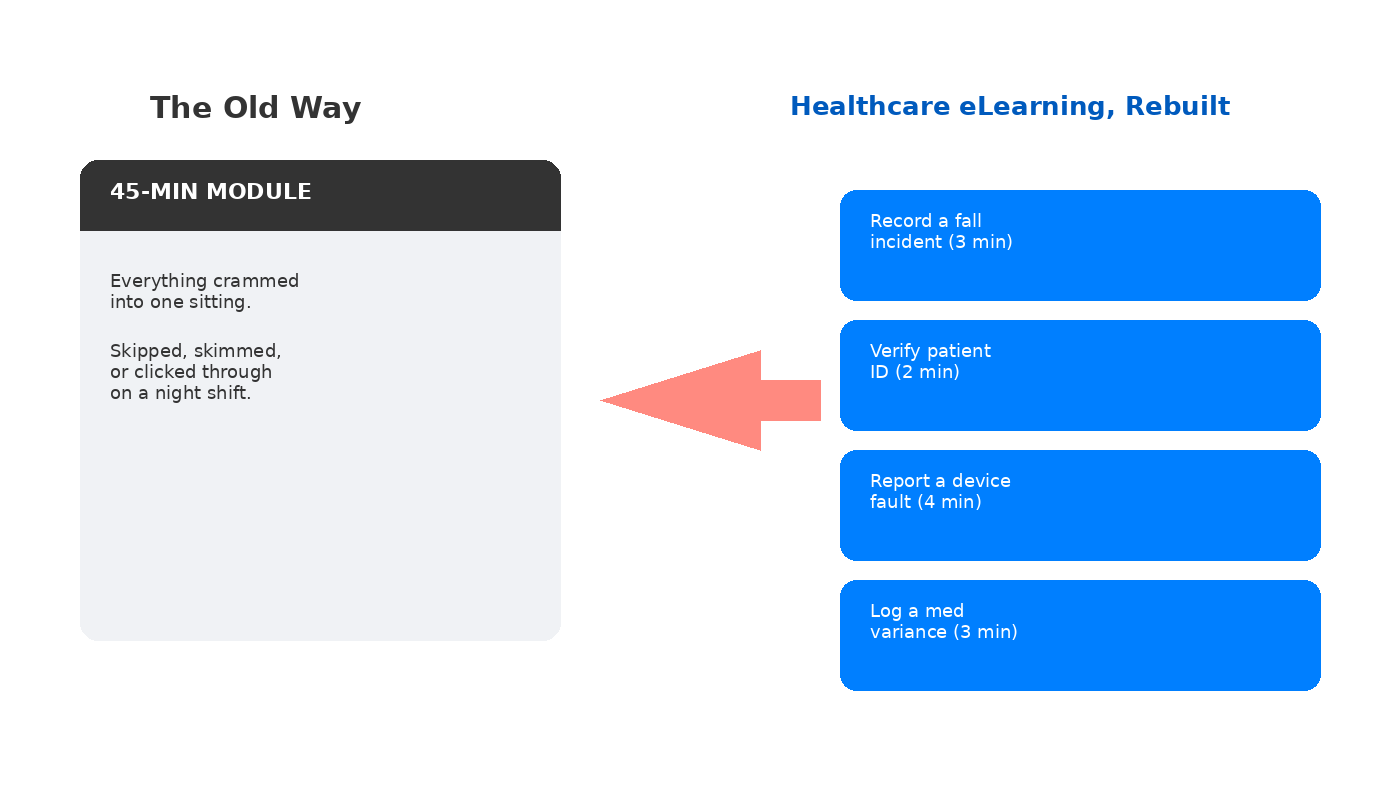
The old way crams everything into one sitting. The rebuilt version breaks it into what a shift can actually absorb.
3. It Standardizes and Makes Training Portable
This one gets underrated. When training lives in a centralized system instead of a manager’s personal PowerPoint folder, a nurse transferring between units, or even between facilities in the same health system, doesn’t have to repeat baseline modules she’s already certified on. Platforms like ProProfs Training Maker handle this kind of centralized tracking and certification natively, which matters more than any single feature on a spec sheet when you’re managing training across multiple locations.
I’ll add a caveat here, because I’ve seen this backfire: centralizing training only works if someone actually owns keeping it current. A perfectly organized LMS full of outdated SOPs is worse than a messy one, because it looks trustworthy and isn’t.
Where Does Healthcare eLearning Actually Get Used?
The benefits are nice on paper. Use cases are where you find out if any of this holds up under a real shift schedule, and each one below comes with a rule of thumb you can apply immediately, not just a description.
1. Training the Difference, Not the Whole Policy
Healthcare guidelines change constantly, and the mistake most organizations make is treating every update like it deserves a brand-new, giant module. Use the two-minute rule instead: if you can’t explain what changed in under two minutes, it’s not a policy update anymore, it’s a new module and should be scoped as one.
If you can explain it in two minutes, build exactly that, a short walkthrough of the difference, and nothing else. A two-minute walkthrough of exactly what changed will be finished. A full re-certification module will get postponed until someone’s manager threatens them.
2. Medical Device and Procedure Training
This is one place where I think the industry overcorrects toward “interactive” for its own sake. Filmed, real-world procedural video, an actual IV pump being set up, an actual surgical tray being prepped, gives learners physical and auditory cues that no amount of animation or narrated slide deck replicates.
Keep each filmed step under ninety seconds, shoot it in the actual unit with the actual device, and pair the video with a one-page checklist job aid rather than replacing the checklist with the video. The video teaches the motion; the checklist is what they’ll actually have open next to them the first time they do it alone.
3. Self-Directed Continuing Education
Clinicians juggling CME requirements need training that fits around license renewal deadlines, not around a corporate training calendar. Peer-presented clinical challenges, where a colleague walks through a real case they handled, tend to outperform generic vendor content here, mostly because the person watching trusts the person presenting.
The practical version of this: record a five- to eight-minute debrief after an actual case review or M&M meeting, get consent from whoever’s presenting, and tag it directly against a CE credit hour in your elearning for healthcare catalog so watching it isn’t extra work, it’s just how the hours get earned.
What Do the Best Examples of Healthcare eLearning Look Like?
Theory is easy. Here’s what this actually looks like when someone builds it well, and what you’d need to do to build your own version of each.
1. The Slack or Teams Compliance Drill
Instead of tracking whether someone watched a video, a metric that tells you nothing about whether they understood it, some organizations push a single scenario question directly into the communication tool staff already use. Answer correctly, and compliance is logged instantly. Answer incorrectly, and you get an immediate micro-correction instead of finding out three months later during an audit.
Building one of these doesn’t require custom development: a scenario-based question bank in a tool like ProProfs Quiz Maker, scheduled weekly and pushed as a link into an existing channel, gets you most of the way there without a dedicated engineering project.
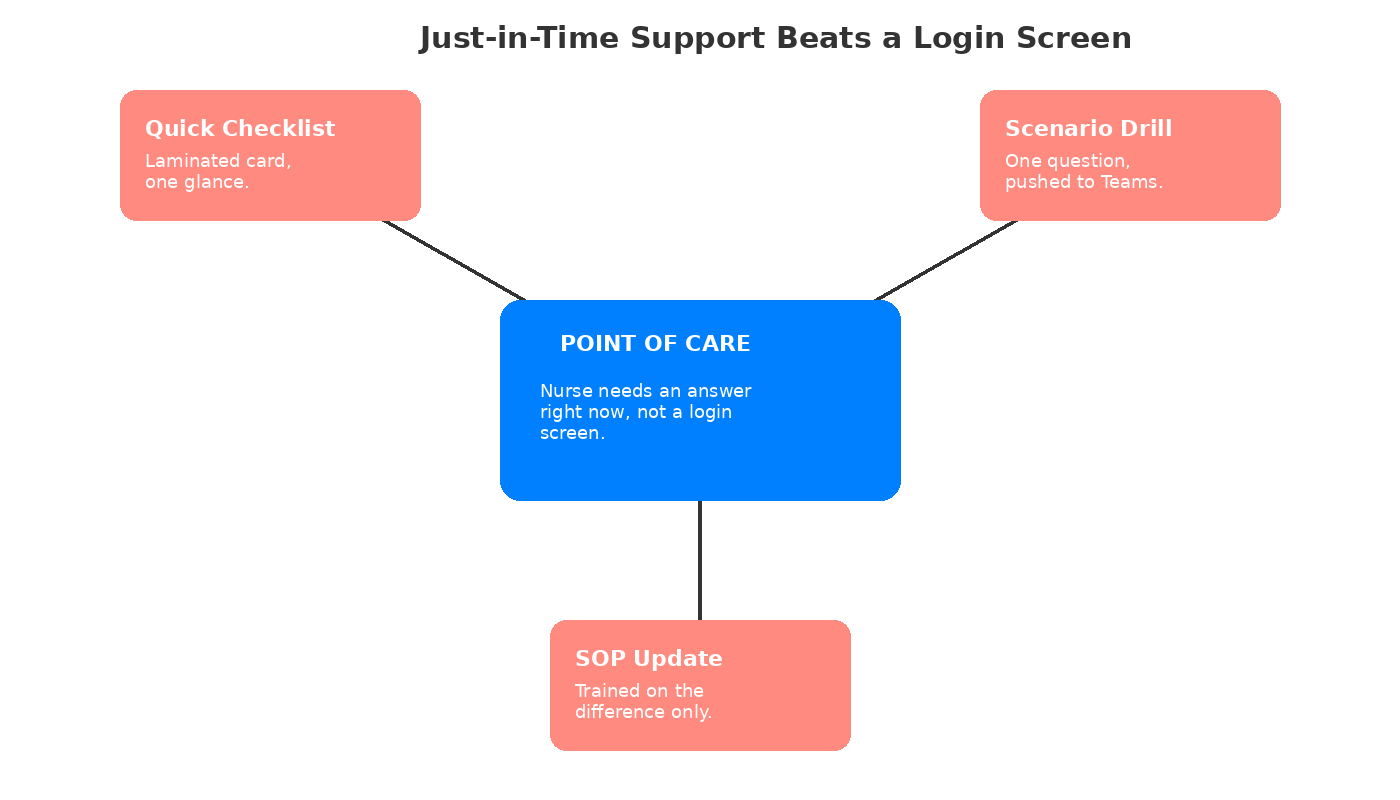
The best healthcare eLearning meets people at the point of care, not at a login screen.
2. Interactive Simulation Films
The Resuscitation Council UK’s short interactive film, Lifesaver, is worth studying regardless of your specialty, not because it’s flashy, but because it’s brief, emotionally honest, and forces a decision at exactly the right moment. That’s the bar. Most healthcare eLearning content aims for comprehensive. This aims for memorable.
3. Just-in-Time Software Walkthroughs
When a hospital rolls out a new EHR module or scheduling tool, nobody wants to sit through a training deck about it. A short, embedded, click-through walkthrough that shows up the first time someone touches the new feature works better than any amount of advanced training, because it arrives exactly when the question does.
The VR Question Nobody Wants to Answer Honestly
I’ll say the unpopular thing: most of the VR and AI-simulation hype in this space is chasing budget approval, not learning outcomes. VR looks incredible in a vendor demo. It also tends to be cost-prohibitive to scale past a pilot, and it still can’t replicate the tactile feedback of actually holding a real instrument or feeling actual resistance in a line. Conversational AI simulations have a similar problem from a different angle: they can quiz someone on protocol, but they can’t replicate the hesitation in someone’s voice or the way a room changes when something goes wrong.
Before any VR or AI-simulation line item gets approved, run it through three questions:
- Does it train a physical sensation or motion that text and video genuinely cannot?
- Will more than a handful of people actually use this specific scenario, repeatedly, not just once in a demo?
- Would an eighty-dollar job aid or a two-minute filmed walkthrough solve most of this instead?
If the honest answer to two of those three is no, that budget belongs somewhere else this year. It means ask what problem the technology is actually solving before it goes in the budget, not whether it looked impressive in the sales pitch.
What Should You Actually Do First?
If you’re staring at a training program that feels like the ninety-four-course dashboard I mentioned earlier, don’t start with format. Start by matching the symptom to the fix.
| If This Is Your Symptom | Do This First | Why It Works |
| Staff have 50+ assigned courses, and most go untouched | Audit and cancel duplicates before touching the format | Redesigning content nobody was ever going to take doesn’t fix the actual problem |
| A module covers a policy that has changed by one step | Build a two-minute walkthrough of the difference instead of a new module | Short updates get finished; full re-certifications get postponed |
| Compliance is tracked by video-watched, not understood | Replace it with scenario-based questions in tools staff already use | Watching doesn’t predict whether someone will act correctly |
| Budget talks keep circling back to a VR or AI pilot | Run it through the three-question test above before approving | Most VR and AI spend chases novelty, not measurable outcomes |
1. Fix the Overload before You Fix the Format
Pull the enrollment report for a single role, say, med-surg RNs, and group every assigned course by who owns it and when it was last reviewed. Anything nobody can name an owner for, or that hasn’t been touched in over a year, gets canceled before you redesign anything else. This is unglamorous work, and it’s the highest-leverage thing you can do. Everything else is cosmetic if this part is broken.
2. Break Your Biggest Module into Task-Specific Pieces Next
Take the course people complain about most, usually something forty-five minutes or longer, and rebuild it as five-minute, task-specific chunks: “Record a fall incident.” “Verify patient ID before a procedure.” Something like ProProfs Training Maker‘s AI course creation tools can turn an existing SOP document into a first draft of this kind of structured, bite-sized course quickly, which saves the redesign from becoming its own six-month project.
3. Add Active Checks before You Add Flashy Tech
Scenario-based drills, even simple ones, beat passive video every time. If you want to layer in gamified quizzes or randomized question banks for compliance testing as part of your broader elearning for healthcare rollout, a tool like ProProfs Quiz Maker fits naturally alongside a training system like this, since assessments and course delivery end up needing to talk to each other anyway.
4. Leave VR and AI Simulation for Later, if at All
This is the trap that looks like progress. It isn’t, not yet, not for most healthcare training budgets. Fix the boring stuff first, and revisit the flashy stuff once your basics are actually working.
The Real Metric Isn’t Completion. It’s Whether They’d Remember.
Most healthcare eLearning gets evaluated by the wrong number. Completion rate tells you someone clicked through to the end. It doesn’t tell you whether they’d handle the actual situation correctly at two in the morning, alone, without a manager standing over their shoulder.
That’s the real test behind every one of the benefits of elearning in healthcare I’ve walked through here, and it’s the standard I’d hold any healthcare compliance elearning program to. Not “did everyone finish it,” but “if this came up for real, would they know what to do?” Start with the diagnostic table above, fix the overload first, and the rest of the redesign tends to sort itself out.
Frequently Asked Questions
What is healthcare eLearning?
Healthcare eLearning is digital training delivered to healthcare staff through courses, quizzes, and job aids instead of in-person sessions alone. It usually runs on a learning management system that assigns, tracks, and certifies training completion for compliance and skills development.
Is healthcare eLearning as effective as in-person clinical training?
For compliance, SOP updates, and knowledge checks, yes, often more so, since it's trackable and repeatable. For hands-on procedural skills, it works best as a supplement to hands-on practice, not a full replacement for it.
What are the main benefits of eLearning in healthcare compared to classroom training?
The benefits of eLearning in healthcare include lower liability through trackable compliance, better retention through active scenarios instead of passive video, and portability, since staff don't repeat baseline training when they switch units or facilities.
How long should a healthcare eLearning module be?
Shorter than you think. Task-specific chunks of three to five minutes get finished during real shift downtime. A forty-five-minute module gets postponed, skimmed, or clicked through without absorption, especially on a busy floor.
What is healthcare compliance eLearning, specifically?
Healthcare compliance elearning covers mandatory regulatory and safety training, like HIPAA, infection control, or OSHA-related protocols, delivered digitally and tracked for audit purposes. Done well, it uses short scenario checks instead of long annual modules.
Can eLearning fully replace hands-on clinical training?
No, and it shouldn't try to. eLearning handles knowledge, protocol, and decision-making practice well. Physical skills like device handling or procedural technique still need real hands-on practice; eLearning works best preparing someone for that practice, not replacing it.
What LMS features matter most for elearning for healthcare teams?
Prioritize compliance tracking with audit trails, mobile access for staff without desk jobs, scenario-based assessments, and the ability to update a single module without rebuilding the whole course. Integration with HR and scheduling systems matters more as you scale.
How do you measure whether healthcare eLearning is actually working?
Look past completion rates. Track scenario-check accuracy, time-to-completion for urgent SOP updates, and whether audit findings drop over time. If completion is high but incident reports haven't moved, the content isn't doing its job.

Let ProProfs AI create your training course

 We'd love your feedback!
What did you like & how can we make it even better?
 Thanks for your feedback!
 Ask Your Question
Have a question? Get expert help to make your decision easier.