

I am going to tell you the part no vendor wants you to sit with.
Your employees are not the problem. The annual 45-minute GDPR module they click through in January, forget by March, and resent by December, that is the problem. And if your current training program is basically a completion certificate dressed up as a compliance strategy, you already know the audit record is real, but the risk reduction is not.
I have spent time across these platforms, talked to security leads who manage them daily, and dug through community threads where CISOs say the quiet parts out loud. What follows is what I actually think, not a feature matrix in paragraph form.
This is for you if you are:
- A CISO or IT manager at an SMB trying to prove GDPR compliance without a dedicated security team
- An MSP evaluating platforms to recommend (and manage) across multiple clients
- A compliance officer who needs both the audit trail and the behavioral change, not one at the expense of the other
- Anyone who has watched employees click through a phishing test and thought, “this isn’t working”
What Is GDPR Security Training Software?
GDPR security training software is a platform that delivers structured cybersecurity awareness education designed to meet EU data protection requirements, with built-in tools to assign, track, and document employee training completion for audit and regulatory purposes.
The General Data Protection Regulation does not mandate a specific training format. What it does require, particularly under Article 39 for organizations with a Data Protection Officer, is that employees who handle personal data receive adequate awareness and training on their obligations.
That word “adequate” has played a significant role in ICO enforcement decisions. Regulators expect training to be documented, role-relevant, and repeated, not annual and generic. Organizations that have faced fines after incidents almost always had training programs on paper. The gap was in whether those programs actually changed behavior.
That is the distinction worth keeping in your head as you evaluate these platforms: the document versus the change.
6 Best GDPR Compliance Security Training Platforms
If you’ve ever tried rolling out GDPR training, you know the real challenge isn’t launching it. It’s getting people to actually care, remember, and apply what they learned.
I’ve looked at a mix of platforms that solve different parts of this problem. Some help you get compliant fast, others focus on behavior change, and a few make sure your training doesn’t get ignored after week one.
Here is the comparison table before the deep dives:
| Platform | Best For | Capterra Rating | Pricing |
| ProProfs Training Maker | Full-cycle GDPR training with compliance tracking | 4.8/5 | Free plan; paid plans start from $1.99 per active learner/month |
| KnowBe4 | Phishing simulation at enterprise scale | 4.7/5 | From $18/user/year |
| SoSafe | EU-native GDPR and behavioral science | 4.9/5 | Per-seat subscription |
| usecure | Automated risk-adaptive training for MSPs and SMBs | 4.7/5 | Per user, per month |
| Wizer | Best free tier for budget-constrained teams | – | Free plan; paid from ~$3/user/month |
| Guardey | Gamified weekly training to fight compliance fatigue | – | From €2.99/user/month |
1. ProProfs Training Maker – Best for Easy AI-Powered GDPR Training and Full Compliance Tracking
I have watched teams spend weeks building compliance courses that look like they were made in 2011.
ProProfs Training Maker was the platform a colleague at a mid-size fintech firm switched to after their TalentLMS costs started rising and their admin overhead wasn’t decreasing. Her summary after six months: “I stopped chasing people. The platform does it.”
What makes it genuinely useful for GDPR training is not any single feature.
It is the fact that everything lives in one place. Course creation, assessment, completion tracking, certifications, and reporting all happen inside the same system. No spreadsheets stitching together what three tools produced separately.
The AI course builder is the part I find most impressive for GDPR programs specifically. Type a prompt about what you need, and it generates a working course structure you can edit. For organizations building their first proper GDPR security awareness program, this dramatically reduces setup time. Give it a spin:

Let ProProfs AI create your training course
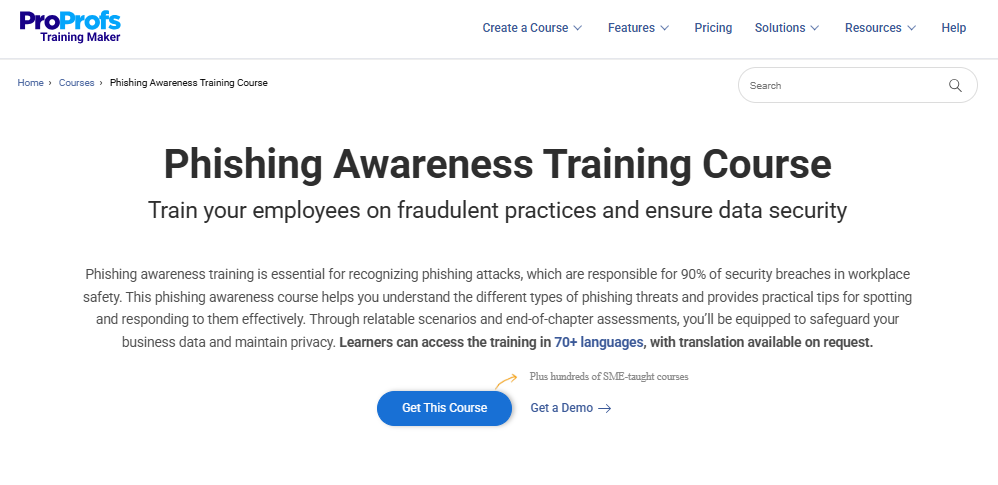
And if you do not want to start from scratch at all, there are 500+ expert-built, ready-to-use courses covering topics like data protection, workplace safety, and compliance, so you have a solid starting point on day one. Here, they even have a complete course on GDPR Training:
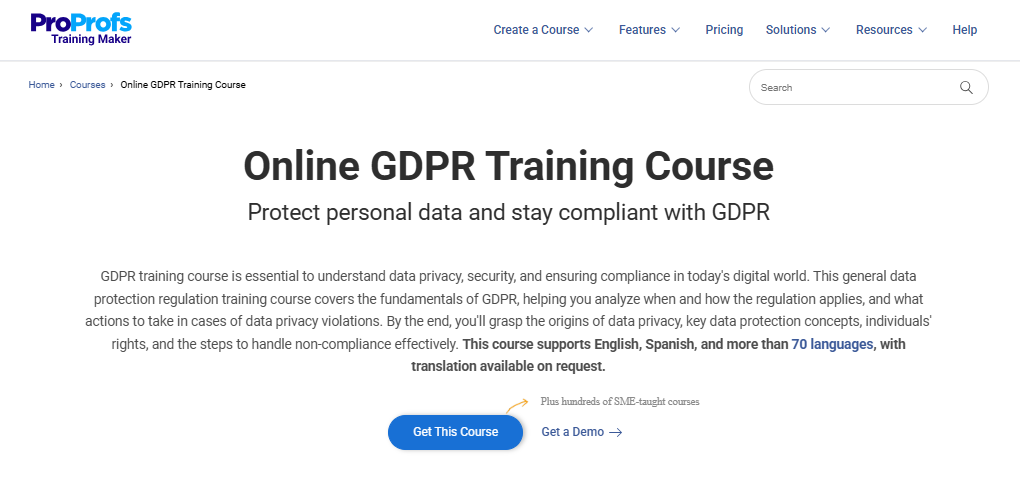
Role-based learning paths mean your customer service team and your engineering team can get different training that matches their actual GDPR exposure.
The 70+ language support means your distributed teams get the same experience without someone having to rebuild the whole program in French.
What I found most useful for GDPR compliance:
- Completion audit trails and real-time progress reports you can pull before an auditor asks for them
- Branched scenarios and gamification that reduce click-through behavior instead of just measuring it
- SCORM compatibility, if you have existing content you want to bring in
- Integration with HR, CRM, and SSO tools so training fits your existing workflow
Pros:
- AI builds course content for you, cutting weeks of development time to hours
- 500+ expert-built courses mean you can launch GDPR training on day one without building everything yourself
- Anti-cheat settings and flexible question types make assessments actually meaningful
- Branding customization, with AI handling content edits on request, keeps the learning experience consistent for your team
- Clear reports and real-time learner tracking give you something to show at audit time
- 70+ language support for global or remote workforces
- Integrates with HR, CRM, and SSO tools; SCORM support for existing content
Cons:
- No downloadable or on-premise version
- No dark mode, which some people genuinely notice on late sessions
Pricing: Free plan available. Paid plans start at $1.99 per active learner/month; Business plan at $3.99/active learner/month.
2. KnowBe4 – Best for Phishing Simulation at Enterprise Scale
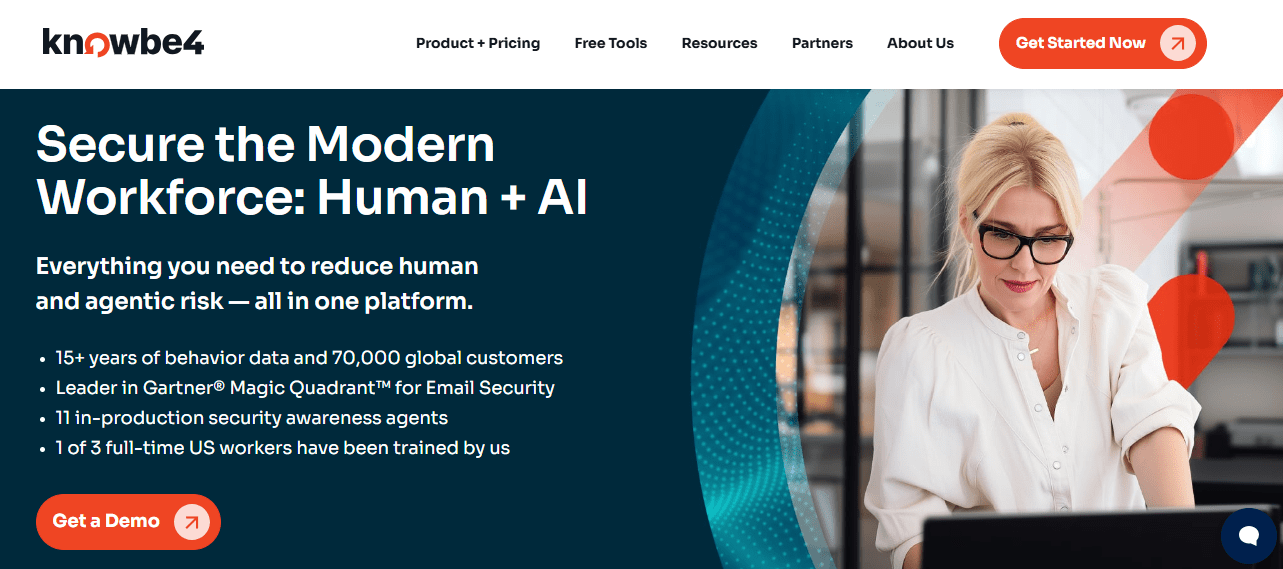
KnowBe4 shows up in almost every enterprise security conversation. The reason is simple. If phishing is your biggest GDPR risk, this is one of the most mature tools for it.
The phishing simulation engine is strong. A security lead I know at a 500-person logistics company said it clearly: “Phishing clicks dropped by nearly 20% in six months. The rest of the training is fine.”
That “fine” matters.
I have noticed the broader GDPR content is thorough, but not role-specific. Developers and sales teams often get similar modules.
Where KnowBe4 really stands out is its phishing library. There are thousands of templates. The reporting dashboard is also detailed and useful.
The platform offers 1,200+ modules in 35+ languages, so coverage is not an issue. But coverage is not the same as engagement.
From what I have seen, it works best when someone actively manages campaigns. It is not a set-and-forget platform.
What works well for GDPR compliance:
- Phishing simulations that mirror real GDPR-adjacent threats, including spoofed subject access request emails
- Deep admin reporting and compliance dashboards for audit documentation
- Microsoft 365 and Google Workspace integrations
- Automated training triggered by phishing test failures
Pros:
- Unmatched phishing simulation depth and template library
- 1,200+ training modules across 35+ languages
- Strong audit reporting and compliance documentation
- Automatically assigns remediation training after a simulation failure
Cons:
- Content can feel repetitive to long-term users
- Higher cost at scale; pricing is per user per year and adds up quickly
- Some admin features are not intuitive and have a learning curve
- Better results when actively managed, which requires dedicated admin time
Pricing: From $18/user/year. Pricing varies by tier and org size.
3. SoSafe – Best for EU-Native GDPR Behavioral Training
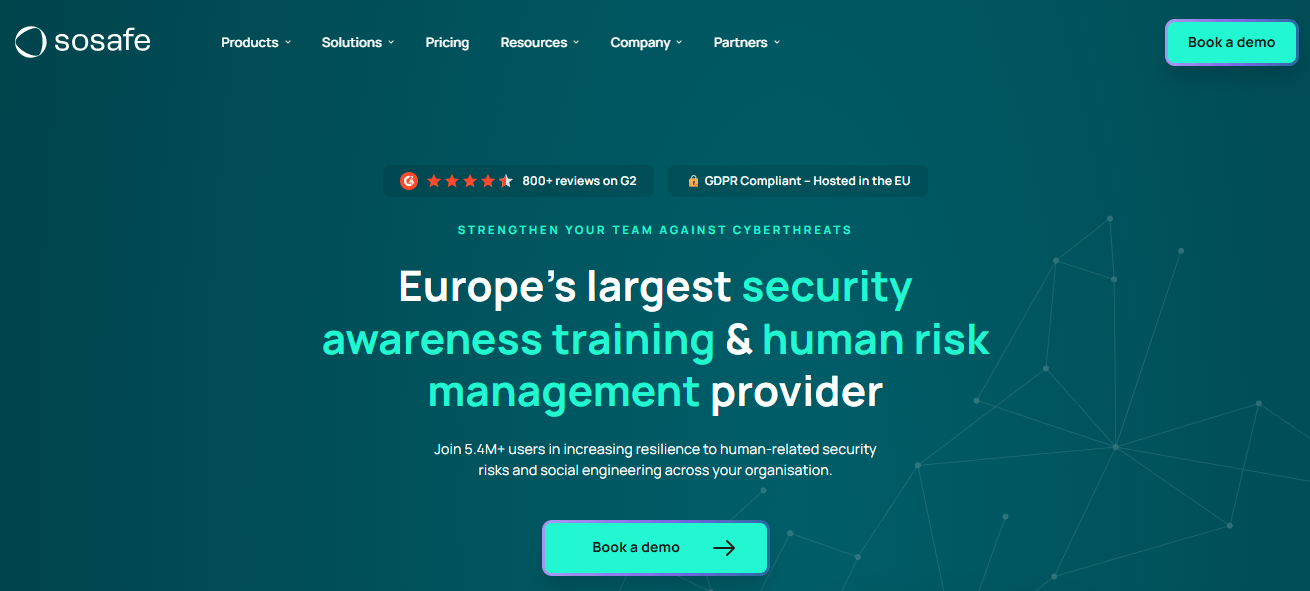
SoSafe was built in Germany, and that shows. The GDPR alignment feels native, not added later. The scenarios reflect real European workplaces, and the platform also covers NIS2 and DORA alongside GDPR.
I have not used SoSafe directly, but it comes up often in conversations around behavior change, not just compliance records.
What stands out is its Human Risk OS. It tracks risk at the individual level, not just completion rates. Training happens in the moment, with nudges through tools like Microsoft Teams and Slack when risky behavior is detected.
That approach is different. It focuses on changing habits, not just finishing modules.
The Sofie AI copilot adds real-time alerts inside everyday workflows. SoSafe claims phishing click rates can drop by up to 70% within the first year.
What works well for GDPR compliance:
- Role-based, personalized microlearning adapted to each employee’s behavior and risk profile
- Multi-channel delivery through Teams, Slack, email, and SMS
- Covers GDPR, NIS2, and DORA in one integrated program
- Behavioral science approach measures risk change, not just quiz scores
Pros:
- Built natively for EU regulatory requirements, not adapted from a US-first product
- In-the-moment training delivered inside the tools employees already use
- Behavioral risk measurement that goes beyond completion tracking
- Strong phishing simulation with click rate analytics over time
Cons:
- Enterprise-tier pricing; not practical for organizations under 50 seats
- Some users report simulation emails occasionally landing in spam folders
- Content customization options are relatively limited compared to build-your-own platforms
Pricing: Per-seat subscription; plans from Essential to Ultimate. Contact for pricing.
4. usecure – Best for MSPs and Automated Risk-Adaptive GDPR Training
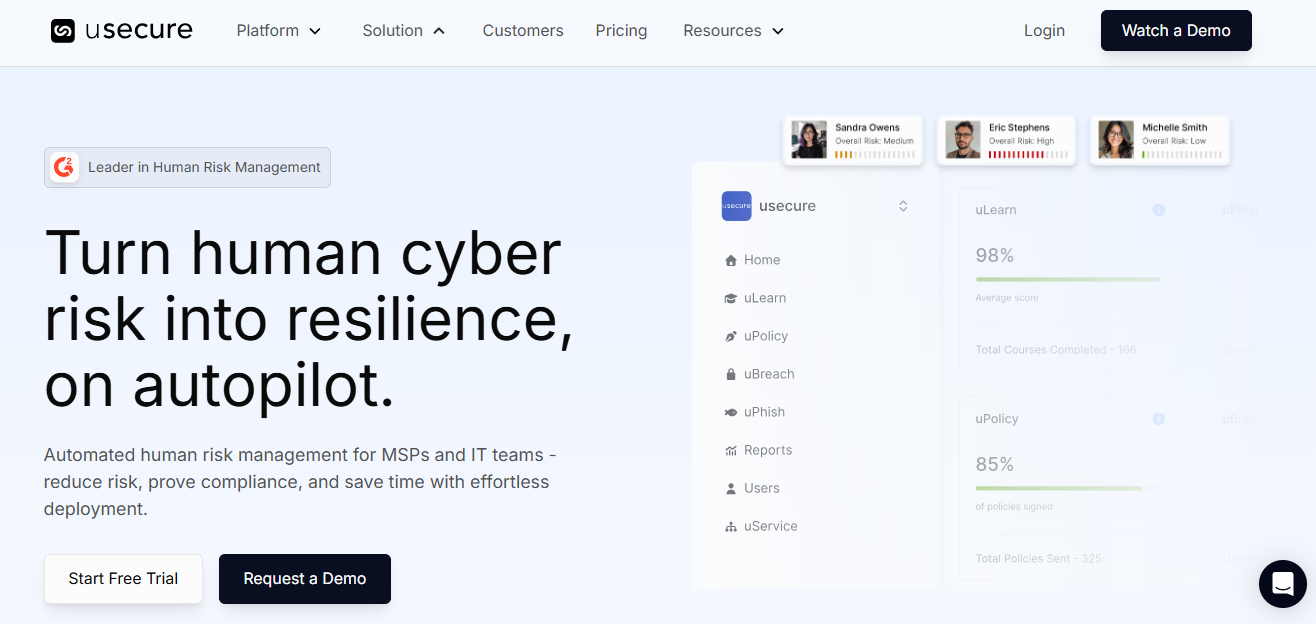
What stands out to me about usecure is how consistent the feedback is, especially from MSPs. I keep hearing the same thing: “I set it up, it ran on its own, and the client stayed compliant.” That is the core value.
The Auto Enrol feature does most of the heavy lifting. It assigns training, sends reminders, and escalates based on risk scores. If you are managing multiple clients, that level of automation is not optional. It is what keeps the program running.
I have also heard this from a CISO I know in financial services. The human risk report gave her something she did not have before. A clear view of how risk was distributed across teams, not just overall completion rates.
That is where the platform becomes useful beyond compliance.
What works well for GDPR compliance:
- Automated enrollment and reminder workflows that significantly cut admin overhead
- Adaptive training that adjusts based on user behavior, not fixed schedules
- Strong MSP multi-tenant architecture for managing multiple clients from one dashboard
- Covers GDPR alongside ISO 27001 and Cyber Essentials requirements
Pros:
- One of the lowest-friction deployments in this category; MSPs are up and running fast
- Adaptive training that responds to actual user behavior
- Strong phishing simulation with customizable templates
- Price point and flexibility work well for SMBs without enterprise training budgets
Cons:
- Content library is narrower than KnowBe4 or SoSafe
- Reporting exports require some manual work; PDF reporting is limited
- Breach monitoring feature (uBreach) is functional but less developed than the training components
Pricing: Per-user, per-month subscription. Contact vendor for current rates.
5. Wizer – Best Free-Tier GDPR Security Awareness Training
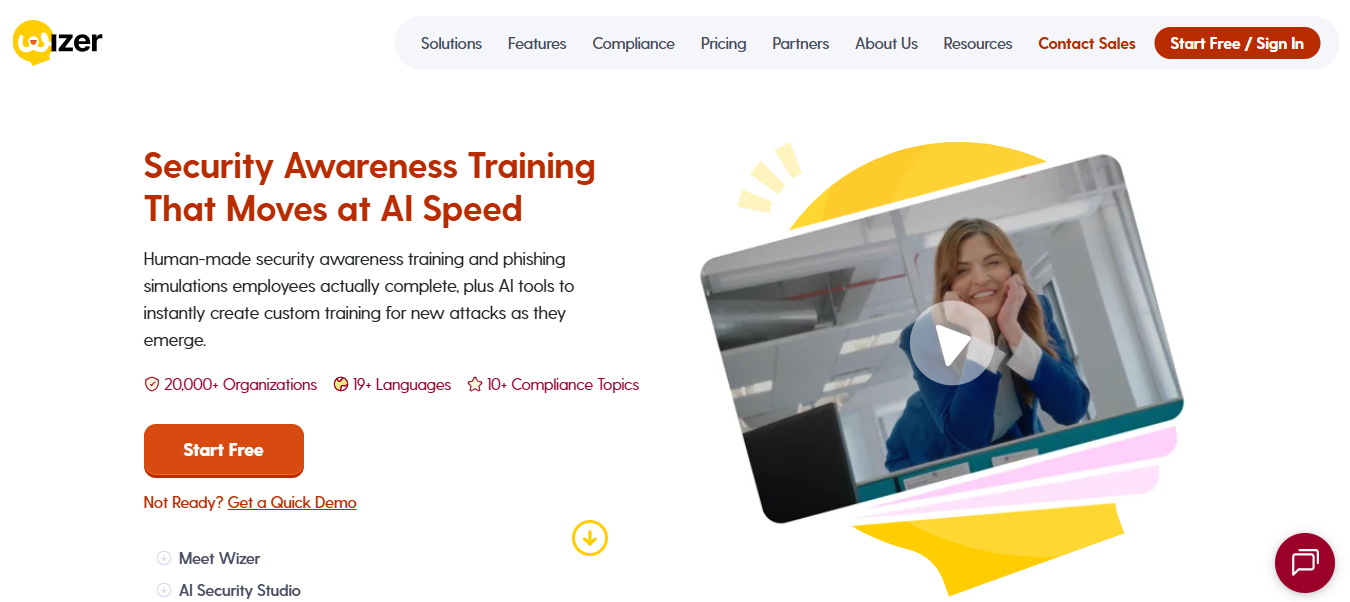
Wizer is what I recommend when someone says, “We need this, but we have no budget.” The free tier actually works. It is not a trial with locked features. You get unlimited users, tracking, reporting, quizzes, and animated training videos. GDPR training and phishing simulations are paid, but the base is solid.
A colleague of mine at a 40-person nonprofit set up a GDPR awareness program in under a week. No L&D team. No budget. That says a lot.
What makes it work is the format. Short, story-driven videos that run two to five minutes. People actually watch them instead of skipping through.
WizerAI Studio is another useful addition. It turns internal policies into training videos, which is helpful if you already have GDPR documentation but need to make it usable.
What works well for GDPR compliance:
- GDPR training modules available as paid add-ons to a genuinely free base
- Animated story-driven video format significantly reduces dropout and click-through behavior
- Simple admin interface accessible to non-security professionals
- SCORM compliant for integration with existing LMS environments
Pros:
- Truly free tier with unlimited users and real tracking features
- Engaging content format that addresses the training fatigue problem directly
- WizerAI Studio generates custom training from internal documents
- NIST-recognized; used by 100,000+ organizations
Cons:
- GDPR-specific content and phishing simulation require paid upgrade
- Audit trail depth is less robust than enterprise options
- Complex role-based learning paths hit ceiling on lower tiers
Pricing: Free plan available. Wizer Boost paid plan from approximately $3/user/month.
6. Guardey – Best for Weekly Gamified GDPR Training
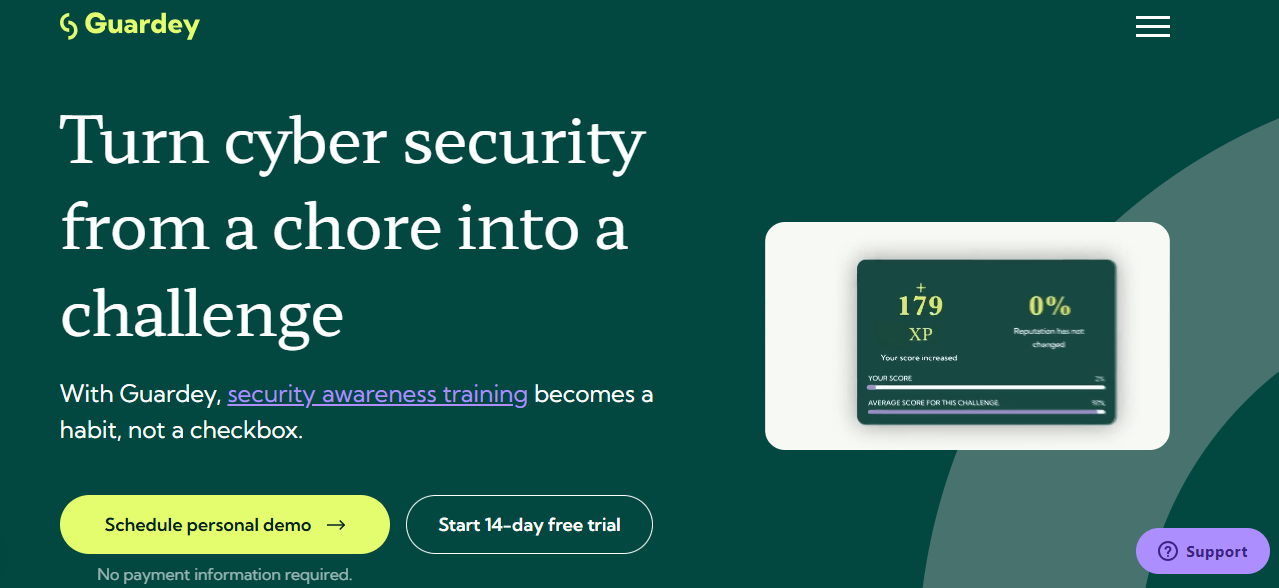
Guardey feels different from most platforms I have looked at. It focuses on the one problem others struggle with, keeping people engaged after the first training cycle.
Instead of long annual modules, it uses three-minute weekly challenges. The format is gamified. Employees build a fictional company, compete on leaderboards, and earn points as they go. Topics repeat over time, so knowledge does not fade.
I came across it through a security manager who described their old GDPR training as “done in January, forgotten by February.” After switching, completion rates did not change much. Behavior did. Employees started reporting suspicious emails on their own.
That shift is hard to achieve, and it is what actually matters.
Guardey also includes a business VPN and real-time threat monitoring. That makes it useful for small teams that need both training and basic security coverage.
What works well for GDPR compliance:
- Weekly gamified challenges maintain GDPR awareness across the full year, not just after annual training
- Leaderboard and points system creates genuine voluntary engagement
- Compliance with ISO 27001 and NIS2 in addition to GDPR requirements
- Reporting dashboard shows participation rates and topic-level performance for audit documentation
Pros:
- Weekly three-minute format is genuinely low-friction and high-retention
- Built-in VPN adds operational security coverage alongside training
- Leaderboard and gamification create the habit loop that annual training cannot
- Free 14-day trial before commitment
Cons:
- No Capterra reviews yet; newer platform with less public third-party validation
- Not a standalone compliance documentation system; better as a reinforcement layer
- Customization options for challenge content are more limited than build-your-own platforms
Pricing: Phishing plan from €1.53/user/month; Awareness from €2.99/user/month; Advanced at €3.33/user/month.
How Were These Tools Evaluated?
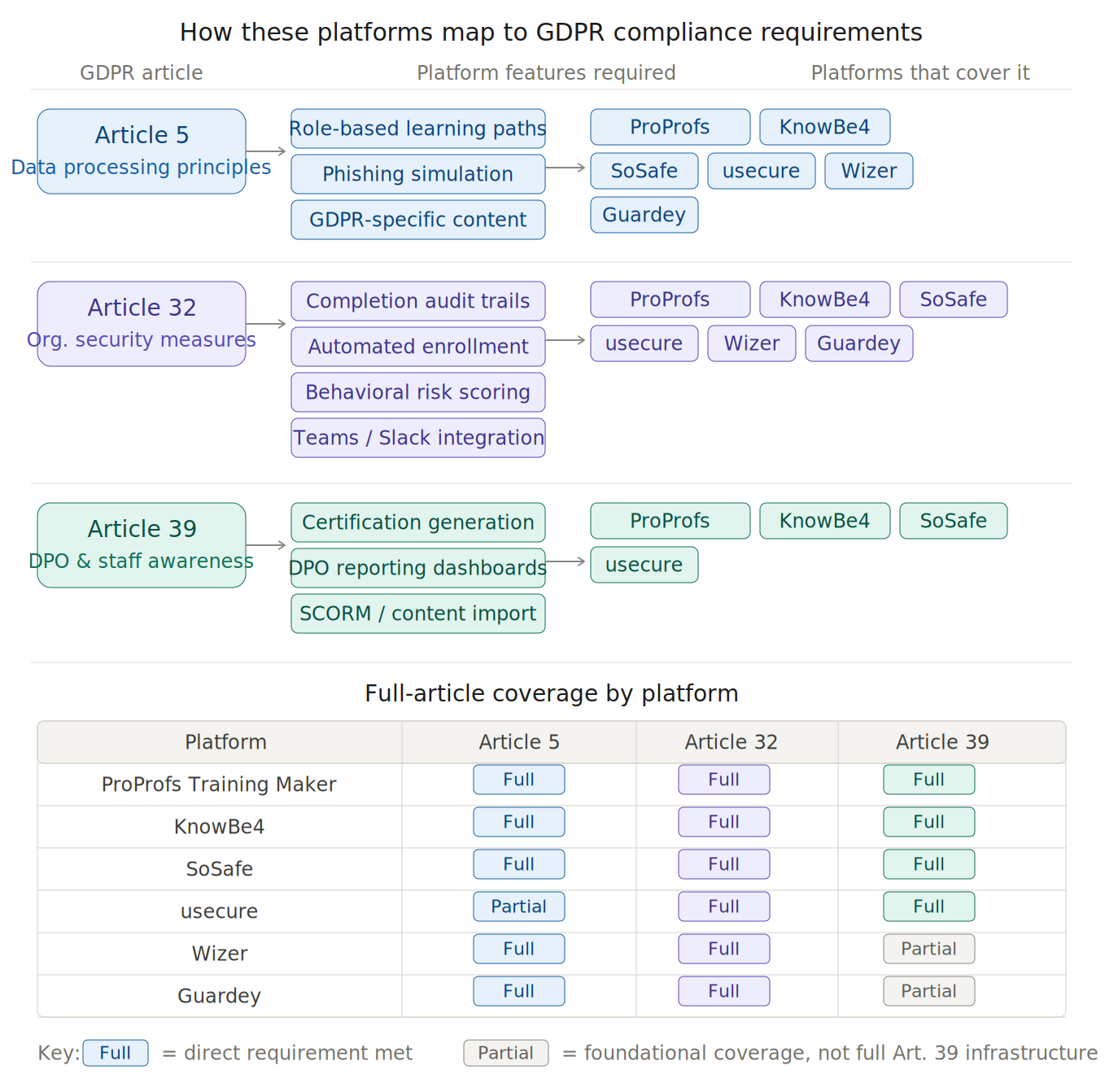
I shortlisted based on five criteria that map to what GDPR compliance actually demands in practice, not what makes a good feature table.
Audit trail depth: Can you produce documented proof of who completed what, when, and with what score? This is what a DPA investigator or external auditor will ask for first. Platforms that produce only high-level completion dashboards, without individual-level, timestamped records, fail this in a compliance scenario.
Watch: How to Analyze Training Course Results
Role-specific content delivery: GDPR creates different obligations for different functions. A developer who designs systems that process PII has different training requirements than a customer service rep handling subject access requests. Platforms that deliver one universal module to everyone miss this entirely. The ones worth using let you build different paths for different roles without rebuilding the whole program.
Behavioral engagement mechanics: Does the training change what employees do, or just log that they sat through it? The community research behind this article is consistent: click-through compliance training does not produce behavior change. Platforms that use gamification, adaptive scheduling, phishing simulations, and in-the-moment nudges are materially different from those that just host videos and run a quiz at the end.
Integration fit: Training that arrives inside Teams or Slack gets engaged with. Training that requires employees to log into a separate portal once a year does not. Integration depth matters more than most comparison articles acknowledge.
Admin overhead versus automation: For a security manager at a 200-person company, or an MSP handling fifteen clients, the platform that runs itself after setup is worth significantly more than one that produces better reports but requires weekly manual management.
What Are the Best Security Training Platforms for GDPR Compliance? Top 3
If I had to narrow it down quickly, these are the platforms I’d personally recommend starting with.
They stand out not just for features, but for how effectively they help teams move from basic compliance to actually handling data more responsibly.
ProProfs Training Maker for teams building their first complete GDPR compliance training infrastructure. The AI course builder, 500+ ready-to-use courses, full audit trail, certifications, and compliance reporting in one platform mean you are not stitching together three tools to do one job. The price point makes it accessible for growing teams without a training budget that scales with headcount.
SoSafe for European organizations subject to GDPR alongside NIS2 or DORA. If you need behavioral change evidence rather than just documentation, and you are operating in the EU regulatory environment, SoSafe is purpose-built for that context.
usecure for MSPs. The automation, multi-tenant architecture, and adaptive training make it the most deployable option at scale across multiple clients.
Wizer for teams that need to get something real in place without a budget. The free tier is honest.
What GDPR Security Training Types Does Your Organization Actually Need?
This is the question most evaluation guides skip. Not every employee needs the same training, and the regulation does not require you to provide the same training to all. What it requires is that the training is adequate for the role and the risk.
Here is how to think about this:
General awareness training covers the basics every employee should know: what personal data is, what a data breach is, what to do if you think one occurred, and how to handle a subject access request. This applies to everyone from the front desk to the C-suite.
Role-specific GDPR training goes deeper for roles with greater data-handling exposure. Customer service teams that process large volumes of personal data, HR teams that manage employee records, marketing teams that run consent-based communications, and any team with access to sensitive categories of data (health or financial data) need training that addresses their specific obligations, not a general overview.
Developer and technical training is the most frequently skipped and the most consequential for GDPR. Compliance for systems that process personal data is not about watching a video. It is about building retention policies, applying least-privilege access controls, implementing privacy-by-design from the ground up, and implementing logging practices that produce an audit trail. Platforms like Wizer (with its developer secure coding track) and KnowBe4 (with technical module depth) address this more directly than most.
Phishing simulation is not technically a training type, but it is a GDPR compliance requirement in practice. The ICO expects organizations to demonstrate that they have taken steps to reduce the human risk of a breach. Regular phishing simulations with remediation training after failures are among the clearest ways to demonstrate that.
Why Is GDPR Security Training Important for Organizations?
If you look at real breach data, one pattern keeps appearing.
Most incidents are not caused by complex hacks. They come from simple human mistakes.
Think about things like:
- Sending personal data to the wrong recipient
- Falling for phishing emails
- Mishandling data due to unclear processes
These are training problems, not technical ones.
From a compliance standpoint, GDPR is clear about this:
- Article 32 requires organizations to implement appropriate security measures. Training is one of them.
- Article 39 makes staff awareness and training a direct responsibility of the DPO.
- Article 83 allows penalties up to €10 million or 2% of global annual turnover for failures.
But the real value of training shows up when something goes wrong.
An organization that can demonstrate:
- Role-based GDPR training
- Ongoing awareness programs
- Clear training records
is in a much stronger position during an investigation.
I see it this way. Training is not just about passing an audit. It is proof that you took data protection seriously before the breach happened, not after.
Your Training Record Won’t Save You. Your Training Program Might.
Your training record will not protect you. Your training program might.
Here is what I have seen. Almost every company that faced a GDPR fine already had “training.” The issue was not the absence of training. It was the absence of impact.
A record shows completion. A real program changes how people handle data.
That is where these platforms differ.
I would use ProProfs Training Maker if I needed to quickly roll out structured, trackable GDPR training that stands up in audits. If my concern was behavior, like reducing phishing clicks, I would look at platforms like SoSafe or usecure. If engagement is the problem, tools like Wizer or Guardey make training stick beyond day one.
I would not chase features. I would fix what is actually broken.
Frequently Asked Questions

What features should GDPR compliance training platforms include?
At minimum: individual-level completion tracking with timestamps, role-based course assignment, built-in assessment tools with anti-cheat settings, certification generation, and exportable reports for audit purposes. Better platforms also include phishing simulation, adaptive scheduling based on risk profiles, integration with communication tools like Teams or Slack, and behavioral engagement mechanisms that go beyond click-through completion.
What are the best platforms for GDPR security training?
For growing teams and enterprises needing a full compliance infrastructure: ProProfs Training Maker. For European organizations subject to GDPR and NIS2: SoSafe. For enterprise-scale phishing simulation: KnowBe4. For MSPs managing multiple clients: usecure. For budget-constrained organizations: Wizer. For ongoing behavioral reinforcement: Guardey.
What types of GDPR security training should organizations provide?
General data protection awareness for all employees; role-specific training for teams with higher data handling exposure (customer service, HR, marketing, technical teams); developer training covering privacy by design and secure system practices; and regular phishing simulation with remediation training after failures. The frequency and depth should scale with the function's level of access to personal data.
How often should GDPR security training be repeated?
Annual training meets the minimum documentation threshold for most compliance frameworks. Leading practice is more frequent and lower volume: monthly or quarterly short-form training has materially better retention outcomes than annual dense modules. The ICO expects organizations to demonstrate ongoing awareness, not just a completed annual record.
Is GDPR security training legally required?
GDPR does not mandate a specific training format, but it does require that organizations implement appropriate organizational measures for data security, which includes staff training. Organizations with a DPO are explicitly required to ensure staff awareness and training under Article 39. Regulators treat the absence of documented training as a contributing factor in breach investigations.
What is the difference between security awareness training and human risk management?
Security awareness training focuses on educating employees about threats and compliance obligations. Human risk management is a broader approach that measures individual risk behaviors, identifies high-risk employees or departments, and adapts training accordingly. Platforms like SoSafe and usecure lean toward HRM; traditional SAT tools focus primarily on content delivery and completion tracking. For GDPR compliance, HRM platforms can demonstrate risk reduction more convincingly than documentation alone.
Can small businesses get free GDPR security training platforms?
Yes. Wizer offers a genuinely usable free tier with unlimited users, progress tracking, and a library of security awareness videos. ProProfs Training Maker has a free plan for growing teams. The limitations at free tier are primarily around GDPR-specific content depth, phishing simulation, and audit report granularity. For organizations that need only the basics documented, free tiers are a legitimate starting point.
Let ProProfs AI create your training course

 We'd love your feedback!
What did you like & how can we make it even better?
 Thanks for your feedback!
 Ask Your Question
Have a question? Get expert help to make your decision easier.